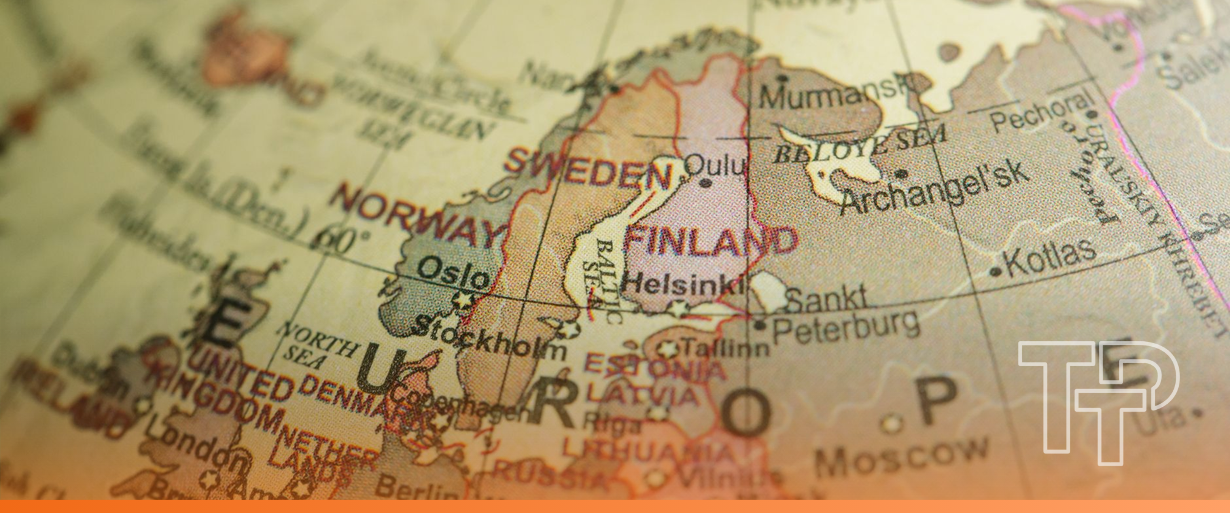

The Nordic countries – Denmark, Sweden, Norway, and Finland – are all deeply dependent on international trade.
Unsurprisingly, given their similar history and geographical traits, they also share a number of other common characteristics. Their economies are all highly export-oriented, perhaps because they all have relatively small domestic markets, which makes internationalisation necessary. They all tend to have a specialisation in technology, energy, maritime solutions, life sciences, and advanced industry. And they all have strong public export credit institutions.
Nordic companies have built global reputations for competing on quality, innovation, and sustainability rather than on price alone. Yet even the strongest products can struggle to secure international contracts if buyers cannot access attractive financing.
Access to export credit, guarantees, and buyer financing, therefore, has become an increasingly important part of the overall export offering.
The Nordics as a global export region
Historically, export finance was mainly used for large projects in shipping, energy, and infrastructure. Today, however, financing solutions are applied much more broadly.
Nordic export credit institutions offer, among other things:
· Guarantees to banks financing foreign buyers
· Direct loans to international customers
· Risk cover against political and commercial events
· Financing for green projects
· Support for small and medium-sized exporters
In many international tenders, financing can be just as decisive as the quality of the product itself. The ability to offer long-term credit is often the difference between winning and losing a contract.
Geopolitics increases the need for public risk capacity
Recent years have shown that global trade flows are no longer driven solely by market-based considerations. War in Europe, tensions between the United States and China, and uncertainty around energy supply and critical raw materials have increased the focus on economic resilience.
Many projects today are carried out under more complex risk conditions than before. Private banks often face limitations on exposure to certain markets or long tenors, creating a need for public risk sharing.
Export credit institutions play an important role here by supplementing the private market and enabling the financing of projects that would otherwise not be realised. This role has been evident during the financial crisis, the COVID-19 pandemic and the most recent geopolitical crises.
Another strong area of growth in global exports is green technology. Wind energy, Power-to-X, energy efficiency, electrification, and sustainable infrastructure require enormous investment, and many of these projects have long payback periods, which increase the need for long-term financing.
Nordic companies are particularly well positioned to benefit from this trend. Denmark has built global leadership in offshore wind, energy efficiency, and other clean technologies, while Norway has become a pioneer in maritime decarbonisation, offshore energy, and low-emission shipping. Sweden and Finland have also developed internationally competitive industries spanning electrification, advanced manufacturing, sustainable mining, and digital technologies. As these sectors increasingly rely on complex, capital-intensive projects, access to long-term export finance has become an important competitive advantage.
In such an environment, however, one cannot consider competitiveness to be determined solely by productivity, technology, or price, as it is increasingly shaped by the ability of governments and financial institutions to mobilise capital, share risk, and support strategic industries.
This creates challenges and opportunities for small, open economies – such as the Nordic countries – in that they must preserve their market-based strengths, while ensuring that their exporters are not disadvantaged in a world where public financial capacity has become a key element of international competition.
From national to European competitiveness
As this global competition intensifies, another important question is how Europe can strengthen its collective competitiveness against larger economic powers such as the United States and China.
Between 2019 and 2023, European export credit institutions provided new commitments worth several hundred billion euros, making clear the scale of public financial support already available to exporters. Yet this capacity remains largely organised through separate national systems, each one of which operates under its own mandate and priorities.
National export credit institutions do have the advantage of proximity. Being located in and focused on a single market means that they are able to truly understand their domestic industries and can tailor support to the needs of individual companies. This is particularly valuable for small and medium-sized enterprises, which may require more guidance on international transactions.
At the same time, there is growing recognition that closer European coordination could deliver additional benefits, particularly as projects become larger and more strategically significant. Greater coordination could allow institutions to share risks, combine financing capacity, and support projects involving suppliers from several European countries.
For the Nordic countries, though, the objective should not be to replace national institutions with a centralised European model. To be effective, they must preserve their close relationships with domestic companies and other localised strengths, while using wider European instruments where greater scale is required. Done effectively, this could give Nordic exporters access to deeper financial capacity and strengthen their ability to compete for major international projects, even against rivals supported by the financial resources of the United States and China.
The future of export finance
In an era marked by geopolitical tensions, the green transition, and tougher international competition, export finance is becoming an increasingly important tool for creating growth and securing market access.
Future solutions will increasingly be characterised by:
· Focus on green and sustainable growth
· Closer interaction between export, development, and investment finance
· Greater digitalisation of processes
· Expanded support for small and medium-sized enterprises
· Increased management of geopolitical risks
· Stronger cooperation between national and European institutions
For the Nordic countries, the path forward needs to be as much guided by the need to support companies’ access to global value chains, new markets, and strategic growth opportunities, as it is by the need to simply finance exports.
Ultimately, the competitiveness of Nordic exporters will increasingly depend not only on the products they develop, but also on the financing ecosystem that enables those products to reach global markets.