


Foreign exchange (FX) risk is a major challenge in international development finance, but not managed effectively. In emerging markets and developing economies (EMDEs), investments are often funded in hard currency (HCY), even though most revenues come in local currency (LCY).
This mismatch puts borrowers at risk of exchange rate fluctuations and affects their ability to sustain debt and keep projects viable, raising the cost of capital. This leads to consequences that can impact development outcomes, especially for vulnerable groups and sectors that depend on local currency revenues.
On the back of this, a dialogue took place at Wilton Park in July 2026 in partnership between the Foreign, Commonwealth & Development Office (FCDO), the Currency Exchange Fund (TCX), and Crown Agents Bank. Following the dialogue, the report titled “Local currency finance: what works, what scales, what’s next?” was released in early September. This report, as discussed in this piece, offers insights on how to effectively expand local currency finance, overcome structural barriers, and align incentives between institutions and markets.
The importance of scaling local currency finance
Many emerging and developing economies (EMDEs) face ongoing foreign exchange (FX) exposure due to a mix of factors. For instance, foreign capital is mostly raised in hard currency. Multilateral development banks (MDBs) and development finance institutions (DFIs) manage this type of capital. However, the market tools needed to handle FX risk, such as hedging markets, are often missing or not well-developed, especially in low-income countries.
The Wilton report says that developing economies are likely to face more than $2 trillion in unhedged foreign exchange risk. Currency fluctuations significantly add to the risks involved in international lending. This risk impacts both government budgets and private investments, influencing how money flows and the conditions for financing.
Borrowers often choose to finance in hard currencies because they seem to have lower initial costs, even though this option carries long-term risks. This behaviour reflects gaps in information and misaligned incentives.
As a result, scaling LCY finance becomes quite important. When effectively implemented, LCY finance enhances debt sustainability, aligns currency risk with revenue, and supports stronger investment decisions.
Focus on developing domestic financial and money markets
Strong domestic financial markets are significant for successful LCY finance. While external capital and hedging tools can mitigate foreign exchange risks, they cannot replace onshore markets for managing local currency finance. Many countries are still struggling with issues such as weak money markets, limited investor engagement, and fragmented financial systems, hindering progress.
The report notes that money markets are the foundation of a healthy LCY finance ecosystem. Without liquid interbank markets, active repo transactions, and reliable short-term benchmarks, it becomes difficult to construct yield curves, extend loan maturities, or develop derivatives markets.
One of the challenges here is the insufficient liquidity circulation between banks, which limits access to and pricing of local currency financing. There is a need to adjust market development strategies. The report emphasises that while expanding sovereign bond markets and increasing long-term lending have been prioritised, the level of focus should be placed on enhancing money markets and reference rates for liquidity management and risk transfer.
The issue is not just creating new financial products but also strengthening the underlying market infrastructure. Domestic liquidity often concentrates in government debt, and regulatory frameworks sometimes unintentionally encourage banks to favour sovereign securities over lending to the private sector. Helping local banks manage their liquidity, collateral, loan duration, and foreign exchange risk can free up more local resources for productive investments. This reduces their dependence on external financing.
Importance of local currency finance for SMEs
The Wilton report also focuses on how LCY finance is crucial for the growth and survival of small and medium-sized enterprises (SMEs).
Most SMEs do not borrow from international institutions or capital markets. They rely on local banks and non-bank financial institutions. These intermediaries already have the systems in place for credit assessment and risk management. By directing institutional capital through wholesale funds to them, loan access can be provided to SMEs while also managing foreign exchange risk internally. This can bridge fragmented demand and connect local and international capital more effectively.
To achieve this, a clear, step-by-step approach is a must. The first step can be to improve liquidity circulation and interbank market operations. The next step is to establish the infrastructure and regulatory frameworks for repo markets and benchmark rates. Finally, the last step includes leveraging this foundation to support derivatives markets, develop the yield curve, and mobilise additional capital. This sequencing should guide program design, ensuring that interventions target the most pressing market weaknesses with the right tools and partnerships.
Building better data and diagnostics to drive local currency finance
Scaling local currency finance depends on access to clear and reliable information. Currently, data on market size, currency risks, and performance is scattered across various institutions. This hinders the ability to identify where assistance is needed, and progress monitoring becomes ineffective.
Creating standardised tools to assess local markets, especially money markets, can be a game changer. These tools could measure liquidity, bank activity, repo markets, benchmark rates, and pricing, providing a consistent way for development banks and partners to coordinate efforts and prioritise countries. The report says that the International Monetary Fund (IMF) could strengthen this work by integrating these diagnostics into its regular economic reviews and technical assistance. This would help countries understand the market conditions needed for safer borrowing in local currency and better management of currency risks. More focus is needed on how currency mix, liquidity, and collateral rules affect risk, ensuring that local currency borrowing truly reduces exposure rather than just shifting it around.
The report states that improving data collection and transparency is crucial. Consistent reporting on local currency loans, risk levels, and outcomes would enable development banks to make better decisions and price risks accurately. The report also says that credit rating agencies should broaden their coverage of local-currency borrowers, particularly small businesses, and create ratings specific to these assets. These steps can help improve investor confidence as well as promote more sustainable LCY finance.
Institutional capacity building and data transparency
Capacity constraints affect not just instruments to manage foreign exchange risks but also institutional capabilities. The report says that it’s essential to strengthen the treasury, risk, and credit functions within MDBs, DFIs, and domestic financial institutions.
Technical assistance should focus on live market functions, including repo markets, collateral usage, benchmark construction, and derivatives activity. Borrowers, including ministries of finance and businesses, need better analytical tools to evaluate currency exposure and financing options clearly. There are institutions such as the TCX Local Currency Academy that offer practical frameworks and technical support for managing foreign exchange risk in low- and middle-income countries.
The Wilton report notes that better data collection and reporting on local currency lending, by currency, tenor, product, and instrument, are required for transparency and informed decision-making. If the diagnostics for local money markets are standardised, it would enhance support targeting and coordination among MDBs, DFIs, and partners.
Priorities for advancing local currency finance
To effectively scale LCY finance and manage foreign exchange risk, the Wilton discussion talked about seven key priorities.
This includes i) raising ambition through shareholder channels ii) making LCY the default financing choice iii) focusing on market functions enabling LCY intermediation iv) expanding and tailoring risk-sharing and hedging solutions v) building a robust LCY data and diagnostics framework vi) strengthening the MDB LCY Policy Forum vii) developing LCY mobilisation pathways for institutional capital.
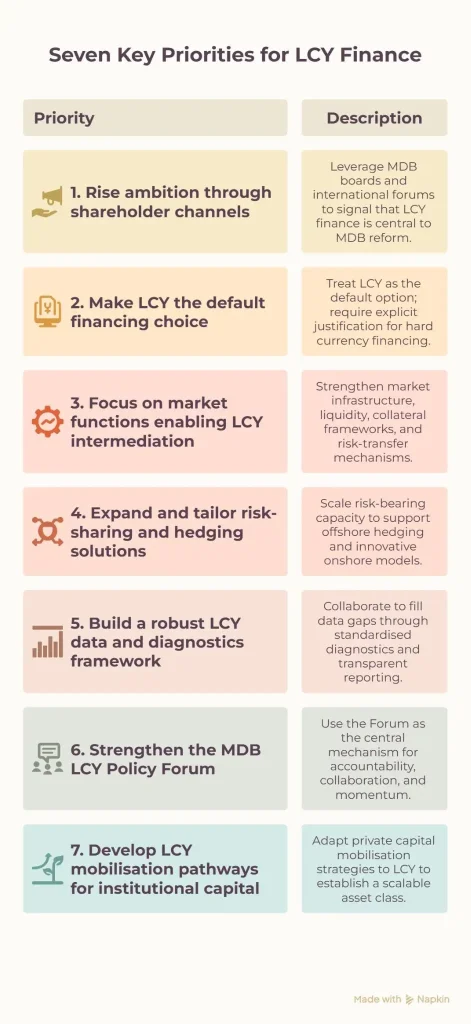
Together, these priorities form a comprehensive roadmap to overcome existing barriers and unlock the full potential of local currency finance in emerging and developing economies.
Local currency finance: From niche to core pillar
Local currency finance is no longer a niche technical concern but a test of the development finance system’s ability to adapt to the realities of the economies it supports. This opportunity is a game changer. It is not just about changing the currency for loans. It is about how risk, resilience, and investment can be shared among international organisations, local markets, and borrowers at the end.
The building blocks for expanding LCY finance are available but fragmented. For the next stage, there is a need for strong political support, institutional leadership, and coordinated action among shareholders, MDBs, DFIs, governments, regulators, and private investors.