The successes of the past have a lasting impact. Sometimes, this impact is obvious, and you can trace a lineage of imitators back to an original who broke the mould. Other times, the influence is more subtle – the nature of a success sends ripples that appear to establish a sort of blueprint and new normal for practices and behaviours, even without conscious imitation.
The study of history can be illuminating in any field; looking backwards can help us forge forward, presenting us the opportunity to dissect how the great successes navigated uncertainty or why the failures were not equipped to do the same.
In short, lessons can be learned.
In the trade world, where digitalisation marks the way forward and billions of dollars are invested in engineering modern rails for centuries-old instruments, we can certainly look to the past for lessons in ingenuity and adaptability.
One, perhaps less expected, place we can look is at the story of American Express.
Before the black card
“Don’t leave home without it” – the tagline of the credit card giant. And it’s a catchy one, at that. It implies trust. Necessity. A cursory look at the history of Amex reveals that this is not hollow advertising, but a perfect crystallisation of the company’s ethos when it comes to the financial services it has provided throughout its storied history. The trust Amex exudes in its marketing is built on action and a carefully curated, sometimes costly, dedication to its customers.
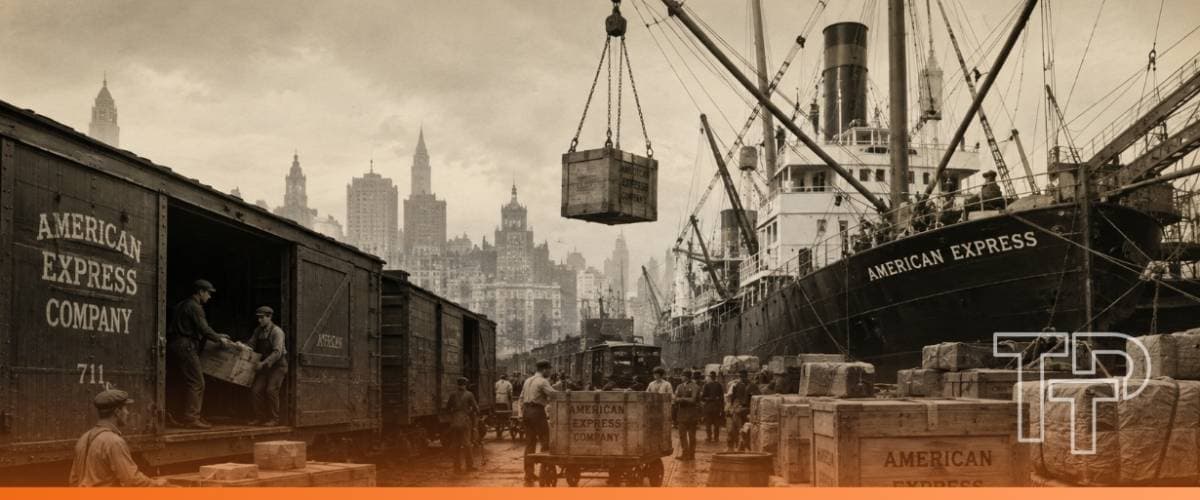
But long before the days of the Black Card, Amex was a freight forwarder. Born in 1850 from a merger between express mail rivals Henry Wells, William G. Fargo, and John Butterfield, the company made its living in its first few decades moving physical goods, currency, and bullion across the fragmented American frontier.
Then, a challenge: shifting federal monopolies and heavy regulation squeezed the profitability out of private freight forwarding. How was the company to respond?
A critical pivot
Rather than set to work thinking how to, say, develop a better stagecoach and fight against the decline in its core business, Amex took this challenge as an opportunity to look beyond logistics.
In the early 1880s, the company had begun to dabble in financial services by successfully launching its own proprietary money orders. These competed directly with the U.S. Post Office’s postal orders and proved that Amex had the capacity to disrupt traditional finance channels and offer new, valuable services to customers. It was the first step towards the company we recognise today.
Commerce, at the time (and much as it still does today), relied heavily on letters of credit. While these historical instruments should not be directly equated with the documentary credits governed today by UCP 600, they fulfilled a broadly similar role in facilitating commerce by providing trusted financial undertakings. Administering them was a large, prestigious, bank-dominated sector.
The rigidities that came with the sector, however, elicited a few frustrations for travelling executives. Indeed, this was the experience of then-president of Amex J.C. Fargo back in the 1880s. He was frustrated by the trouble he encountered trying to obtain cash with traditional LCs when travelling outside of major cities.
Upon returning home, he directed Marcellus Berry, a manager at Amex, to devise a solution to his problem. He wanted a product that would improve upon the deficiencies of the LC he had experienced. And so, Amex’s famed travellers’ cheques were born.
This major new financial service allowed customers to make purchases or exchange the cheques for local currency when abroad, and they became a lifeline for American citizens stranded in Europe in the First World War. American Express honoured not only their own cheques, but cheques from other providers at a time when other financial institutions would not. They were under no obligation to do so, but they did so all the same so they could give American travellers access to money when otherwise they had none.
And so, their reputation and the trust of their customers grew even more. The nationalisation of private shipping companies during the First World War saw Amex finally exit the logistics arena entirely and focus on its now-famous financial services.
Don’t leave home…
Travellers’ cheques solved a real, tangible problem Amex had identified with existing instruments and represented a significant pivot for the company that would define it into the next century.
Although the travellers’ cheques were born of a spirit for proactive problem solving, there were some within the organisation who were reluctant to embrace the same spirit when discussions were had in the late 1940s about introducing a credit card. It seems impossible to believe now with the Amex alive in our modern consciousness, but voices within the company were on record as saying that they, quote: “cannot develop any enthusiasm for credit cards in general”.
Of course, the naysayers did not win out, and Amex did indeed continue its legacy of innovative financial services for its customers by introducing a charge card that would serve as the progenitor of a famed range of cards used by tens of millions of people around the globe today.
The outlier’s advantage
In times gone by, the key to the success of a business was often to conquer its niche. Just consider the likes of Western Union, who dominated telegram communication, or the Pullman Company who devoted its energies to commanding the luxury rail market in the early 1900s. This is why at the turn of the 20th century, the capacity for Amex to pivot and not only operate but excel outside of its freight-forwarding niche arguably made it an outlier. It was also likely the ultimate key to its success.
Eventually, others had to similarly pivot in order to survive. Western Union would begin to abandon communications and focus on its money transfer services, but not until the 1980s. The Pullman Company could not react to changes that impacted its core business and eventually folded. Both have striking parallels to the Amex story and highlight why Amex succeeded so: it was ahead of the curve. Or perhaps, it forged the curve.
Amex’s adaptability fuelled an attitude for innovation. It was perhaps by virtue of the fact that they tackled financial services with an outsider’s view that they were able to innovate so, bringing a fresh, challenging perspective and not being bound by traditional practices.
Amex’s ripples in history?
As we continue through the 21st century, this same capacity and willingness to adapt, operate outside of a niche or silo, and bring new, disruptive ideas to established industries is practically a necessity. We live in a post-silo world; simply think about the logistics companies of today. DHL or Kuehne+Nagel have evolved beyond what would have been identifiable as simple freight forwarding at the time when Messrs Wells, Fargo, and Butterfield formed Amex. To maintain a basic foothold in the market, they must embed other offerings like customs brokerage, predictive supply chain analytics, and integrated access to supply chain finance solutions directly into their service portfolios.
The success of organisations like Amex subtly set the blueprint for what is needed to thrive, even if it didn’t necessarily attract direct imitators. With what was once the exception becoming the norm, we perhaps have more fertile ground for innovation. New challenges seem to be constantly being identified and novel solutions created. We’ve almost gotten used to dynamic innovation as standard.
Even in such an environment, however, the true successes – the history makers – will always be those who can effectively identify the real problems people face and create practical solutions. Those who fall into the trap of innovating for innovation’s sake are often consigned to be footnotes.
So, there are still plenty of watershed products on the horizon; new ‘travellers’ cheques’ to be cashed. In the modern trade finance sphere, what form will the next game-changer take? Will it be some innovation to tackle digitalisation? Data architecture that makes the solution to the challenges of interoperability suddenly seem deceptively simple? Or perhaps it will be the mainstream adoption of blockchain-enabled smart contracts and automated e-Bills of Lading (eBLs) that bridge the gap between document transfer and cash release?
Time will tell, but the pipeline is there. It may have been influenced, at least in part, by American Express.
Editor’s Note: This article was updated after publication to clarify that the historical letters of credit referenced in the late nineteenth century differ from the documentary credits used in modern trade finance under UCP 600.