
In June 2026, the United States dollar (USD) dominated global payments, accounting for approximately 50.10% of total transaction value, says the July 2026 edition of the Global Currency Tracker, published by SWIFT.
The euro (EUR) remains the second most used currency, accounting for 21.88% of the volume.
The British pound (GBP) ranked third with a 6.71% share. The Chinese renminbi (CNY) moved one rank up to fifth position with a 3.10% share, while the Japanese yen (JPY) was fourth with a 3.66% share.
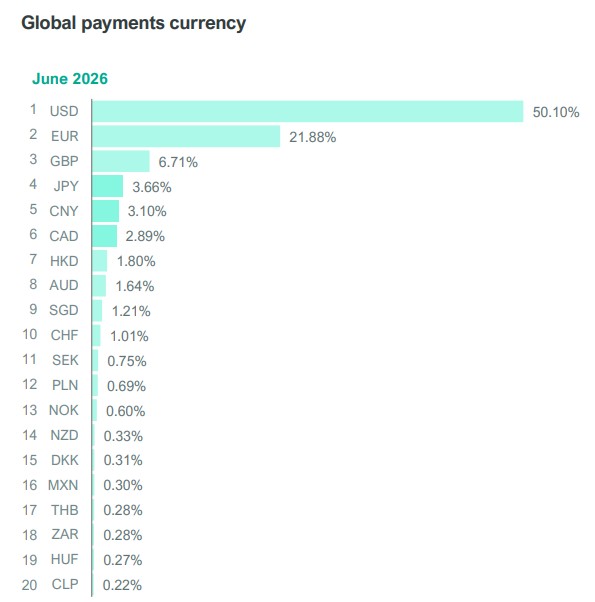
These figures show the USD and EUR as the principal currencies in international trade and finance, together comprising over 70% of global payments by value.
Smaller currencies such as the Australian dollar (AUD), Swiss franc (CHF), Singapore dollar (SGD), and Polish zloty (PLN) each capture between 0.50% and 2.0% of global payments.
Offshore Renminbi payments: Steady growth outside mainland China
The report highlights the continued expansion of offshore RMB payments, excluding mainland China, with Hong Kong leading as the primary clearing centre.
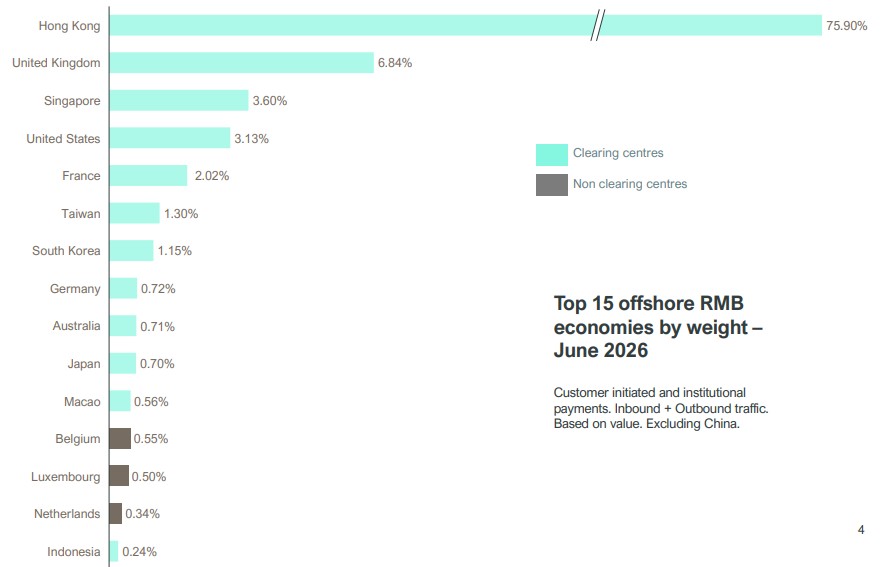
Hong Kong accounts for 75.90% of offshore RMB transaction value, highlighting its role as the dominant offshore RMB hub. The United Kingdom and Singapore follow distantly, with shares of 6.84% and 3.60%, respectively.
This concentration shows the importance of Hong Kong in RMB internationalisation, serving as a critical gateway for RMB liquidity and settlement outside China.
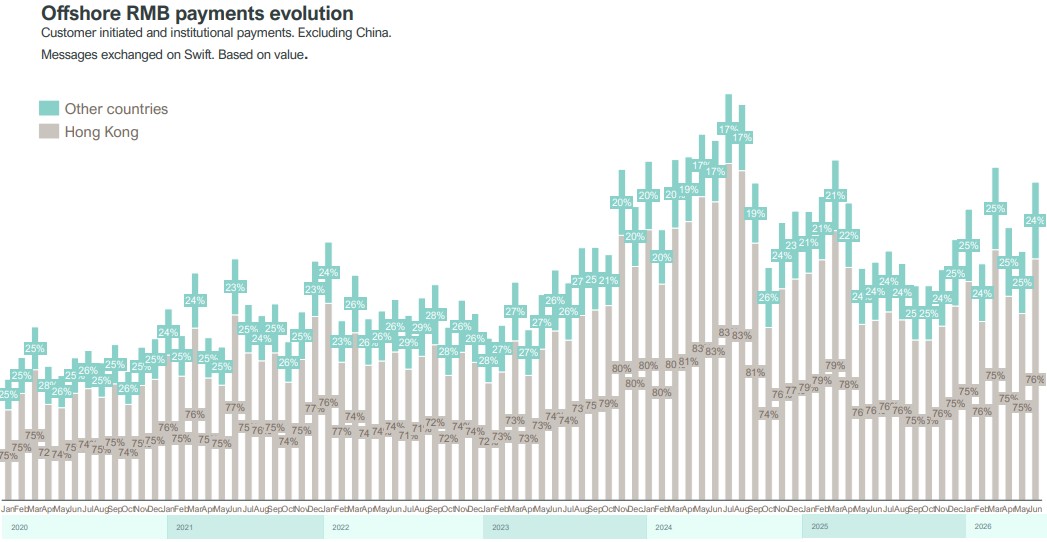
Offshore RMB usage remains stable; Hong Kong consistently holds its share despite global economic uncertainties.
Foreign exchange spot transactions
In June 2026, the UK was the leading economy in the FX spot market with a share of 37.82%, followed by the US at 14.40%.
Hong Kong was in third position with a 10.97% share, and France was fourth with an 8.83% share.
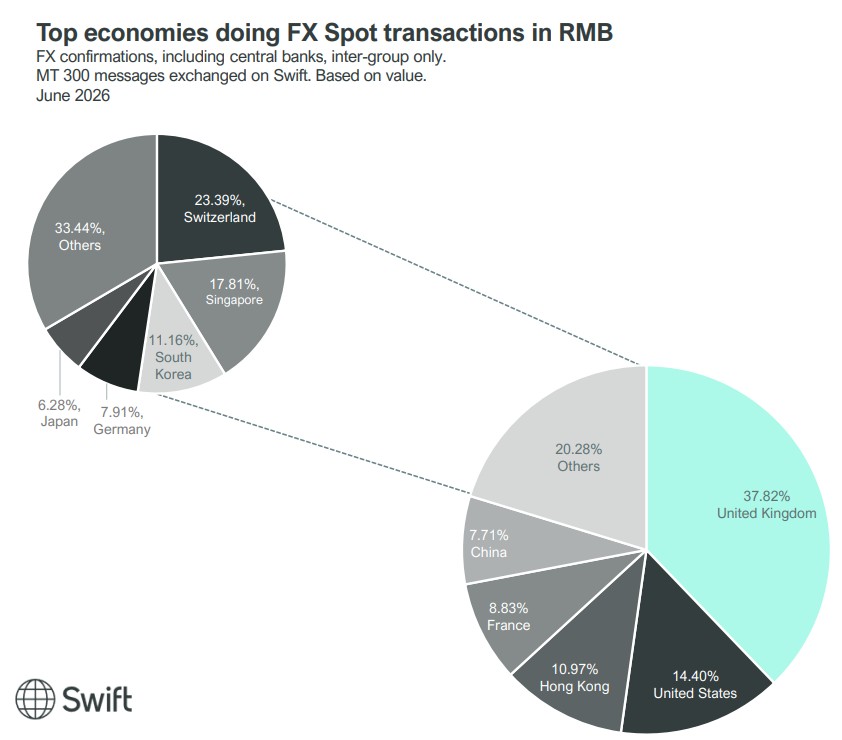
China ranked fifth with a 7.71% share, which is an increase from a 7.50% share in June 2025. However, compared to last month, it is lower by 0.05%.
This is a gradual increase in RMB’s utilisation in FX markets, reflecting China’s efforts to promote its currency as a global trading and reserve currency.
In terms of currencies, USD was the most traded one, followed by EUR, GBP, JPY, and CNY.
USD dominates trade finance transactions
In June, most trade finance transactions used the US dollar, which made up 81.16% of the total value.
The Chinese RMB followed, accounting for 8.00%, while the euro had a smaller share of 5.59%.
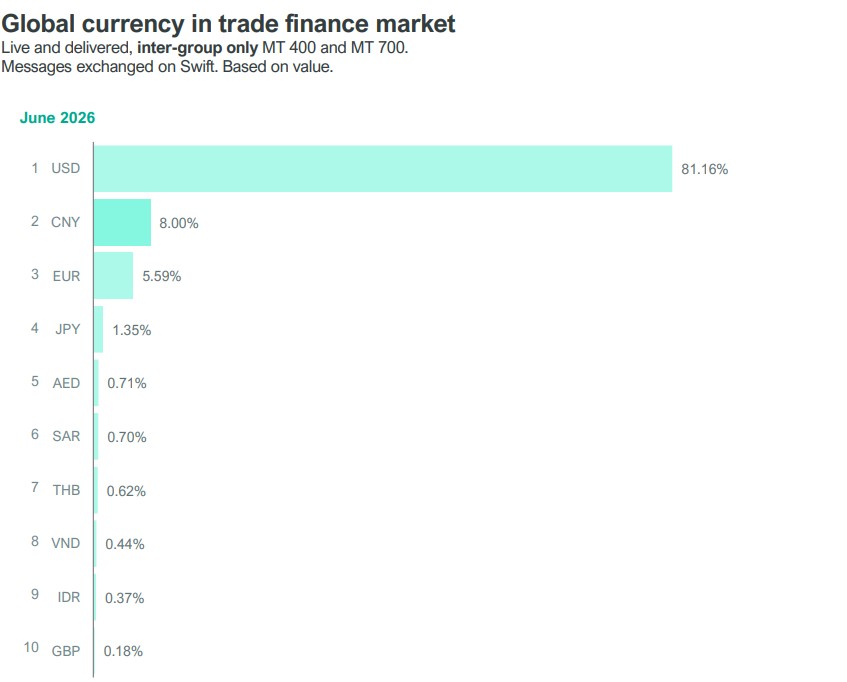
The USD maintains its leading position with a long gap of 70%+ between its counterparts.
The July 2026 data shows the persistence of established currencies like the USD and EUR as the backbone of international payments and FX markets. However, the steady rise of the RMB in offshore payments signals a gradual diversification of global currency usage.
The SWIFT tracker provides insight into the use of various currencies in global payments, trade finance, and foreign exchange markets. Previously referred to as the RMB Tracker until February 2026, the report now focuses on capturing the variety of currencies flowing through the SWIFT network.
Access the tracker here.