
“If one does not know to which port one is sailing, no wind is favourable.”
Seneca
For two decades, I have built and launched trade finance solutions, both internal systems run by multinationals and platforms connecting many parties. More recently, I have helped shape the ISO 20022 trade finance messaging and legal-entity identities those systems run on. That work taught me what separates the digitisation efforts that take off from the ones that fail to scale.
Each past trade digitisation wave stalled on the same three challenges: negotiable title documents, multi-party platform and standards adoption, and untested legal risk. The current wave is different. It is defined by two maturing technologies arriving together: practical AI for processing documents that a company already has and legally recognised interoperable electronic documents. It also arrived at a time when trade is fragmenting into regional blocs, and more corridors face elevated risk of chokepoints.
One view, mainly held by standards bodies and carriers, is to treat electronic documents as the foundation for quality data feeding AI. Another, taken by many technology providers and bank operations teams, is to see electronic documents as a real destination, with AI being a temporary bridge. Both views lead exporters to invest in a solution that does not solve their specific problems. The solution that repays the effort first is not a matter of strategy or preference. It depends on what and where you ship.
Two different tools for two different costs
At the heart of this contention, though, is the assumption that AI and electronic documents are competing versions of the same thing. They are not. They address different costs, and it is important to understand that distinction.
AI reads, structures, and cross-checks the content of documents that already exist, whatever their format, and, in doing so, it removes the cost of document errors and the manual checking they require. That cost includes missing documents, discrepancies between documents, rejected presentations under a letter of credit, customs holds, and rejections caused by compliance and certification errors, slow examination, and inconsistent data across a company’s own filings. AI is available to a single firm and works with the paper or digital documents its counterparties already send, with no one else required to change anything.
The cost of document errors is high and persistent. When the ICC revised its rules into UCP 600, it reported that global surveys found roughly 65 to 80 per cent of presentations were rejected on first presentation. Practitioners say the rate has changed little since. The discrepancy problem cannot be solved by a new regulation. What can reduce it is better checking of the documents before they are presented. Eighty-four per cent of banks now report using AI to prevent fraud and analyse risk. The same capability that catches a mismatch between an invoice and a packing list is one an exporter can apply to its own outbound documents.
Electronic trade documents remove a different cost. A natively electronic record that is legally recognised can move instantly. For a bill of lading, it means instant transfers. Two costs disappear: the letters of indemnity and vessel demurrage that accrue when the original travels slower than the ship, and the release of cargo that a validated copy cannot lawfully effect. This benefit, however, is not unilateral and requires counterparties that issue and accept interoperable electronic records, as well as statute that grants those records document-of-title status.
The distinction is why the first wave of digital trade platforms failed. we.trade, TradeLens, Marco Polo, and Contour all launched in the late 2010s and closed between mid-2022 and the end of 2023. They did not fail because their technology did not work. They failed because each one required carriers, banks, government agencies, and buyers to join the same network before anyone gained value.
That difference, between digitising the handling and digitising the instrument, is the subject of this article. So AI and digital documents are complements that address separate problems. AI is available everywhere today. Electronic documents are available only where the surrounding conditions allow. Those conditions are set by cargo and corridor.
What you ship
Cargo determines which cost dominates because the cost falls in a different place for each cargo type. The exhibit below maps this relationship across six main cargo types: dry bulk, liquid bulk, breakbulk, project cargo, reefer, and dangerous goods.
For cargo with high reliance on a negotiable document of title (principally liquid bulk and dry bulk), the dominant cost is the title-release problem. The cargo is traded multiple times while in transit, and the vessel often arrives before the original document. The carrier will not release cargo against a copy, so the parties issue a letter of indemnity to move it. That cost is high, and no amount of accurate reading removes it. Release depends on surrender of the original, not on the accuracy of its contents. Only electronic documents remove this cost. For these cargoes, the main gain lies in adopting electronic documents.
The market is already moving where the gain is largest. The major miners – BHP, Rio Tinto, Vale, and Anglo American – reached roughly a quarter of electronic bill usage by mid-2024. Some commodity trades now run near 60 per cent, where only about 11 percent of bills were electronic in 2025, because the title-release cost they carry is so high. The exposure behind that cost is real and has been litigated. In one case before China’s Jiangsu High People’s Court, an issuing bank sued a carrier for releasing cargo against a letter of indemnity instead of the original bill. That is the precise situation the letter of indemnity exists to manage, and it shows the title-release cost is not hypothetical. Where a cargo depends on negotiability in this way, the electronic document can remove a liability.
For cargo with low reliance on a negotiable document of title (principally reefer, packaged goods, and anything moving on a sea waybill to a known buyer), the situation reverses. There is no original to surrender, so there is little title cost to remove. The dominant cost is compliance, clearance, and, for perishables, spoilage caused by a delayed or erroneous certificate. All of this is exactly what AI resolves now. For these cargoes, electronic document adoption offers minimal benefit, while AI captures the benefit that matters.
Dangerous goods shipments are the clearest case where the main cost is a misdeclaration or accuracy problem rather than a title. It is estimated to cause close to a quarter of serious containership incidents, with a major fire roughly every sixty days, and carriers now charge $5,000 to $35,000 per container or bill. Cross-checking the hazard data against the rest of the bundle before filing is a control AI applies today, and no electronic bill would add to it.
Exhibit. The paper cost of a shipment, and the technology that removes it, both vary by cargo type.
| Cargo type | Extra documents beyond the core bundle | Dominant paper cost driver | Indicative paper-attributable cost | Negotiable title use | Technology that resolves it |
|---|---|---|---|---|---|
| Dry bulk (coal, ore, grains, oilseeds, raw sugar, feed) | Charter party bill of lading; draft survey and weight certificate; quality and moisture certificate | Vessel demurrage while waiting on documents, plus letters of indemnity for cargo sold in transit before originals arrive | About $10,000 to $100,000+ per voyage. Demurrage of $5,000 to $30,000+ per day, plus a bank guarantee fee of roughly 0.5-2% p.a. on a letter of indemnity issued at up to 200 per cent of cargo value. | High | AI now for compliance and customs clearance; digital records and legal recognition to remove the letter of indemnity |
| Liquid bulk (crude, products, LNG, edible oils, molasses, juice concentrate) | Certificate of quality; certificate of quantity; ullage and temperature report; load and discharge survey | The same mechanics as dry bulk at the largest scale, with near-universal letters of indemnity on very high cargo values | Tens to hundreds of thousands per voyage. VLCC demurrage of $30,000 to $80,000 per day, depending on the market; a delay of a few days reaches $150,000 to $400,000. A near-universal letter of indemnity carries a bank guarantee fee on a face value of up to 200 per cent of the cargo. | High | AI now for compliance and customs clearance; digital records and legal recognition to remove the letter of indemnity |
| Breakbulk (steel, timber, machinery, packaged shelf-stable goods) | Mate’s receipts and tally sheets; mill and inspection certificates; fumigation and phytosanitary certificates | Claused bills and disputed piece count and condition, causing rejection under a letter of credit | About $3,000 to $30,000 per shipment in correction fees, financing costs, and dispute resolution | Moderate | AI now (with digital records for condition evidence) |
| Project cargo (turbines, plant) | Per-crate packing lists; weight and dimension certificates for lift planning; abnormal-load and route permits | Coordination errors across many documents and legs, and milestone payments held up by document presentation | About $20,000 to $100,000+ per delay event in financing and idle specialised transport, cranes, and escorts | Moderate | AI now and digital records |
| Reefer (temperature-controlled pharma, fresh and frozen produce, meat, seafood, dairy) | Phytosanitary, sanitary, veterinary and health certificates; temperature and data-logger records | Spoilage when a delayed bill of lading or health certificate holds temperature-sensitive cargo | Handling in the hundreds per day, plus a spoilage tail from tens of thousands to $500,000+ on total cargo loss | Low | AI now for certificate accuracy; digital records and regulatory acceptance for timely release and border clearance |
| Dangerous goods (chemicals, fuels, batteries, fishmeal, high-proof alcohol, dry ice) | Dangerous goods declaration; safety data sheets; container packing certificate; special permits | Misdeclaration penalties and outright rejection or offload from inconsistent hazard data | $5,000 to $35,000 per container or bill in carrier penalties, plus rehandling, above a high-severity incident tail | Low | AI now |
Technologies: AI now, content read and cross-checked from existing paper or PDF, available to a single firm today; Digital records, natively electronic documents that move at data speed, needing counterparties on interoperable records; Legal recognition, statute of the UNCITRAL MLETR type granting document-of-title status. Negotiable title use is an indicative estimate of how often each cargo relies on a negotiable document of title, not a measured figure; a higher rating means more of the cost sits in the digital and legal layers. Cost ranges are modelled estimates drawn from DCSA, McKinsey, ICC, industry demurrage data, and carrier tariffs,.
And where you ship it
So far we have looked at what is being shipped. Now let’s turn to the second variable, corridor, which matters for two reasons. First, it determines whether electronic documents are even an option, and second, it determines how urgent AI has become.
Electronic document adoption is available only where a corridor has two things. The first is legal recognition, meaning a statute of the kind the UNCITRAL Model Law on Electronic Transferable Records (MLETR) provides. The second is counterparties and customs authorities ready to issue and accept digital records. Adoption of that law remains thin. UNCITRAL lists thirteen jurisdictions. They include Singapore, the United Kingdom, the United Arab Emirates, France as the first European Union member to transpose it, and China for bills of lading. That leaves most trade lanes outside it. For a large share of lanes, the electronic document is therefore not a deferred priority. It is not yet possible at all. In those corridors, AI is not the second-best option. It is the only option the exporter controls.
The corridor also sets the urgency of AI independently of title. In the European Union, the Carbon Border Adjustment Mechanism (CBAM) became a customs control at the start of 2026. Customs now validates an importer’s authorisation before covered goods are released, and in the first week of operation, 10,483 import declarations carrying CBAM goods were validated automatically and in real time. The deforestation regulation (EUDR) brings comparable origin checks into force from the end of 2026. Behind these measures, the customs reform agreed in 2026 will route trade through a single EU customs data hub managed by a new EU Customs Authority. It will also reward a trust-based trader category with lighter checks, in return for real-time access to their systems, phased in from 2028. Authorities are also cross-matching customs declarations against tax and transfer-pricing records, so inconsistencies between departments surface automatically. In these corridors, the demand for clean, structured, consistent data is arriving by mandate, and AI is what produces that data from the paper an exporter still receives. Here, the corridor raises AI’s priority on its own, regardless of whether the cargo depends on a negotiable document of title.
The decision framework
Combine cargo type and corridor digital readiness, and you can decide which tool to prioritise.
| Corridor legally ready (recognition and digital counterparties) | Corridor still paper-bound (no recognition yet) | |
|---|---|---|
| High title dependency (liquid bulk, dry bulk) | Prioritise electronic documents. The letter of indemnity is the highest cost to be removed. Run AI in parallel for compliance and clearance. | Prioritise AI. The title benefit is not yet reachable in law. Use AI to capture the compliance and clearance costs, and to structure data in advance for when the corridor gains recognition. |
| Low title dependency (reefer, packaged, sea-waybill trades) | Prioritise AI. There is little title cost to remove, so the gain lies in the compliance and spoilage-from-error costs. Adopt electronic documents where counterparties already offer them. | Prioritise AI. It is both the only available option and a sufficient one for this cargo. |
The matrix makes it quite clear that whatever the cargo or corridor, AI is the sensible first move for nearly every exporter. It is available in every cargo and every corridor. It is also the layer that makes any later electronic document adoption a conversion rather than a rebuild. AI extracts the content of each paper document and maps it to common data elements. Those elements already carry defined meanings, and this is where the foundation matters. The ICC Digital Standards Initiative (DSI) on Key Trade Data and Documents Elements (KTDDE) provides that foundation. It is a map of meanings rather than a format every issuer must adopt. Because it defines what each data element means rather than how it must be transmitted, it removes the need to commit to any single electronic standard up front. Data mapped to KTDDE can later be expressed in ISO 20022, the WCO Data Model, or any format a corridor is ready to accept. Adopting an electronic document then becomes a matter of routing data that is already structured, not digitising it again from scratch. The electronic standard is then chosen to suit each corridor, rather than the corridor being forced to fit a standard chosen too early.
The network barrier is easing too. The industry completed its first standards-based transfer of an electronic bill between competing platforms in May 2025. By June 2026, five providers had adopted a shared interoperability framework, so an electronic bill can move across a network of platforms rather than only within one. This removes the single-platform constraint that held back the first wave.
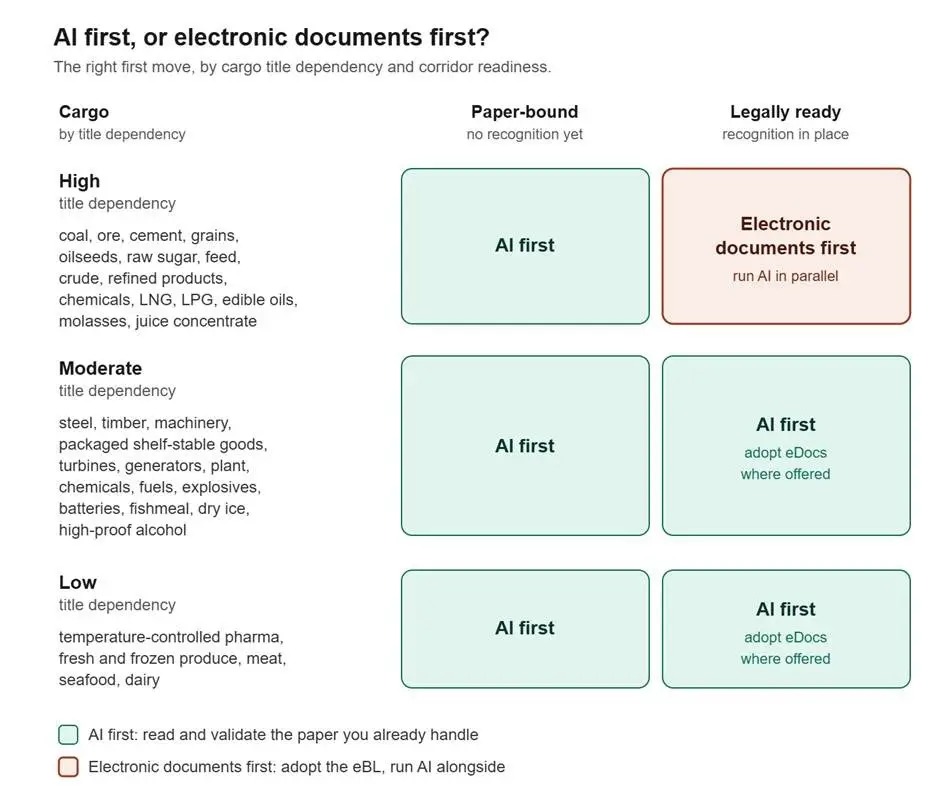
Electronic document adoption is the targeted second step. It is worth prioritising in the one segment where cargo is title-dependent, and the corridor is legally ready.
The difficulty is applying a single answer to every lane. Exporters should not invest effort in digitising documents in corridors that cannot yet recognise them, or for cargo that never needed title. They should also not see digital documents as a precursor to the quality data needed by AI, or treat AI as a temporary measure to be abandoned once electronic documents arrive.
Test it against your own trade lanes
The useful question is not whether to choose AI or electronic documents in the abstract. It is narrower and answerable. For this cargo, in these corridors, which cost can be reduced or eliminated this year? Map your main lanes onto the two variables: title dependency of the cargo and legal readiness of the corridor.
Knowing the port matters only if you can read the wind. For an exporter, the wind is the cargo and the corridor. They decide whether electronic documents are reachable now or still years away. AI is the tool that works in every wind, on the paper you already have, and it readies you for the day the corridor opens.