The year is about to end on a note of aftershocks of geopolitical tensions this year, along with trade tensions and supply chain disruptions. However, the situation seems calmer than earlier, if not completely still. Amidst this, business leaders are regaining confidence compared to six months ago, says the HSBC Global Trade Pulse Survey’s November 2025 edition. The survey is based on responses from 6,750 global business decision-makers.
A gradual return to confidence amid lingering uncertainty
About 67% of respondents have a better understanding of how trade policies impact their operations, showing that businesses are adapting to the “new normal” with greater confidence.
This is especially true for consumer-focused sectors, where 77% of leaders find it easier to understand recent trade policy changes.
“Improving sentiment shows that businesses are responding effectively to ongoing trade shifts and demonstrating strong resilience. Rather than wait for uncertainty to subside, we can see that business leaders are actively deploying a range of strategies as they adapt to this new normal,” said Vivek Ramachandran, Head of Global Trade Solutions, HSBC.
Yet, this confidence is far from unqualified. The global economic and political environment is still volatile, with cost pressures continuing to rise. Over 70% of respondents cite rising costs across raw materials, logistics, and compliance as key challenges.
This extends beyond tariffs, with nearly half of companies facing higher shipping (47%), raw material (44%), and supplier pricing (43%) costs. Larger firms report greater compliance expenses, highlighting widespread financial pressures.
The weight of cost and revenue pressures
Cost inflation is a major issue, with many companies facing higher prices for materials and operating costs.
The report categorises revenue impact expectations into three bands: 21% of businesses anticipate revenue declines exceeding 25%, 45% foresee falls between 5% and 25%, and 34% expect declines up to 5%.
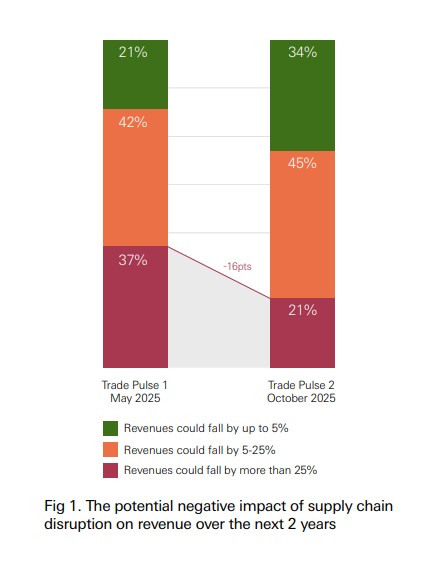
These numbers are better than those reported in the May 2025 Survey, indicating that some firms have successfully mitigated the worst effects.
Rethinking global footprints and corporate responses
In response to these pressures, businesses are actively re-evaluating their strategies. About 76% of them are taking several steps to manage these increased costs. This includes increasing prices, renegotiating contracts with suppliers, and investing in AI and automation to improve efficiency.
Additionally, 84% of companies are already planning to diversify their supplier bases, while 50% are planning to explore new markets.
Companies are increasingly using digital technologies like advanced analytics, blockchain for supply chain transparency, and automation, to enhance agility and reduce costs.
Uneven preparedness across the globe
Preparedness for ongoing and future trade disruptions varies significantly across sectors and company sizes. Larger companies have more robust risk management frameworks and access to advisory services, enabling them to anticipate and respond more effectively.
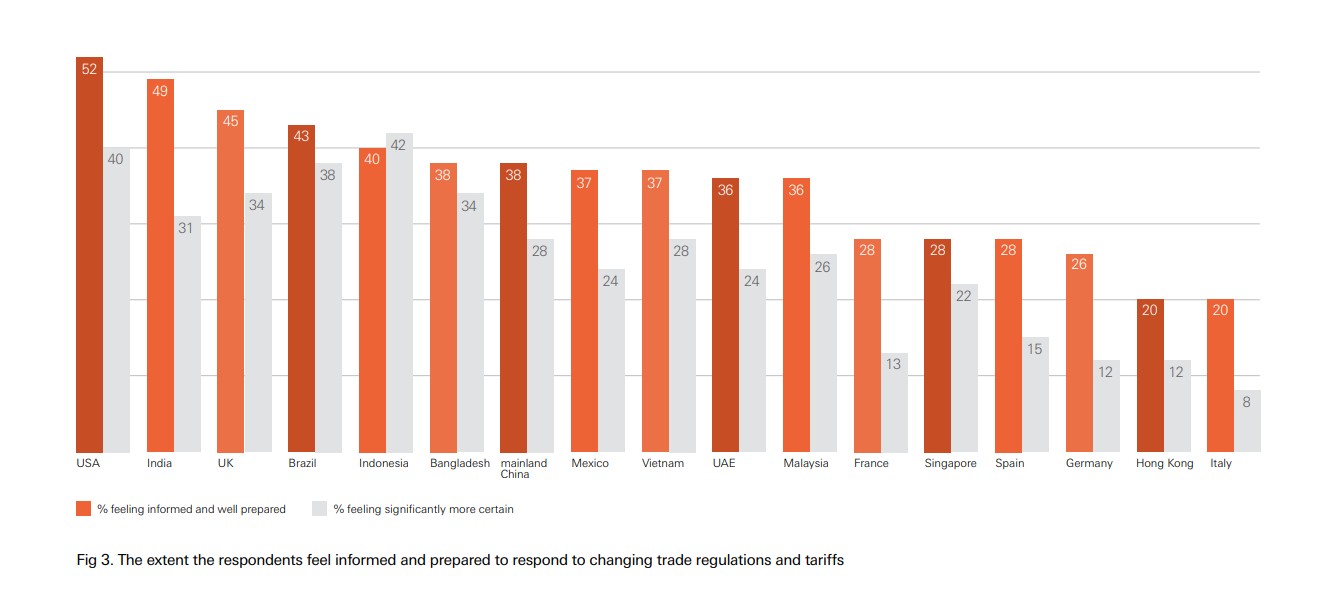
In the US, businesses feel the most prepared for changes in trade regulations, with 52% reporting they are well informed and ready to respond. This contrasts with 35% in Europe and 32% in East and North Asia.
Among surveyed markets, Hong Kong and Italy rank lowest, with only 20% of businesses feeling well prepared. Additionally, B2B companies express less certainty about trade policy impacts (56%) compared to consumer-facing businesses (72%).
Tariffs remain the leading factor affecting revenues, with 48% of global businesses reporting an impact in the past six months, closely followed by pricing changes at 47%.
Companies focused solely on goods are more vulnerable to revenue shocks, with 42% experiencing negative impacts compared to six months ago, versus 33% of services-only businesses.
Looking ahead, 55% of goods-reliant firms expect further negative effects in the next six months, compared to 44% of service providers. This divergence aligns with global trade trends: in 2024, services trade grew 9% to US$8.7 trillion, outpacing goods trade, which increased by only 2%.
Working capital takes centre stage
One of the most striking findings of the report is the heightened focus on working capital management. As cost pressures intensify and revenue streams become less predictable, maintaining liquidity has become paramount. Increased working capital requirements are most pronounced in India (77%) and the US (73%), affecting all sectors with some variation.
The TMT sector sees the highest impact (69%), while healthcare experiences the least (56%). 67% of B2C businesses report higher working capital needs, compared to 52% in B2B.
Companies selling both goods and services face greater pressure (63%) than those focused solely on services (49%).
Business size offers limited protection: 20% of the largest firms experience serious liquidity issues, compared with 15% of smaller companies with revenues below USD 500 million.
The ability to optimise cash flow and secure flexible financing arrangements is now a critical determinant of business continuity and growth potential.
The way forward for trade ambitions
Despite challenges, companies remain ambitious about global expansion. Emerging trade corridors in Asia-Pacific, Africa, and Latin America are gaining attention due to rising consumer demand, infrastructure investments, and new trade agreements. At present, 34% of businesses have expanded into less-affected regions, and 50% plan to do so in the future.
The path forward is contingent on multiple factors, including the resolution of ongoing trade negotiations, technological advancements, and geopolitical developments.
Download the report here.