About This Video
Video not playing? Watch via Youtube.
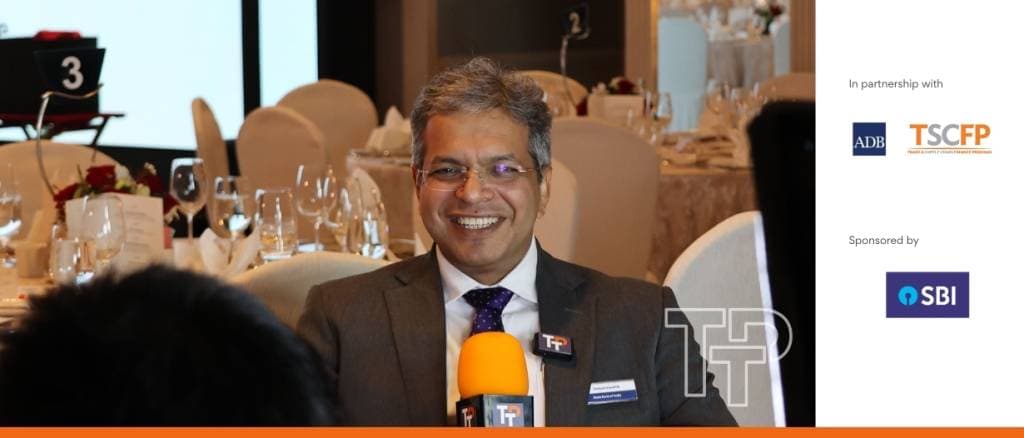
At the Asian Development Bank’s Trade & Supply Chain Finance Program (TSCFP) Awards in Singapore, Trade Treasury Payments spoke with Deepak Kaushik, Regional Head – East Asia at State Bank of India (SBI), on India’s role in mobilising trade finance across developing markets.
Kaushik highlighted India’s growing weight in the global economy, with trade flows now approaching USD 2 trillion annually. “In India we talk about Vasudhaiva Kutumbakam, the world is one family,” he said. “For us, it is not just developed economies we work with, it is across the globe. South–South trade is an important part of that story.”
With a market share of around 22%, SBI’s scale gives it a unique responsibility in supporting corporates at home and abroad. Kaushik noted that volatility and shifting trade patterns are, in some respects, creating new opportunities: “The bit of chaos you have seen of late is actually helping our cause… we are not only growing in India, but also becoming a global bank, collaborating across geographies.”
ADB has been a longstanding partner to India. In 2024 alone, ADB committed USD 167 million through its Trade & Supply Chain Finance and Microfinance Programs to support Indian banks and businesses. Cumulatively, ADB’s trade and supply chain commitments to India now total more than USD 1.25 billion, underpinning resilience for exporters and SMEs .
Kaushik emphasised how that support translates into market access: “The trade cover we get from ADB gives us real comfort and has helped us take exposure to new countries. Whether it is Southeast Asia or Central Asia, working with ADB has really helped.” He added that the collaboration has delivered “excellent results” and expressed commitment to strengthening the relationship further.
For SBI, mobilising trade finance is not only about business growth, but also about contributing to global resilience and helping economies move to the next level.
Key Topics
- India’s economic rise
- A global outlook shaped by shared values
- A broad and balanced trade network
- The role of State Bank of India
- Partnership with Asian Development Bank
Key Insights
Expert Analysis
India’s approach to trade reflects a careful balance between ambition and inclusivity. The country is not simply expanding its economic footprint; it is doing so in a way that emphasises collaboration across regions. The philosophy of Vasudev Kutumbakam underpins this approach, encouraging engagement with a wide range of economies. This has helped India avoid overdependence on any single market while strengthening its global relationships. State Bank of India plays a vital role in this process. With a significant share of the domestic market, it supports large Indian corporates as they grow beyond national borders. Its ongoing work with Asian Development Bank is particularly important, as ADB’s trade support provides reassurance when entering newer or more complex markets. Rather than holding back during uncertain times, India and its institutions are using these moments to extend their reach and build stronger international partnerships.— Deepak Kaushik
Key Findings
- India’s annual trade is close to two trillion dollars.
- SBI accounts for roughly 22 per cent of the banking market in India.
- The bank is steadily increasing its international presence.
- ADB support helps build confidence when entering newer markets.
- Strong engagement is already in place across Southeast Asia and Central Asia, with scope for further growth.
Implications
- India is likely to strengthen its position as a major global economic player.
- There will be continued expansion into emerging markets, particularly across Asia.
- Risk in new markets can be better managed through institutional partnerships.
- Trade between developing economies is expected to grow further.
- SBI’s evolution into a more globally active bank will continue.
Key Takeaways
- India’s growth is closely linked to global collaboration.
- SBI plays a central role in supporting international trade.
- Diversifying trade relationships remains a clear priority.
- Partnerships with organisations such as ADB are essential to progress.
- Challenging global conditions can create new opportunities.