
How CBI is transforming European payments
As the industry chases the promise of instantaneous transactions, the plumbing of European digital payments – spanning open banking, API-based infrastructure, and fraud prevention – is quietly evolving. At the heart of its evolution is a fundamental re-engineering of how money moves, how bills are presented, and how trust is anchored in a digital-first economy.
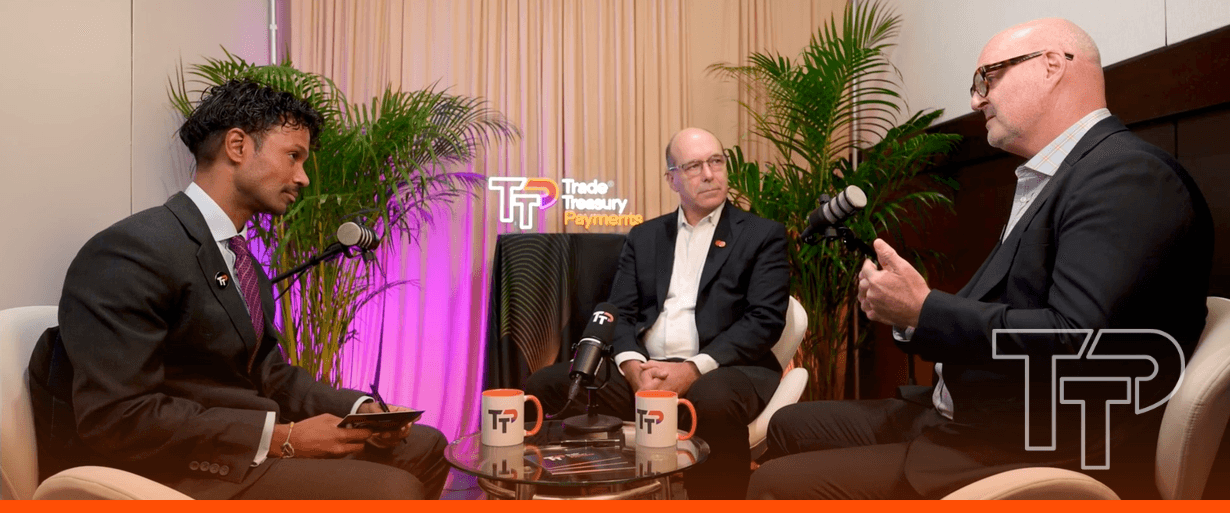
At Sibos in Miami, Carter Hoffman, Deputy Editor at Trade Treasury Payments, had the opportunity to sit down with Ms. Lucrezia Lancia, Head of the Sales Office at CBI, to discuss this revolution of digital services in the payment sector and explore how the Italian consortium is shaping the future of digital payments, open banking, and secure transaction workflows across Europe.
Collaborative banking infrastructure
CBI, owned by over 400 banks and payment service providers in Italy, is a paytech and benefit corporation that operates on a distinct business-to-business-to-consumer (B2B2C) model. Rather than facing the retail or corporate customer directly, CBI instead builds centralised infrastructure and shared services that individual financial institutions can leverage to craft competitive offerings for their clients. CBI’s services and infrastructure are built around three core principles, as Ms. Lancia explains: interoperability, centralisation, and collaboration. Interoperability ensures services function seamlessly at a European level, supported by CBI’s active participation in standardisation bodies, such as ISO and Berlin Group working groups. Centralisation sees operations such as monitoring, reporting, and assurance handled collectively, freeing banks to focus entirely on delivering value to end users. Finally, collaborative product design and CBI’s commitment to listening “to the needs of banks” ensure that new solutions are shaped through ongoing dialogue with participating banks, creating a service tailored to those needs. This infrastructure-led, collaborative philosophy has underpinned long-standing staples of Italian commerce, including corporate cash management systems spanning over three decades, alongside the CBILL digital payment network that allows citizens to view and settle utility and public administration bills effortlessly. More recently, this framework has scaled to encompass modern open finance mandates, such as CBI Globe. This PSD2-compliant platform currently serves roughly 300 banks and captures 80% of the Italian banking market, according to Ms. Lancia.The shift to Request to Pay
Historically, as Ms. Lancia details, payment flows “were usually reactive” – consumers or corporate buyers would initiate transactions manually after receiving static invoices. Request to Pay (RTP), she believes, will fundamentally change this paradigm. By shifting from push-based invoicing to a structured, message-driven request delivered directly into the secure home banking channel, RTP brings a new layer of control and visibility and offers “comprehensive advantages for corporates, banks, and also final customers”. For corporate users, this innovation directly targets perennial issues like payment reconciliation and overdue cash flows, ensuring every step of the transaction is traceable and improving efficiency of cash flow management. On the consumer side, CBI’s framework offers a familiar, secure environment that will boost user engagement. These benefits are not merely theoretical. Having first conceived of this approach almost 20 years ago in 2008, CBI officially rolled out its RTP service in February of this year, debuting with a high-impact Business-to-Government (B2G) use case. Across Italy’s diverse regional landscape, public administrations are now using the API-based infrastructure to transmit fines and municipal bills straight into citizen home banking applications. This completely digitises the billing lifecycle, phasing out paper-based processes and embedding multi-factor authentication into every approval.Mitigating fraud in the era of instant payments
Faster transactions are not without their own inherent issues, however. As transaction speeds accelerate, so security vulnerabilities scale alongside them. Ms. Lancia highlights a sobering industry reality: “the fraud on instant payments are three times higher than [fraud on] the traditional ones, so there really is an issue to solve”. To tackle this issue, verification mechanisms have become as vital as emerging fast settlement rails. CBI has positioned itself at the forefront of this defence with tools like its Name Check service, a real-time verification mechanism designed to check account holder names against IBAN data across European banks in compliance with emerging supplementary regulations. Advanced centralised algorithms allow the tool to intercept discrepancies before funds move, drastically cutting down authorised push payment fraud. Complementing this is CBI’s Check IBAN service. Active since 2020 and heavily utilised by the Italian public administration during pandemic-era cashback initiatives, it now reaches over 90% of the Italian banking market. It operates via real-time API orchestration, prompting destination banks to instantly verify whether a specific IBAN corresponds correctly to a given tax or fiscal code, returning one of two simple responses: verified or unverified.Building a unified future
As the discussion came to a close, Ms. Lancia remarked that it was encouraging to see collaboration frequently being discussed as an important factor in the payments sector throughout Sibos. Indeed, if she has one key message to offer to stakeholders it is that “collaboration…is the key to unlock new opportunities and new business ideas”. Achieving a frictionless, cross-border payment ecosystem will certainly require more than top-down regulation – it demands synchronised execution across the entire market chain. Ms. Lancia points to three main actors in particular who must align. First, banks must continue to invest in secure environments and frictionless user experiences to drive widespread adoption of advanced protocols like Name Check. Then, there are the gateways and infrastructure providers like CBI who she describes as “the enabler of scale”. They must act as operational glue, enforcing harmonisation, technical standardisation, and seamless API orchestration. Finally, merchants – as the final adoption catalysts – play a key role in the industry, embedding innovative touchpoints like Request to Pay directly into commercial checkouts to move features from optional add-ons to daily habits. The future of payments will be defined, in Ms. Lancia’s view, not by one single actor, but by “the work of all the players inside the chain”. As the industry looks ahead to transformative concepts like the Digital Euro and broader cross-border frameworks, the value of Ms. Lancia’s pragmatic core message is clear. Regulatory directives can establish the framework, but true market innovation will ultimately depend on deep, cross-industry collaboration. Actors and authorities must work together to help create a “standardised and harmonised environment”. Prefer to listen? The full conversation is also available as a podcast below.Key Topics
- CBI, the Italian banking consortium, builds shared, centralised infrastructure that member banks use to deliver their own services to clients.
- Request to Pay replaces static, push-based invoicing with structured, message-driven payment requests delivered into secure home banking channels.
- Fraud on instant payments is significantly higher than on traditional payments, making real-time verification tools essential.
- Collaboration among banks, infrastructure providers and merchants is needed to build a harmonised, cross-border European payments ecosystem.
Expert Analysis
Lucrezia Lancia, Head of the Sales Office at CBI, argues that Request to Pay will fundamentally change payment flows that were historically reactive, offering comprehensive advantages for corporates, banks and final customers. She also stresses that the fraud rate on instant payments is three times higher than on traditional payments, so verification mechanisms must keep pace with fast settlement rails. Her central message is that collaboration is the key to unlocking new opportunities, with the future of payments shaped by the work of all players in the chain.
Key Findings
- CBI's Request to Pay service launched in February, debuting with a business-to-government use case for fines and municipal bills in Italy.
- According to Ms Lancia, fraud on instant payments is three times higher than fraud on traditional payments.
- CBI Globe serves roughly 300 banks and captures 80% of the Italian banking market.
- The Check IBAN service, active since 2020, reaches over 90% of the Italian banking market.
Implications
- Request to Pay can give corporates greater traceability and efficiency in reconciliation and overdue cash flows.
- Verification tools such as Name Check are needed to counter authorised push payment fraud as transaction speeds increase.
- Banks, infrastructure providers and merchants must align to achieve a frictionless, cross-border payments ecosystem.
- Regulatory directives set the framework, but lasting market innovation depends on deep, cross-industry collaboration.