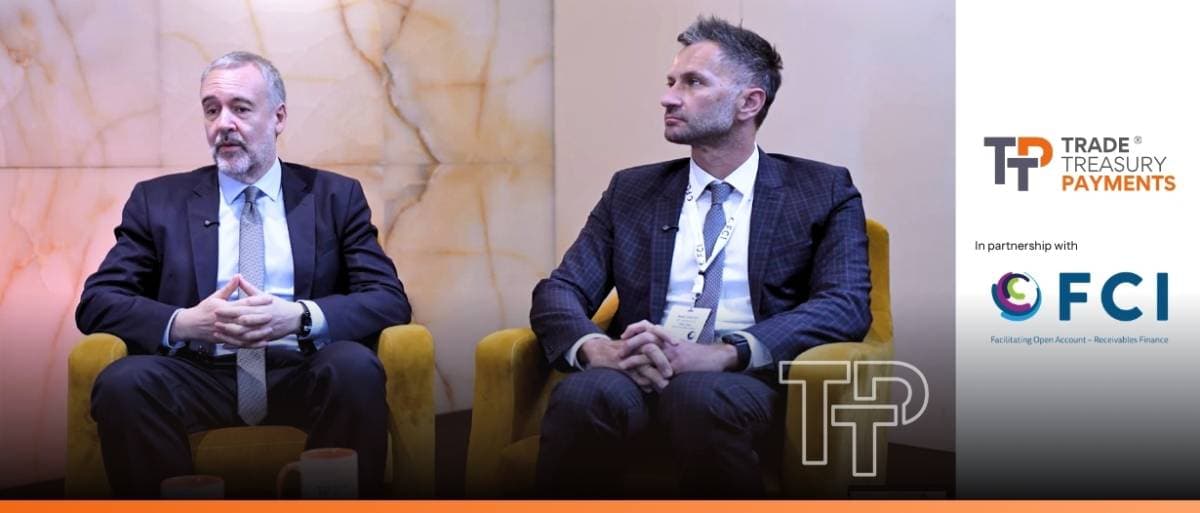
Digital trade for growth in the Middle Corridor: foundations, finance, and adoption
By: Carter Hoffman, Trade Treasury Payments
At a recent “Digital Trade for Regional Growth: Foundations, Finance & Adoption”, held in Tbilisi, Georgia, Trade Treasury Payments (TTP) spoke with five experts from across government, banking, international development, and legal reform about the future of digital trade and the growing strategic importance of the Middle Corridor.The conference was co‑organised by EBRD, ADB, ICC Digital Standards Initiative, Bank of Georgia, and ICC Georgia, that brought together around 170 participants from the banking sector, private sector, logistics, and public institutions.
As conflict and geopolitical strife are forcing a rerouting of trade flows between Asia and Europe, Georgia and the wider Caucasus region are increasingly being considered as the next key bridge between the two markets.
Alkis Vryenios Drakinos, Director and Regional Head of the Caucasus at the European Bank for Reconstruction and Development (EBRD), said, “For the simple fact that it is in the middle between Central Asia and Europe, [the Caucasus] has significant geographic and geopolitical value in the middle corridor.”
It is widely agreed that extracting that value will require a degree of physical infrastructure investment along what many in the region hope will become a bustling trade route.
However, there are also a number of other, less visible foundations – things like legal reform, digitalisation, and access to finance – that those along the corridor will also need to invest in for the corridor to reach its potential.
Tianmi Stilphen, Lead for Regulatory Affairs and Legal Reform at the ICC Digital Standards Initiative, explained that global trade still remains heavily dependent on paper documentation despite years of discussion around digitalisation. “Even if every single step of the way has been digital, that trade deal itself is still anchored in paper,” she said.
That dependence on physical documents creates countless inefficiencies across global trade, including trade moving along the Middle Corridor. “That creates a structural bottleneck,” Stilphen said, “slowing down transactions, increasing costs, and also restricting access to finance.”
Part of the solution lies in legal reform. Earlier this year, Georgia adopted a new factoring law designed to strengthen the receivables finance market and improve access to working capital for SMEs. Irakli Gabriadze, Deputy CEO of Enterprise Georgia, said, “We passed the law in April this year, 2026, and we are expecting this law to fundamentally reshape the accounts receivable market.”
One of the core objectives of the reform, according to Gabriadze, is to address power imbalances between large buyers and smaller suppliers, particularly where SMEs have historically struggled to assign receivables to financing providers. “By creating the platform,” he said, “we are hoping that it will be easier [for SMEs] to access the factoring services and just satisfy their demand for working capital through the factoring transactions.”
The reform is also expected to support long-term market growth. Gabriadze said the platform could eventually host transactions equivalent to between 3% and 5% of Georgia’s GDP over the next decade.
But legal reform is only one of the inconspicuous challenges for the market. Pikria Kekelia, Head of Trade and Structured Finance Department at Bank of Georgia, said, “The main challenge is the awareness of the product on the market, and factoring is less understood than traditional lending products.” The new factoring law, Kekelia hopes, will prove to be a significant milestone that provides clearer legal recognition for receivables finance as a standalone financial instrument.
Banks in the region are also increasingly exploring how technology and artificial intelligence can improve trade finance operations internally. “The problem, Kekelia said, “was that our experts spent their time on manual, repetitive tasks, and we wanted to protect their time and let them concentrate on decisions that truly matter.”
Both businesses and economies are also tending to regard this digital transformation in terms of the potential competitive advantage that it can provide. Fady Asly, Chairman of ICC Georgia, said, “In a world that is moving so fast, you cannot be the last one to change.” There are many advantages that having digital trade processes will bring, particularly around speed and accessibility. “Usually it takes 15 days to one month to receive your documents,” Asly said. “With the digitalisation, it takes hours or a day or two.”
It is little surprise then that digital trade is increasingly becoming tied to a number of other factors that will collectively contribute to the rise of the Middle Corridor, including competitiveness, SME access to finance, and the ability of countries to integrate more effectively into global commerce.
Key Topics
- Legal reform to reshape the accounts receivable market
- SME access to factoring and market awareness challenges
- Digitalisation of trade and the shift away from paper
- AI adoption to reduce manual work and improve efficiency
- The Caucasus middle corridor as a strategic trade route
Key Insights
Expert Analysis
Georgia’s reform agenda demonstrates how legal clarity, digital infrastructure and AI adoption can collectively modernise a receivables market. The country is tackling structural barriers head on, from SME financing constraints to paper based trade processes. The strategic positioning of the Caucasus amplifies the impact of these reforms, strengthening its role as a regional trade corridor. As one speaker put it, “in a world that is moving so fast, you cannot be the last one to change.” Georgia’s approach reflects a proactive shift towards a more open, efficient and digitally enabled trade ecosystem.
Key Findings
- The 2026 factoring law is expected “to fundamentally reshape the accounts receivable market.”
- The law addresses power imbalances where “big retailers have been restricting SMEs to assign their accounts receivable.”
- A dedicated factoring law provides “much needed legal clarity and recognition of factoring as a stand alone financial instrument.”
- Digitalisation dramatically reduces processing times, making trade documents accessible to banks and authorities simultaneously.
- The new factoring platform is expected to host “about ten billion transactions” over ten years, equal to three to five percent of GDP.
Implications
- Fairer access to finance for SMEs as legal barriers to assigning receivables are removed.
- Greater competitiveness for Georgian businesses through faster, digital trade processes.
- Improved investor confidence as the business climate becomes more transparent and rules based.
- Enhanced regional connectivity with the middle corridor offering a viable alternative to geopolitically challenged routes.
- Operational efficiency gains as AI reduces manual workloads and accelerates decision making.
Key Takeaways
- Legal reform is the foundation for a modern receivables finance market.
- SME education is essential to unlock factoring adoption.
- Digitalisation removes long standing bottlenecks in trade processing.
- AI enhances efficiency while keeping human oversight central.
- The middle corridor strengthens regional trade resilience and connectivity.