
Private credit, partnerships, and technology: unlocking liquidity in trade finance
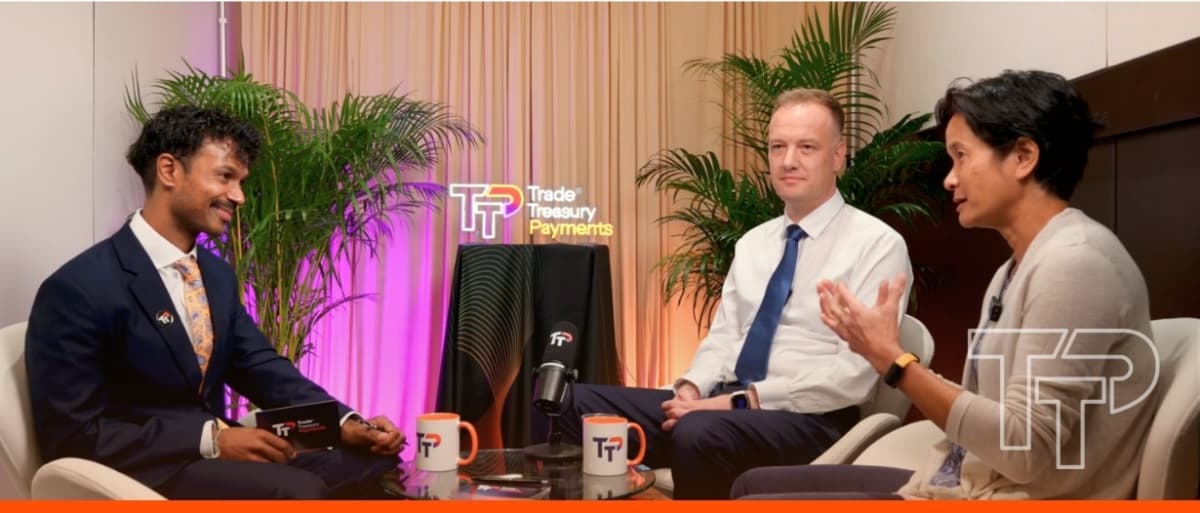
At the LiquidX Rooftop Event in New York City, Trade Treasury Payments (TTP) spoke with industry leaders from banks, fintechs, and service providers to explore how technology, partnerships, and new sources of liquidity are reshaping trade finance.
For LiquidX, which has spent the past decade at the intersection of financial technology and trade, the conversations showed a shift in global finance, where digital infrastructure and alternative capital are converging to meet the funding needs of businesses large and small.
Dominic Capolongo, Chief Revenue Officer at LiquidX, said about the event held in New York City, “It’s an opportunity for folks from around the industry to gather, spend some relaxing time, and talk about where the market is going… One of the things we’re hearing a lot about is distribution. New markets have opened up, the entrance of private credit lenders and the opportunities they present for the market also obviously increase competition because of it.”
Capolongo described private credit as one of the most significant forces now influencing trade and working capital finance. He said, “We think private credit is going to be a game-changer in the industry. It’s going to open up new sources of liquidity, new opportunities for folks that hitherto have been unable to access the trade finance space.”
Partnerships and ecosystems
That view was echoed across the rooftop. For Paul Simpson, Vice Chairman at Broadridge Financial Solutions, which has been both an investor and partner in LiquidX for several years, partnerships between established financial institutions and technology platforms are driving a new model of ecosystem-based delivery.
Simpson said, “If you take asset managers or areas where operations and service are needed, LiquidX provides the workflow and the technology, and Broadridge can step in and help on that. As we start looking at larger financial institutions, there may be opportunities to provide staff augmentation to a workflow or technology that Broadridge is going to provide on behalf of LiquidX.”
This combination of workflow innovation and institutional is a sign of how trade finance ecosystem is changing alongside industry digitalisation efforts. Gone are the days of siloed providers, especially for banks, where collaboration with fintechs is now considered a foundation aspect of existing in the market.
Marco Fracchia, Managing Director for Trade and Supply Chain Finance at Intesa Sanpaolo, an Italian-headquartered bank, explains how partnerships are redefining supply chain finance delivery.
“There’s a unique opportunity that comes at the convergence of the collaboration between banks and fintechs and supply chain finance platforms,” Fracchia said. “Banks obviously bring their corporate relationships, balance sheet, and funding capabilities, while the fintechs can really deliver on providing digital solutions – both the digitisation of assets, as well as onboarding and execution – the backbone to supplier finance programmes.”
The digitalisation of these programmes is also helping banks by extending their access to new regions and suppliers.
“Emerging markets are more and more suppliers of manufactured goods, higher value-added goods,” Fracchia said. “For any bank that values sustainability and inclusion and helping their clients find working capital solutions and diversify their supply chain, I think that’s key, directly chipping away a little bit at that trade finance gap.”
Using technology to promote equality
From the bank side, technology is helping level the playing field between global giants and regional players. Cory Speece, Managing Director for Supply Chain Finance and Global Trade at Huntington National Bank, said that the integration of platforms like LiquidX has transformed what mid-sized institutions can achieve.
“When you consider the types of programmes that regional banks of our size and smaller had been working on before the advent and infusion of technology like LiquidX’s, we were relegated to really small programmes with one seller, maybe one account debtor, a handful of invoices,” Speece said. “What LiquidX’s technology has allowed us to do is grow in an economy of scale that’s a magnitude of X.”
He explained this with an example: “One of our smallest programmes is by far our highest-volume programme. The client’s first upload was over 100,000 invoices. That would have taken us weeks to consolidate and prepare to offer. With LiquidX technology, the client was able to log in, upload their invoices, digitise, and submit them for offer. That was sent to us within 20 or 30 seconds.”
For Speece, scalability isn’t just about competitiveness as much as it is about speed. “When you think about economies of scale, it puts us on par with pretty much every lead arranging bank or money-centre bank that has built their own technology,” he said. “It puts us on a level playing field and gives us an opportunity to really run with the bigger banks while still offering the relationship-driven, white-glove service that smaller regional banks are known for.”
Data, efficiency, and insight
Technology’s role in trade finance is also transforming how institutions handle data. Jordane Rollin, Managing Director and Head of Trade Finance and Working Capital, GTB Products at TD Securities, a Canadian-headquartered bank, noted that automation and data extraction are making reconciliation and process management far more efficient.
“In supply chain finance and receivables, this is more about reconciliation,” Rollin said. “Historically, banks and corporates were looking at ways to get more efficient in reconciling POs and invoices and making sure that data matched when they received various payments. That’s really where you now have applications happening around how you match that data together, how you extract data, so that you can be more efficient in your processes, both for banks and also for corporates.”
He added that the value technology brings goes well beyond efficiency improvements within the backend of the bank.
“The client benefits are first about turnaround time, and then efficiency as well,” he said. “You’re finding a way where you can gain on turnaround time without having to change too many of your processes. Whereas before you would have to think about how to remove the paper from the equation, now, if you have a technology that allows you to extract data from paper and then run the checks directly, you don’t need to change as many of your processes. That’s what’s helping both banks and corporates. It’s more about how you can then extract information from the data you’ve processed and get a better overview of the processes themselves.”
Looking ahead
As the evening wound down over the New York skyline, it became easy to see that trade finance is changing as a result of the many collaborations taking place across the industry.
From private credit to data analytics, partnerships are blurring the traditional boundaries between banks, fintechs, and investors. Together, they are building a more connected, inclusive, and technology-driven market. Perhaps even one that can finally start to close the trade finance gap.
Watch on YouTube here.
Key Topics
- Trade finance digitalisation
- Private credit liquidity
- Bank fintech partnerships
- Supply chain finance platforms
- Data driven workflows
- Ecosystem collaboration
Expert Analysis
Industry participants emphasise that technology alone is not the transformation, but rather the enabler of new liquidity sources, delivery models, and institutional collaboration. Perspectives from LiquidX, Broadridge Financial Solutions, Intesa Sanpaolo, Huntington National Bank, and TD Securities collectively frame digital trade finance as an ecosystem challenge where liquidity, data, and execution must evolve in parallel to close structural funding gaps.— Dominic Capolongo
Key Findings
- The LiquidX Rooftop Event brought together banks, fintechs, and service providers in New York City.
- Private credit lenders are increasingly active in trade and working capital finance.
- Bank–fintech partnerships are expanding supply chain finance reach into emerging markets.
- Technology platforms enable high-volume invoice processing within seconds rather than weeks.
- Data extraction tools improve reconciliation efficiency without fully removing paper inputs.
Implications
- Expanded participation from private credit diversifies liquidity sources and reduces dependence on bank balance sheets.
- Ecosystem-based delivery models lower barriers for smaller banks to compete in global trade finance.
- Scalable digital workflows accelerate working capital cycles across fragmented supply chains.
- Improved data visibility strengthens operational risk management for banks and corporates.