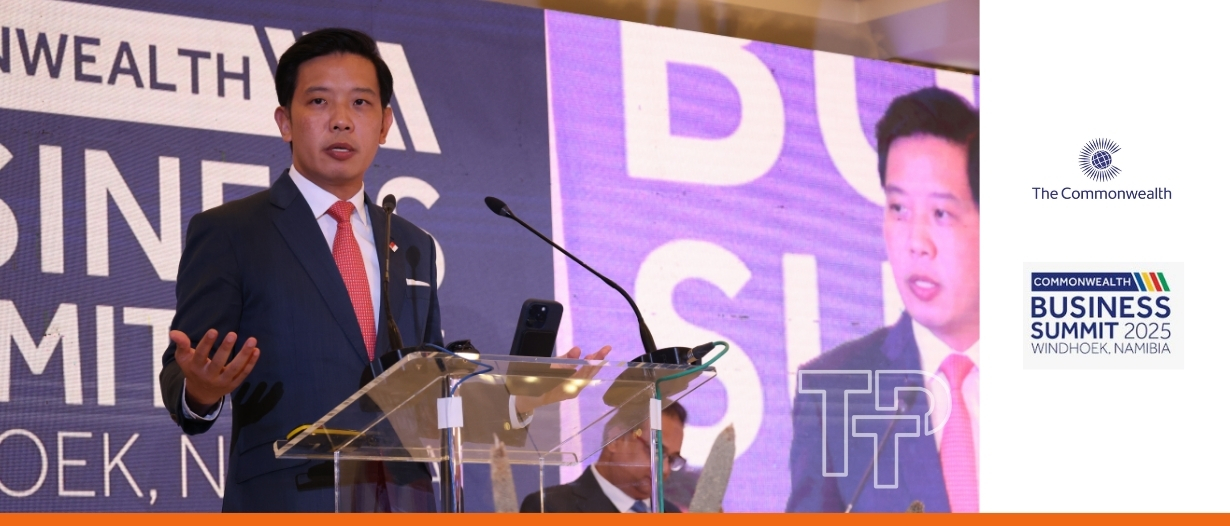

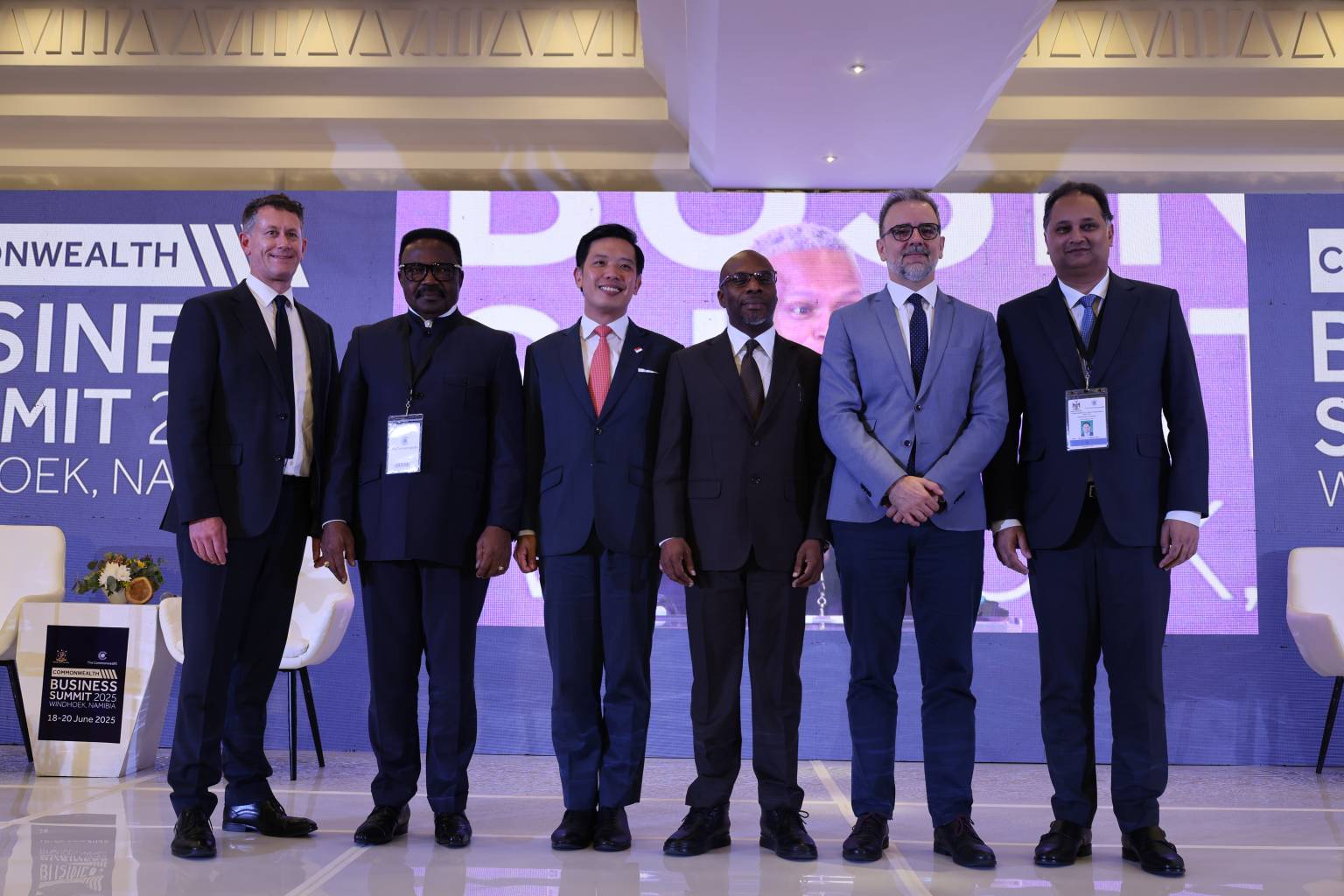
At the Commonwealth Business Summit in Namibia, Singapore’s Minister of State for Trade and Industry Alvin Tan delivered a confident message on how small states can stay relevant in global trade: by upholding a rules-based trading system, strengthening alliances and facilitating new aspects of trade.
As trade corridors fracture and the rules of globalisation grow more contested, Singapore’s approach reflects an emphasis on building on inherent strengths that the Commonwealth and Singapore possess, supporting the multilateral trading system through the WTO, deepening our region-to-region cooperation and addressing emerging issues such as digital economy and sustainability through novel initiatives. That was the message from Minister of State for Trade and Industry Alvin Tan at the Commonwealth Business Summit in Namibia.
Framed around a football analogy (fair rules, good teams, fresh playing styles) Tan’s speech crystallised how Singapore is adapting its trade playbook to meet an era defined by geopolitical risk, digital transformation, and rising pressure to decarbonise.
For small states to remain economically indispensable, they must help shape (not just follow) the rules of the game.
Rules: Anchoring global trade in uncertain times
Tan’s first point (the importance of fair rules) was a familiar one for anyone who follows Singapore’s trade policy. The country has consistently supported WTO reform and rules-based commerce, being both a beneficiary and advocate of the global trade order.
“The referee matters,” he said, emphasising the importance of a rules-based multilateral trading system, with the WTO at its core. It’s a point Tan has made before domestically, including in Singapore’s Parliament. Delivered in Windhoek, it doubled as a call for smaller and mid-sized economies to act in the collective interests of the WTO and its members, in an increasingly transactional world.
While intra-Commonwealth trade exceeded $880 billion in 2024, multilateral momentum has flagged, and Tan knows it. He highlighted the WTO Joint Statement Initiative on E-Commerce, which Singapore co-convenes alongside Australia and Japan, as part of an attempt to keep rules-based trade on course even as the old order drifts with the geopolitical current.
Teams: Alliances as a source of resilience
Tan’s second pillar (the need for strong teams) reflects Singapore’s efforts to strengthen partnerships at the plurilateral level. Singapore has proactively pursued greater regional integration, from ASEAN and the Comprehensive and Progressive Agreement for Trans-Pacific Partnership (CPTPP) to the world’s largest trade pact, the Regional Comprehensive Economic Partnership (RCEP).
The MERCOSUR–Singapore Free Trade Agreement (which is awaiting ratification) is one example of Singapore’s drive to open new trade corridors. So too are strategic pacts with the Gulf and deepening ties with Latin America and Africa.
Tan’s message implied that in a volatile trade environment, instead of waiting for better weather, it is best to build better teams.
Fresh playing styles: Digital and green trade as a competitive edge
It was in his third point that Tan’s speech pivoted from orthodox trade talk where he said that staying relevant means adopting new “playing styles.”
For Singapore, this means working with partners to facilitate trade in new areas like digital economy, green economy, and carbon credits. Initiatives such as the Digital Economy Partnership Agreement (DEPA), which is now expanding beyond its founding members of Chile, New Zealand, and Singapore, include rules, standards and frameworks for data flows and paperless trade.
Tan also pointed to recent Implementation Agreements under Article 6 of the Paris Agreement, including Singapore’s carbon credits partnerships with Ghana and Rwanda. These agreements serve to catalyse investments, scale climate finance, and strengthens our collective transition towards a low-carbon and sustainable global economy.
At home, Singapore has launched sectoral decarbonisation playbooks and a Green Economy Regulatory Initiative (GERI), helping industries transition from ESG ambition to bankable strategy.
Diplomacy with teeth
By asking whether trade (and the Commonwealth) remain relevant, Tan challenged his audience without alienating it.
He positioned Singapore as a like-minded partner, despite the size disparity between African countries like Namibia and Singapore. The speech was relational and yet, the underlying message that WTO remains at the core of the multilateral rules-based global trading system was unmistakable.
To those familiar with Singapore’s trade strategy, much of what Tan outlined was not new. But in Windhoek, he made it relatable to a Commonwealth audience, many of whom are themselves grappling with supply chain disruption, digital capacity gaps, and trade finance shortfalls.
For bankers and corporate treasurers, the mention of carbon credit infrastructure and digital trade platforms hinted at new instruments, standards, and transaction flows that will shape the next decade of global trade.
In a world where scale often trumps rules, Singapore is proving that clarity, connectivity, and credibility still count. Singapore is proving that clarity, connectivity, and credibility still count.