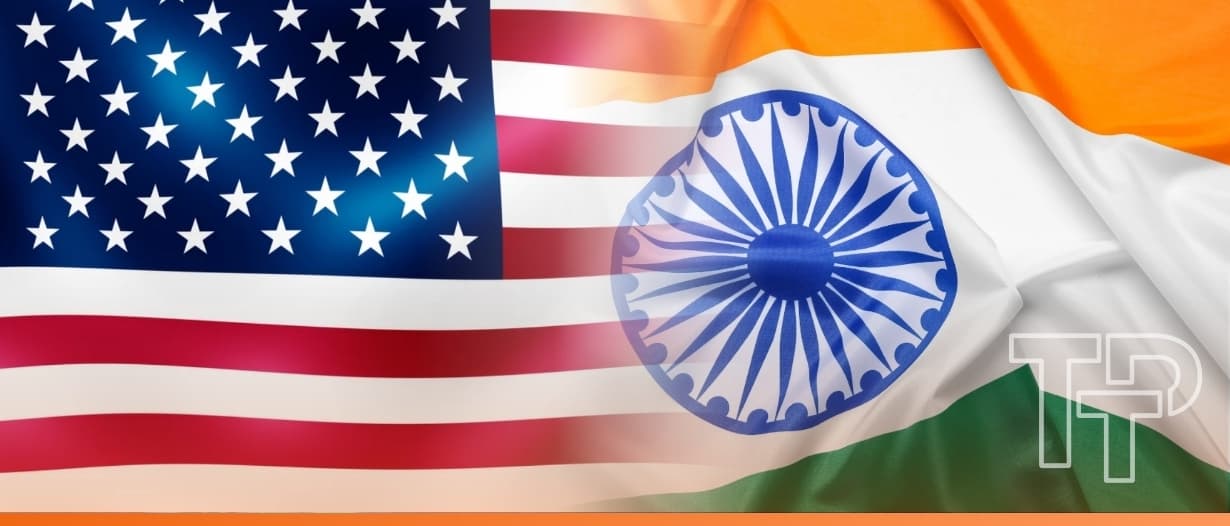
The United States and India have finalised a landmark trade agreement announced on 2nd February 2026, marking a significant advancement in bilateral economic relations. The deal reduces tariffs on Indian imports into the United States from 25% to 18%, setting a new baseline to facilitate increased trade and deepen strategic cooperation between the two democracies.
Tariff reduction and trade commitments
Under the terms of the agreement, India would reduce tariffs and non-tariff barriers against US goods to zero, a move expected to substantially lower trade costs and enhance bilateral commerce.
Prime Minister Narendra Modi pledged to “BUY AMERICAN at a much higher level,” committing India to purchase more than $500 billion worth of US energy products, including coal, alongside technology, agricultural commodities, and other goods.
The deal is designed to bring India’s tariff rates broadly in line with its Asian peers, ranging between 15% and 19%, thereby eliminating a disproportionate drag on India’s exports and its currency, the rupee.
What are the economic and market implications?
India previously had some of the world’s highest tariffs, with an average applied rate of 15.6% and an effective applied tariff of 8.2%, as reported by the World Trade Organization.
The recent tariff hikes by the US, including a doubling to 50% in August 2025 to pressure India to reduce Russian oil imports, have severely impacted Indian markets. India became the worst-performing emerging market in 2025, suffering record foreign investor outflows.
The agreement’s tariff reduction is expected to alleviate these pressures, but US business groups have responded with caution. However, a coalition of over 800 small businesses criticised the deal, warning that the new 18% tariff represents a 600% increase compared to 2024 levels, potentially burdening American businesses.
The tariff cut is anticipated to benefit American exporters, particularly in sectors such as energy and agriculture, which have faced barriers under previous trade conditions. For India, the agreement provides improved access to advanced technologies and critical energy resources necessary for its economic growth.
On this, President Donald Trump said, “It was an Honor to speak with Prime Minister Modi, of India, this morning. He is one of my greatest friends and, a Powerful and Respected Leader of his Country. We spoke about many things, including Trade, and ending the War with Russia and Ukraine. He agreed to stop buying Russian Oil, and to buy much more from the United States and, potentially, Venezuela. This will help END THE WAR in Ukraine, which is taking place right now, with thousands of people dying each and every week!”
“Out of friendship and respect for Prime Minister Modi and, as per his request, effective immediately, we agreed to a Trade Deal between the United States and India, whereby the United States will charge a reduced Reciprocal Tariff, lowering it from 25% to 18%. They will likewise move forward to reduce their Tariffs and Non Tariff Barriers against the United States, to ZERO. The Prime Minister also committed to “BUY AMERICAN,” at a much higher level, in addition to over $500 BILLION DOLLARS of US Energy, Technology, Agricultural, Coal, and many other products. Our amazing relationship with India will be even stronger going forward. Prime Minister Modi and I are two people that GET THINGS DONE, something that cannot be said for most. Thank you for your attention to this matter,” he added.
The trade agreement highlights the strengthening partnership between the United States and India.
India’s Trade Minister Piyush Goyal said, “This agreement unlocks unprecedented opportunities for farmers, MSMEs, entrepreneurs, and skilled workers to Make in India for the world, Design in India for the world, and Innovate in India for the world. It will help India get technology from the US.”
The deal follows closely on the heels of India’s long-awaited trade agreement with the European Union, which aims to eliminate or reduce tariffs on 96.6% of traded goods by value, though it excludes certain sensitive agricultural products.
Implementation and way forward
Details regarding the implementation timeline, the exact start date for the lower tariff rates, and the mechanisms for reducing trade barriers remain limited. As of the announcement, the White House had not issued the necessary presidential proclamation or Federal Register notice to formalise the changes.
A critical outstanding issue involves India’s purchase of Russian oil. The agreement requires India to reduce its imports gradually, from about 1.2 million barrels per day in January 2026 to an expected 800,000 barrels per day by March.
The US has warned that not fully ceasing Russian oil imports could lead to tariff rates exceeding 18%.
Additionally, the Trump administration has been pursuing a similar framework trade deal with other major partners, including Taiwan, as part of a broader strategy to recalibrate trade relationships in Asia.
The deal was announced after months of tense negotiations amid changing global trade dynamics and rising economic nationalism.
It is to be noted that India’s trade with the US in 2024 stood at $220 billion, with the target of $500 billion by 2030.