By: James Dorman
The momentum behind the digitalisation of trade and trade finance is undeniable. Over recent years, it has shifted from an area for debate and abstract thinking to one of practical implementation, driven by both technological advancement and targeted legal reform. For the expert voices gathered to discuss trade digitalisation at the recent EBRD ‘As trade digitalisation accelerates’ panel in Riga, there seemed to be a clear consensus: significant progress is undoubtedly being made, but the industry remains somewhat fragmented. The challenges now lie in trying to move beyond incremental improvements toward a truly transformative, end-to-end digital trade ecosystem.

Marco Nindl, Associate Director, TFP, EBRD
The foundations
Marco Nindl, Associate Director, TFP, EBRD, moderated the discussion and set the stage by emphasising how digital trade sits at the heart of the EBRD’s Trade Facilitation Program (TFP). The panel offered a unique opportunity to ask one-to-one questions of expert consultants with real, practical knowledge of trade digitalisation.
Pamela Mar, Managing Director of the ICC Digital Standards Initiative (DSI), fielded the first question, highlighting the recent milestones already achieved in digitalisation and the remarkable shift in the legal landscape. “Today 62.5% of global exports are coming from countries which have either committed to or already aligned [with the Model Law on Electronic Transferable Records (MLETR)]”, Mar explained. “Two and a half years ago, that number was 34%, so it’s been really impressive”.
Despite such rapid progress in legal reform, Mar cautioned that the industry must now tackle critical issues regarding standards and interoperability. Without these key foundations, the promise of digitalisation and all the benefits it offers will not reach its most important beneficiaries: small and medium-sized enterprises (SMEs). “If it doesn’t work for SMEs, it doesn’t work, period,” Mar cautioned.
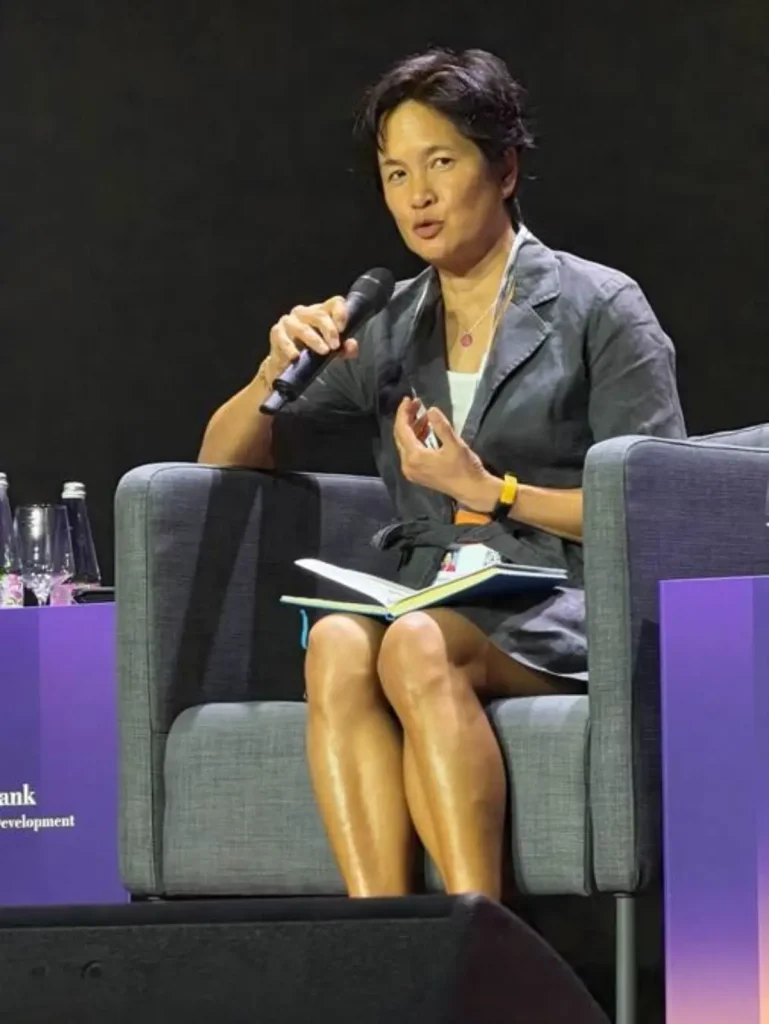
Pamela Mar, Managing Director, ICC DSI
Trust is crucial
Recurrent throughout the discussion was the critical importance of trust in trade dealings and the challenge of ensuring trust is at the heart of modern cross-border trade. Sean Edwards, Chairman of the International Trade and Forfaiting Association (ITFA), echoed the idealised sentiment shared by peers that “we should all do business with friends,” meaning trust is a core principle of the transaction, but argued that the industry must move beyond purely relationship-based trade. Trust must instead be integrated into the trade process itself.
“Integrating trust operationally into cross-border trade is very important,” Edwards explained. He noted that many of the challenges in the digitalisation of trade lie in legacy practices and the conservative mindset of many companies over a lack of access to technology. Many organisations, particularly SMEs, lack the capacity and knowledge to navigate the plethora of emerging technologies available to them, even in technologically sophisticated countries like Japan. The industry needs a shift in mindset as much as anything else to facilitate digitalisation.
Interestingly, he explained how the regulatory environment in Europe is creating a positive pressure for trade digitalisation. Despite Edwards’ own view that “the market should find its solution,” he acknowledged that initiatives like the Electronic Freight Transport Information (eFTI) regulation and eIDAS2 are driving a shift towards digital trading. “All of this is pushing Europe into a very definite direction,” he observed.

Sean Edwards, Chairman, ITFA
The logistics of implementation
Milot Ahma, Principal Counsel at the EBRD, offered a legal and regulatory perspective to the discussion, in particular the role of the EBRD in legal reforms to facilitate trade digitalisation. He outlined a significant shift in the role of his institution – “we are having to do less and less advocacy, and more and more action” in terms of implementing changes, he explained.
The EBRD is currently working with several countries to implement concrete roadmaps for digital trade. “The gap remains between market conditions and legal society,” Ahma observed. To bridge this gap, the strategy of the EBRD is evolving away from country-specific interventions toward operating in the regional and cross-regional space, fostering corridors where digital trade can thrive as a common agenda.

Milot Ahma, Principal Counsel. Office of the General Counsel, EBRD
Silvia Kuo, Europe Business Development Director at ASUS, offered complementary insight from the corporate and technology provider perspective. Kuo highlighted how technology like AI, IoT, and digital twins are already being used for “sensing the world”, translating physical movements into actionable, real-time data, while also allowing for the automation of decision making and offering more accurate forecasting.
Crucially, she also addressed the concerns held by some organisations regarding data security, noting how edge computing and secure network architectures tackle these concerns. “The enterprise doesn’t have to hand over this data to some external environment or cloud; they can own the data on site,” she explained. This allows organisations to preserve data sovereignty while benefitting from digitalisation.

Silvia Kuo, Europe Business Development Director of the Infrastructure Solutions Business Group, ASUS, Taiwan
It’s not about the specific platforms
With discussions looking towards the future, the question emerged as to how companies can avoid falling into the difficult position of choosing between competing, siloed platforms, each with different standards and protocols, potentially even feeling the need to adopt different platforms for different customers. Mar argued that it shouldn’t actually be about the platform, and we should instead go “back to the basics” of data sharing.
“You shouldn’t need a third party, you shouldn’t need a new workflow just to create a trade document like an invoice or even a billable claim – you should be able to generate that right from your backend because that’s where the data is coming from,” she noted. The focus should be on bringing standards and trust directly into the IT infrastructure that companies already use. This embeds trust into the trade record itself, rather than being reliant on any specific platform. In this way, the industry can enable data portability and easier credit assessment for SMEs, for example, as “that data is already trusted,” Mar explained.
The priorities moving forward
As the session concluded, the panellists identified the top priorities from their different perspectives for the coming years. For Edwards, it is interoperability through data standards – he echoed Mar’s sentiments, emphasising the need for a unified approach to data standards which would allow platforms to act as delivery vehicles rather than competing, isolated siloes.
For Ahma, it is about accelerating change and the EBRD’s commitment to shifting towards regional and cross-regional collaboration to mobilise collective action. In a similar vein, Kuo spoke of broadening adoption and connectivity, stressing the importance of technology providers doing a better job of connecting with the industry to improve awareness and standardise systems. This is crucial to moving away from siloed systems and toward the elusive target of true end-to-end implementation.
Overall, there was a very clear message from the stimulating discussion in Riga: the digital trade revolution is no longer some exciting possibility on the horizon; it is very much underway. The important conversations to be had now are how precisely to lay the path for widespread digitalisation. As the perspectives of the panellists show, this will require a concerted, cross-disciplinary, industry-wide effort to align standards, ensure legal interoperability, and provide businesses – particularly SMEs – with the tools to participate in a modern, borderless, digital economy.