
GLEIF was built in 2014 to answer one question after the last crisis: who is exposed to whom. It largely succeeded. But what a business must prove, and to whom, has moved on, from the trading floor to payments, trade, and the machine-to-machine economy, and the identifier has not kept pace. This is the story of a good idea that stopped evolving.
I recorded my first podcast on the Legal Entity Identifier in the basement of a New York hotel, at the World Trade Symposium in November 2019, wedged into a corner with Gerard Hartsink, then chairman of the GLEIF board. Someone nearby decided the same corner was the place to take a confidential conference call, so if you ever find the recording, her meeting is faintly on it. I mention it because I should be honest about where this publication starts from. We were, and in most ways still are, advocates. The idea is a good one. That is exactly why the numbers now bother us.
The plan Hartsink set out was expansive. There were about one and a half million LEIs in 2019. He wanted something closer to forty million, the level of the International Chamber of Commerce’s corporate membership, with an identifier in the hands of every exporter and importer, not only the capital markets desks that first needed one. The International Chamber of Commerce had, as the ADB later documented, recommended that the G20 adopt legislation requiring the identifier for all trading companies. A McKinsey and GLEIF white paper put the potential saving to banks at up to five hundred million dollars a year on letters of credit alone. The Asian Development Bank, in two studies that year, called the LEI potentially transformational for trade and for extending finance to emerging market SMEs. Fees, Hartsink promised, would fall as volumes rose.
The who’s who of the identity world
Before going further it helps to be precise about who is who in the acronym filled identity world.
An LEI (Legal Entity Identifier) is a twenty-character code that uniquely identifies a business (or, more precisely, as the name suggests, any legal entity). GLEIF, the Global Legal Entity Identifier Foundation, is the non-profit that runs the system. It does not write the rules (that is the job of the Regulatory Oversight Committee, a body of central bankers and regulators) and it does not sell LEIs directly (LEIs themselves are issued and renewed by commercial and other accredited issuers, which pay GLEIF a service fee from the revenues generated by those registrations).
The vLEI is GLEIF’s newer, cryptographically verifiable version of the LEI that has been built for a machine-readable world. And the pLEI, confusingly close in name, is not GLEIF’s at all: it is a free proto-identifier launched in February 2026 by OpenCorporates.
The three million that is really 1.9 million
Seven years after that basement in New York, the TTP research desk went back to the source. We connected to GLEIF’s MCP endpoints via GLEIF AI, its new Beta AI interface, and queried the live statistics ourselves. At the end of April 2026, the latest reporting month, there were 3,050,226 active LEIs, and GLEIF marked passing three million as a milestone.
Of those, 1,890,348 are current, meaning their reference data has been renewed on schedule. The remaining 1,159,878, some thirty-eight per cent, have lapsed. That renewal rate has been sliding for years. It is worth being precise, because it is easy to overstate: a lapsed LEI is not void. It still identifies the entity, and the company behind it may well still be trading. What has stopped is the annual re-checking that keeps the reference data current, not the identifier itself.
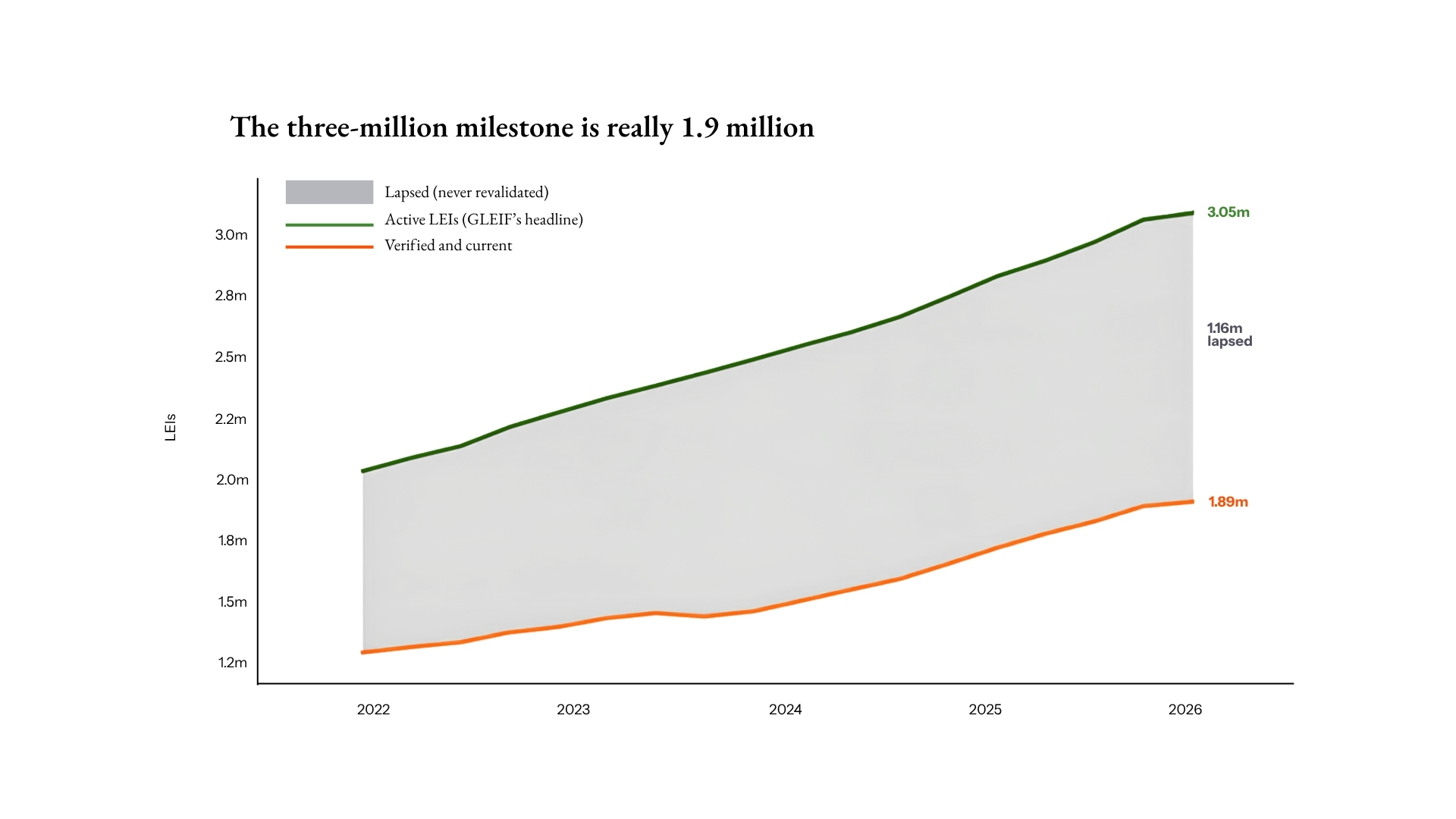
The active line is GLEIF’s headline number of active LEIs. The gap beneath it, widening every year, is the lapsed LEI number that holders stopped maintaining. Source: TTP analysis using GLEIF statistics service.
Further, GLEIF counts identifiers, not companies, and a single large group can hold dozens of LEIs across its subsidiaries. Another search using the Global LEI Index on the top ten banks in the world by total assets returned an average of 454 LEI records carrying each group’s name (several of them already lapsed). GLEIF does not routinely publish a unique-entity figure. GLEIF reported it at around 70 per cent in the third quarter of 2019, and at 56.7 per cent by the end of 2025.
TTP reached out to GLEIF to ask about these figures. The foundation’s chief executive, Alexandre Kech, distinguished between three things: 1) whether an LEI is active, 2) whether its data has been renewed on schedule, and 3) whether it has been corroborated against an authoritative source. A lapsed LEI, he says, “remains a valid and unique identifier”; the label means only that the record was not revalidated by its renewal date, not that the company has ceased to exist, and for uses such as entity resolution or historical identification it is still meaningful. The foundation makes the status transparent, it argues, precisely so users can judge for themselves. It puts the fully corroborated share at 87.9 per cent and concedes that renewal “remains an area where we want continued improvement.”
Kech adds that recent work has “flattened the curve,” with lapses no longer rising and now edging down.
An LEI, the foundation says, can only ever represent a single entity, and each entity can hold only one, so the system is doing exactly what it was built to do, identifying legal entities (as opposed to brands or corporate groups). To label the whole population “companies,” Kech adds, would itself be misleading.
Built for banks, sold to everyone
Let’s rewind to the beginning of the legal entity identifier story. It was built for a narrow job. After the collapse of Lehman Brothers in 2008, regulators found they could not see who was exposed to whom, so the G20 and the Financial Stability Board created GLEIF in 2014 to give every counterparty in the financial system a single code. Even now, as the Bank of England has noted, take-up remains largely among the financial sector, reflecting those post-crisis priorities. The universal-identity-for-trade plot was layered on afterwards, by the ICC, development banks, consultants, and GLEIF’s own marketing to governments.
The ensuing lack is most apparent when you look closely at the market that would, in theory, benefit the most. We filtered GLEIF’s data to Africa. The whole continent, fifty-four countries, holds 13,360 active LEIs, of which just 7,469 are current. That is 0.44 per cent of the global total. The region the marketing is aimed at has, in practice, almost no LEI at all. Large banks, on average, hold more LEIs than Kenya (306) and Ghana (138) combined, and about half as many as exist in all of Nigeria (917).
It is also telling that the loudest of those early champions have since fallen quiet. The Asian Development Bank, whose 2019 briefs called the LEI potentially transformational for trade, has published almost nothing on it in the years since.
One person we interviewed, who has worked closely with GLEIF and spoke on condition of anonymity, said, “We shouldn’t judge GLEIF by the fact that they have failed to scale the LEI across the global supply chain, because it was never set up for that purpose. Today we have expectations of GLEIF that are misaligned with GLEIF’s original mission.”
One former board member, when asked what had blocked adoption, said, “It’s the model, the process, and the price. GLEIF is a great concept, the LEI is a great concept, but it was mandated by the regulators, and the adoption is only in a regulated space.”
A map of compulsion
In many jurisdictions, even those where regulations require businesses to obtain an LEI, there are often no rules that require businesses to renew it. Many companies, therefore, pay once and let it lapse.
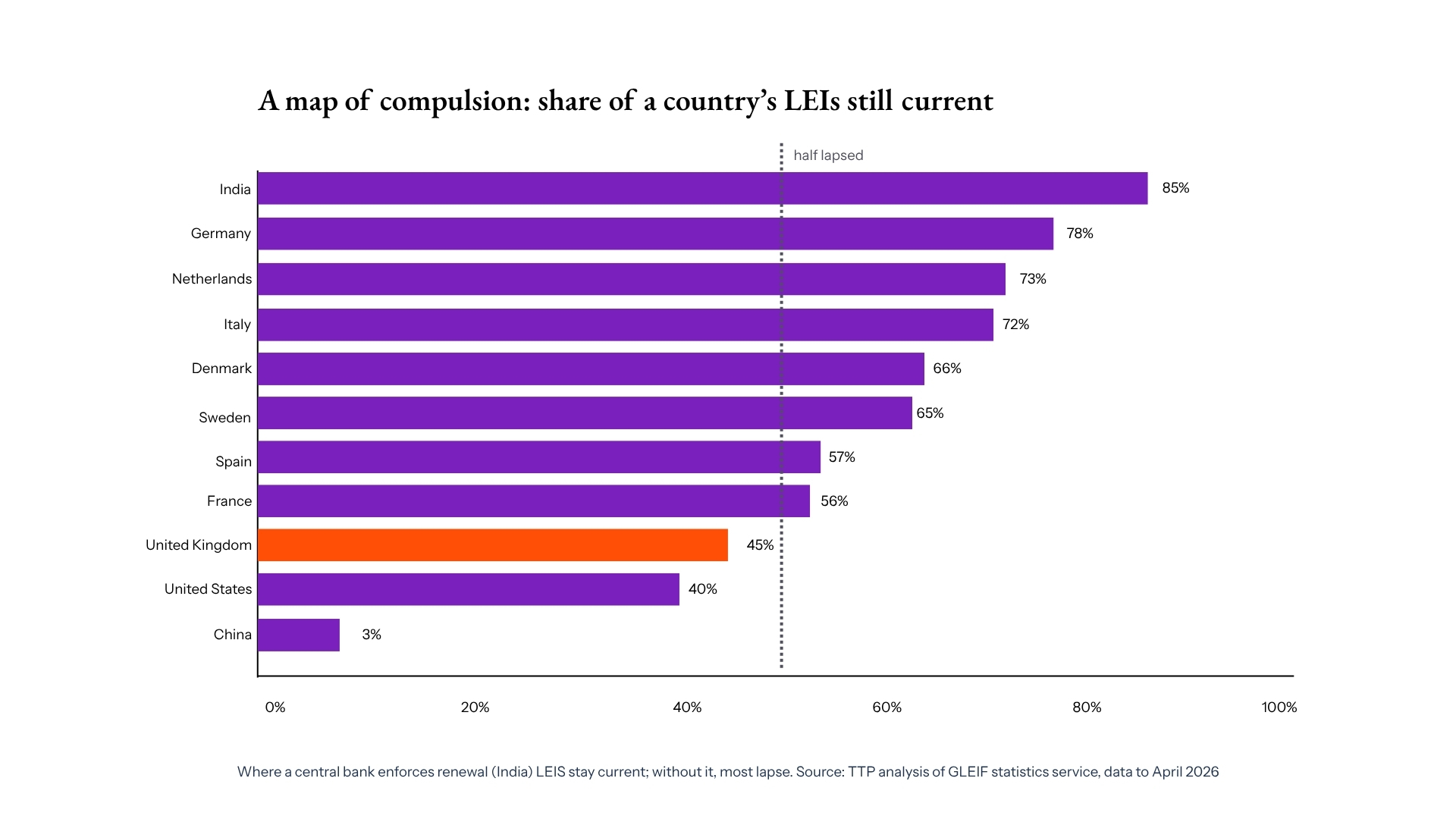
India, whose central bank enforces renewal, keeps 85% current. Britain keeps 45%. China, after a one-off push, keeps 3%. Source: TTP analysis of GLEIF statistics service, April 2026.
India, the one large market whose central bank effectively enforces renewal, keeps eighty-five per cent of its LEIs current. Take the enforcement away, however, and that number shrinks considerably. The United States maintains forty per cent, the United Kingdom forty-five, and China, after an evident one-off issuance push, has let ninety-seven per cent lapse, with just 2,596 of its roughly one hundred thousand LEIs still current. More than half of Britain’s LEIs have lapsed.
A former director said, “The LEI costs, for no immediate benefit, and it needs to be renewed every year. That’s the problem [and leads to] a lot of dormant LEIs.”
If the LEI is used where a rule compels it, why, then, aren’t more jurisdictions compelling it. The answer, from the governments that have been asked to mandate it, is a consistent set of three objections, namely, proportionality (the idea that a hairdresser needs the exact same identifier as would a derivatives trader), cost (it can be viewed as the government effectively imposing a fee on businesses), and sovereignty (some states prefer identity to remain in their own national infrastructure rather than relying on a global identification system overseen internationally).
GLEIF, for its part, disputes this notion that the mandates have dried up. Kech points to fresh regulatory adoption in India, Brazil and Mexico, and to the Financial Action Task Force’s Recommendation 16 (the payments travel rule) which recommends the LEI for payer and payee by 2030 and now has to be implemented jurisdiction by jurisdiction. The Central Bank of Brazil, he says, is preparing a framework to embed the LEI in cross-border payments. On his telling the regulatory track is widening, even as the foundation leans harder on voluntary, market-driven adoption, which he insists is a complement to regulation, running at between 1,200 and 1,500 new LEIs on a typical business day.
Who actually gets paid
Being registered, and staying registered, is a private service, bought and renewed each year through a network of commercial issuers. The two largest issuers are Bloomberg and Ubisecure (the company behind RapidLEI) and between them they manage about 944,000 active LEIs, roughly a third of the entire system. Most of what a company pays goes to issuers like these. GLEIF itself takes a levy of eleven dollars per LEI, and its board reconfirmed that eleven-dollar fee for 2026.
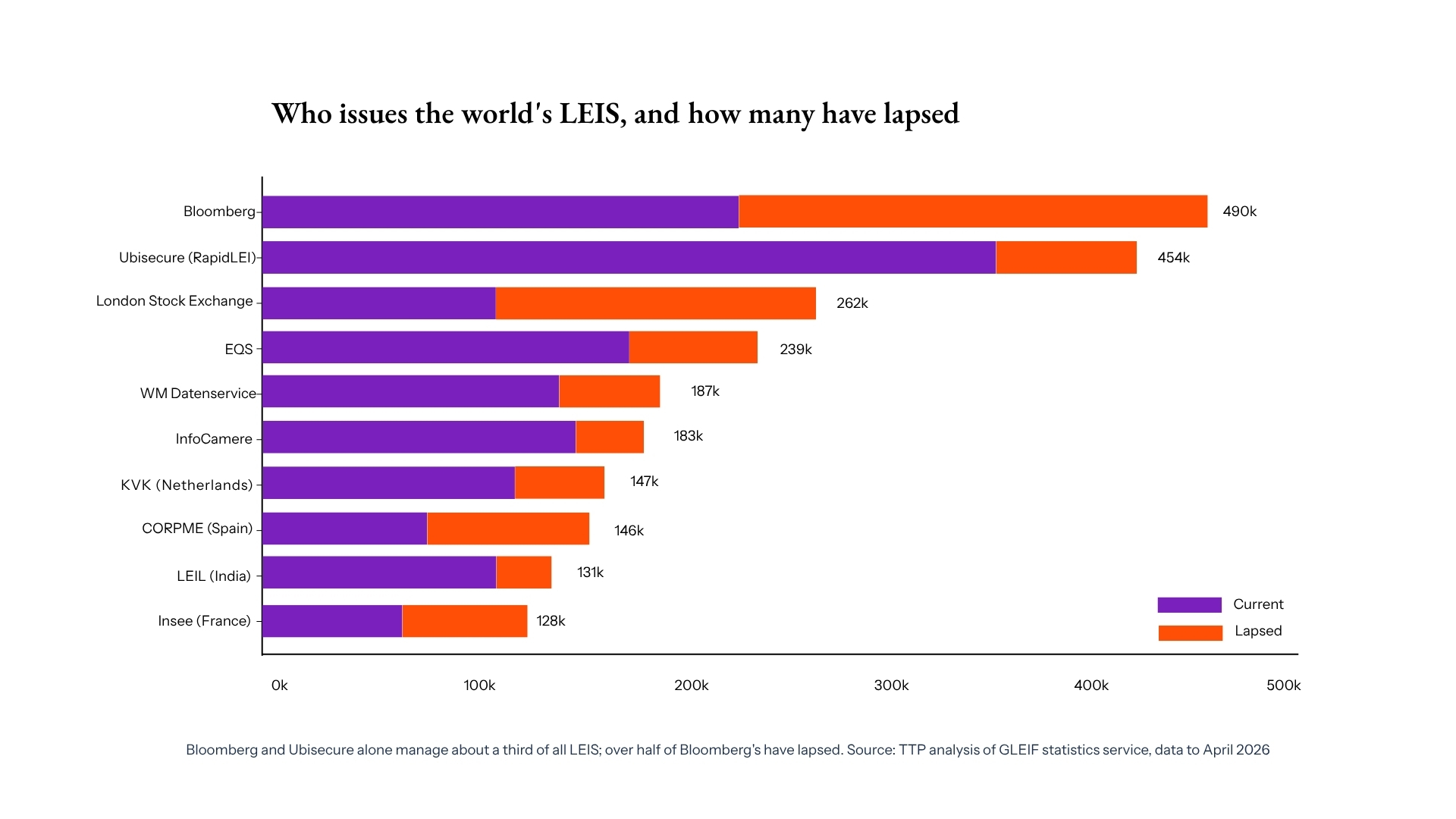
The two largest LEI issuers in the world are commercial. More than half of the LEIs on Bloomberg’s book have lapsed. Source: TTP analysis of GLEIF statistics service, April 2026.
What a company actually pays to obtain and renew an LEI runs to several times the eleven-dollar levy that reaches GLEIF. The remainder goes to the issuer to cover the costs associated with issuing and maintaining the LEI, including validation, annual revalidation, data quality management, technology, and customer service.
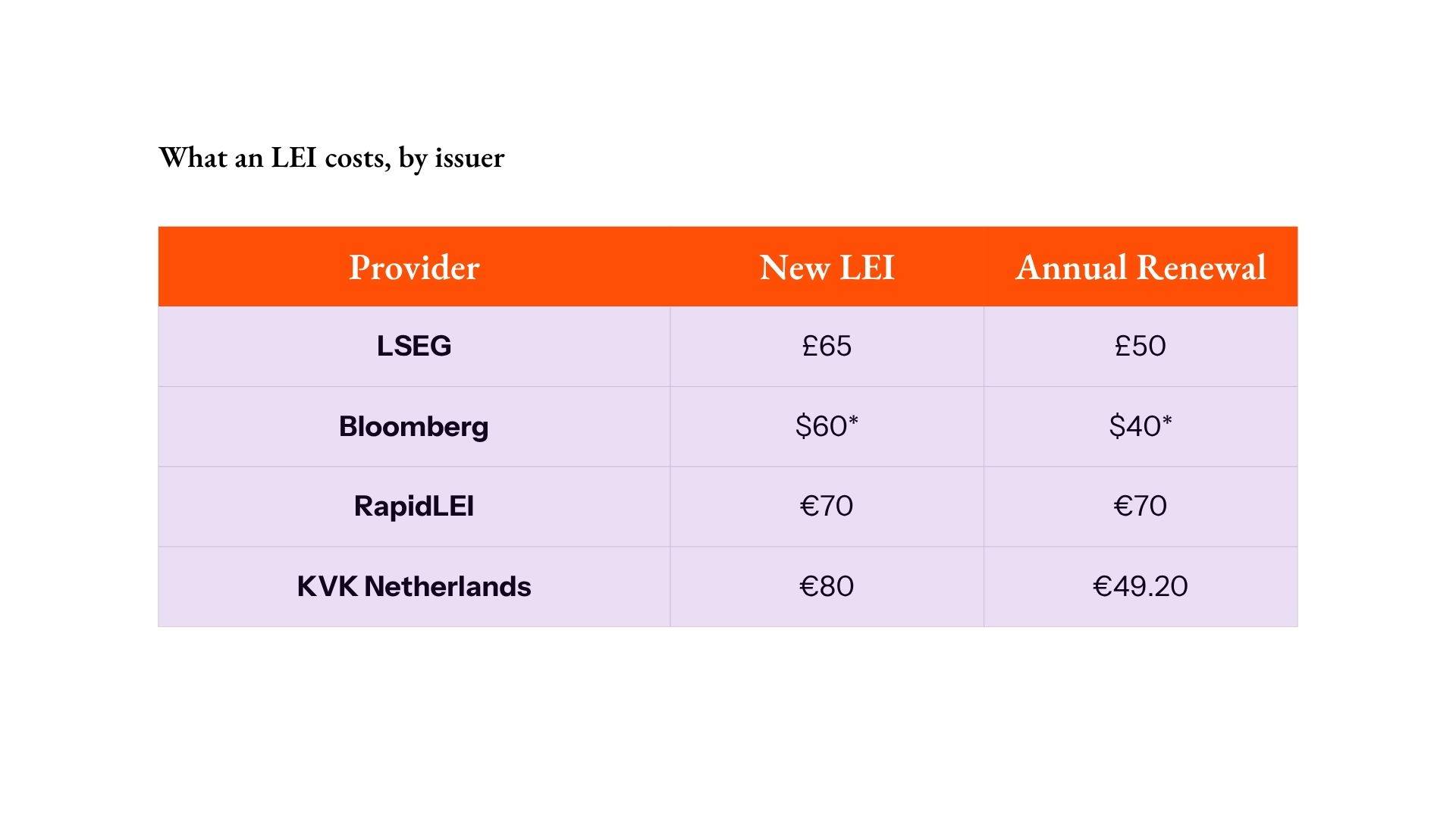
Prices are for a single LEI, as charged by each issuer in its own currency, as of August 2026; each fee includes the $11 annual GLEIF levy. * Bloomberg pricing is in US dollars. Sources: issuer pricing pages.
GLEIF’s audited accounts show fee revenue climbing to $16.2 million in 2024, and the foundation posting a loss in both 2023 and 2024, around $1.1 million last year, with organisational reserves falling from $13.3 million in 2022 to $11.8 million by the end of 2024.
It is worth asking what the money funds. GLEIF is a lean non-profit whose board takes no fee beyond travel, and its audited 2024 accounts are unusually open, itemising costs that many non-profits bury. Roughly two-thirds of funds cover staff costs (66 personnel), and the rest goes to technology, consultants, travel, and communications that running to global standards entails. None of it is remarkable for the sector. The IFRS Foundation, the world’s accounting-standard setter, spends a near-identical share on staff and, like GLEIF, ran a small deficit in 2024 that it covered from reserves. GLEIF is not growing rich. It is a normal, modestly run foundation that took in $16 million, spent a little more than it earned, and drew down its reserves, all while the thing it exists to grow did not grow.
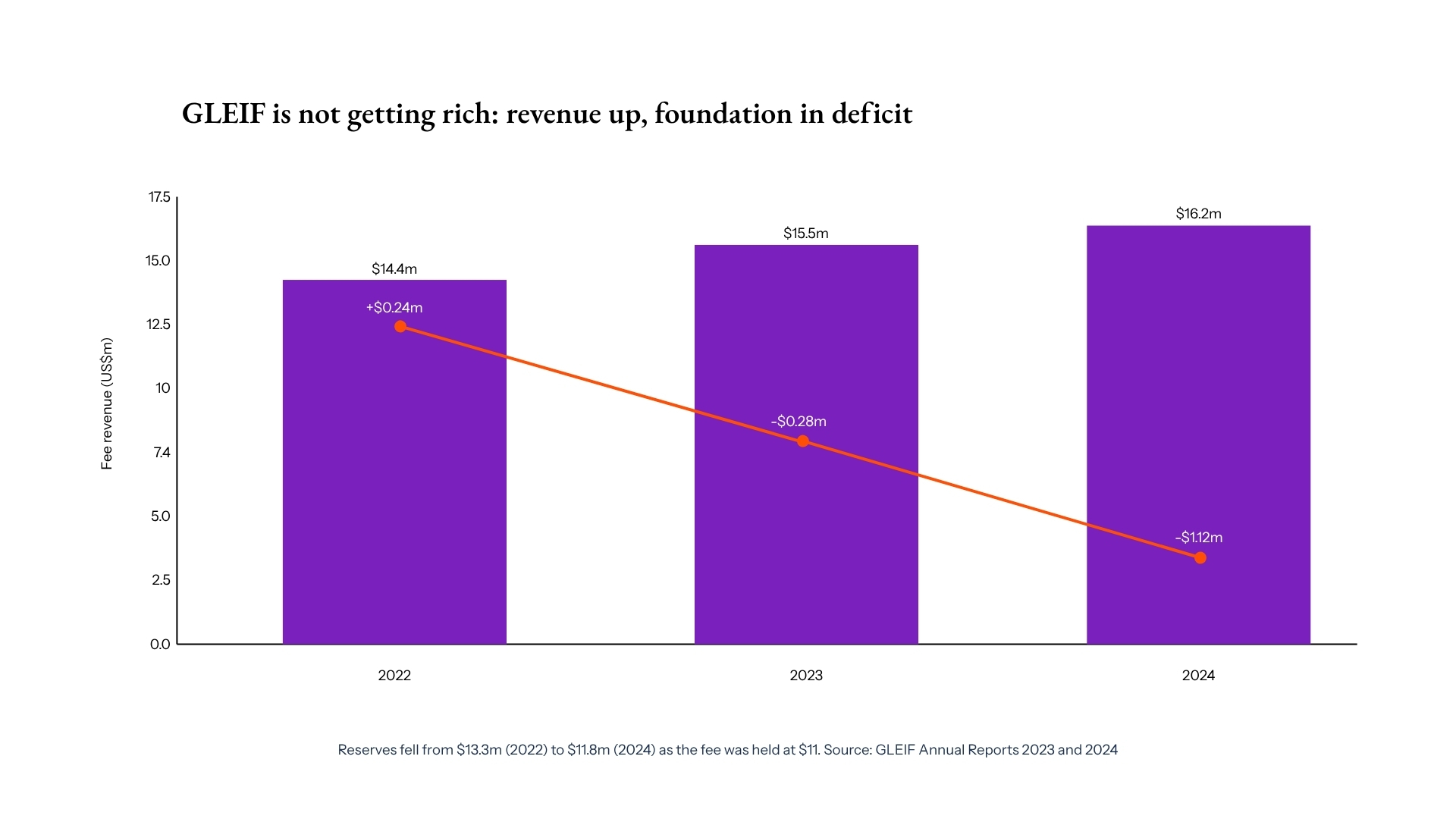
Revenue is rising, but the foundation ran a loss in 2023 and 2024 and is drawing down its reserves. Source: GLEIF Annual Reports 2023 and 2024.
The market is already routing around it
In February 2026 OpenCorporates launched the pLEI, a free proto-identifier built on the same standards, upgradeable to a full LEI, aimed at the small companies the paid model priced out. One of its backers, Stephan Wolf, is the man who ran GLEIF for a decade, who now argues publicly that a free, open identifier is what will unlock adoption among the millions the LEI never reached. When the founder of the system is championing the free alternative to it, the market is telling you something about the model.
One former board member gives a sense of the scale of the free alternative. OpenCorporates, the person says, has built proto-identifiers for more than 200 million companies worldwide, drawn and continuously updated from local business registries, open source and free to use.
That argument has now been made in public, and by the man who built the system. In essays published in mid-2026 as chair of the Verifiable.Trade Foundation, Wolf sets out the case for the proto-identifier as a free, open reference layer that connects the world’s national registries, extending coverage to the hundreds of millions of companies the paid LEI never reached. He describes it as the “global primary key for organisational identity,” federated like the internet’s addressing system and carrying a direct upgrade path to a full LEI.
Nor is Wolf the only figure from that world to have changed tune. Oswald Kuyler, the founding managing director of the ICC’s Digital Standards Initiative and for years a central figure in the drive to digitise global trade, now backs a different approach to reach small and medium-sized firms.
So what should GLEIF do? One option would be a free, entry-level starter identifier: a lighter record, issued at no cost, that puts a usable LEI into the hands of the small companies, with the fuller, verified LEI reserved for those that need it. It would not fix everything, but it would remove the price objection. It is also possible that something along these lines is already in the works. GLEIF’s board approved a project in late 2025 that it has not detailed publicly, and which more than one person has hinted solves the problems set out here.
Asked directly whether a free or freemium tier was coming, Kech says, “[GLEIF] generally does not comment [on initiatives] that have not been publicly announced.” But he did set out the directions that the foundation is exploring. Among these is issuing the LEI at source through national business registries, so that a company can receive their domestic number and an LEI together, and integrate it into regional schemes “like an EU ID that would include the LEI.”
There is a problem, however, with cheering for a private rival. OpenCorporates, as a private, for-profit company, has no Regulatory Oversight Committee of central bankers behind it, and no multilateral mandate. OpenCorporates, Kech notes, has been a mapping partner of the Global LEI System for about five years, and the pLEI, he says, is “a private initiative developed and operated by OpenCorporates to expand its client base,” separate from the governance and scope of the official system, and one that, by intending to integrate with it, “underscores the importance” of the LEI. “Who are we to say you can’t do this,” he says, adding only that he hopes it “will not create confusion in the market.”
Sovereigns are routing around it too
OpenCorporates is not the only challenger. Southeast Asia is developing its own Unique Business Identification Number, or UBIN, embedded in the ASEAN Digital Economy Framework Agreement and backed by Australian development funding, so that a company registered in one member state can be recognised and verified in real time across all ten. It works by making national registries interoperable, treating each country’s own record as the trusted source rather than routing identity through a single foundation abroad.
Digital public infrastructure, built at national level and increasingly promoted by the United Nations, the World Bank, and the multilateral development banks under the banner of digital public goods, are also gaining traction. TTP supports this idea.
UBIN also exposes the real disagreement among the people who know this field best, because they do not agree on the cure. One camp argues that identity should sit with sovereigns, that the national registry is the natural trust anchor, and that the task is simply to make those registries talk to one another, in which case a lattice of interoperable national schemes is the future and a single global code is neither necessary nor welcome. The other warns that a proliferation of regional and national identifiers that do not interoperate cleanly would recreate the very fragmentation the LEI was built to end, and that only a single standard with genuine multilateral backing can work at scale.
The LEI’s future may depend on which of those two worlds the market actually builds.
Where it works, and where it might
Judged against its original mandate, GLEIF has largely succeeded. The LEI is now written into financial regulation across more than forty jurisdictions, it underpins the reporting of over-the-counter derivatives and securities trades it was created for after the crisis, and it works in high-value and wholesale payments. As the world moves to ISO 20022 messaging, and the Financial Action Task Force’s revised Recommendation 16 pushes richer originator and beneficiary data into cross-border payments, the LEI has a natural place in the message itself, where it can strengthen fraud detection and straight-through processing. Alongside that, GLEIF’s vLEI is starting to give organisations a machine-verifiable identity, and to prove the authority of the people who act for them, which is the kind of trust an AI-driven, agentic economy will need.
One person we spoke to noted that the demand for an LEI in trade is real and growing, but the foundation has no ready way to meet it, because the instrument was constructed for finance. The task GLEIF has now set itself is to make a single identifier serve a double purpose, one in finance and one in trade. That is the dilemma it faces, and trade may yet prove one way through it, if the identifier can be tied to something exporters actually need.
We do not yet have proof that the LEI transforms trade the way its champions once promised. A verifiable identity that ties a bill of lading or an invoice to a real company and an authorised signatory could take a genuine point of friction and fraud out of cross-border commerce, and could help the smaller firms that trade finance so often overlooks.
What a working model might look like
If neither compulsion nor a repriceable private code is the answer, what is? Three models are worth putting on the table.
The first shifts from a model where the registered company pays to one where the data user does, so that registration is free, while value-added services bear the cost.
The second ties the identifier to a function no one can trade without. GS1’s Global Trade Item Number, the barcode on almost every product sold, was never mandated, but became the de facto standard because it simplified how commerce worked. The LEI has no equivalent anchor yet, and finding one, whether in payments messaging or in the trade document itself, matters more than any marketing campaign.
The third uses leverage rather than law. For instance, development banks could make an LEI a condition of onboarding partner banks and their clients.
So do we need the LEI like this?
The question is not really whether we need GLEIF. The question is whether we need the LEI in the form the rulebook has fixed it: mandated but not maintained, sold as trade infrastructure it was never built to be, and paid for one company at a time.
The foundation currently answers to the Regulatory Oversight Committee, a body of central bankers and financial regulators, and it was built to serve financial stability. Can a body with that mandate, and those overseers, be the one to build organisational identity for the whole digital economy, for payments, for trade, and for the AI-native world now taking shape? The real question may not be what GLEIF should build, but who should be overseeing the attempt, and whether identity of this kind belongs under financial regulators at all.
The temptation is to conclude that nothing changes, because the people who would have to act are the same financial regulators the system already answers to, and few institutions vote to constrain themselves. But that is to assume the cost of standing still is low. It is not. As long as organisational identity is anchored to a finance-first instrument that most of the world never adopts, some 65 million formal SMEs in developing economies cannot get the finance they need, a $5.2 trillion gap. Their data cannot be cheaply anchored, matched and checked against the KYC and anti-money-laundering tests that decide who gets trade finance, so they are quietly shut out of it, and out of much of trade itself. That is the real risk of carrying on as we are. Not that GLEIF fails, but that the identity layer trade actually needs never gets built, by GLEIF or anyone else.
Trade & Transaction Finance Media Services Limited, the legal entity behind ‘Trade Treasury Payments’, does not have an LEI, and knowing everything we now know, we will not register for one until a rule makes us.
Speaking personally, as someone who argued the LEI’s corner for the better part of a decade, that is not a comfortable thing to write. I want verifiable identity at the level of the company, and I do not want to pay for it, and I do not think the corporates and the SMEs who did not cause the financial crisis should have to either.
–
Update: This article was updated on 17 August 2026 to clarify the costs associated with LEI issuance and the relationship between the Global LEI System and national business registries. A passage concerning GLEIF’s governance was also removed.