By: Devanshee Dave
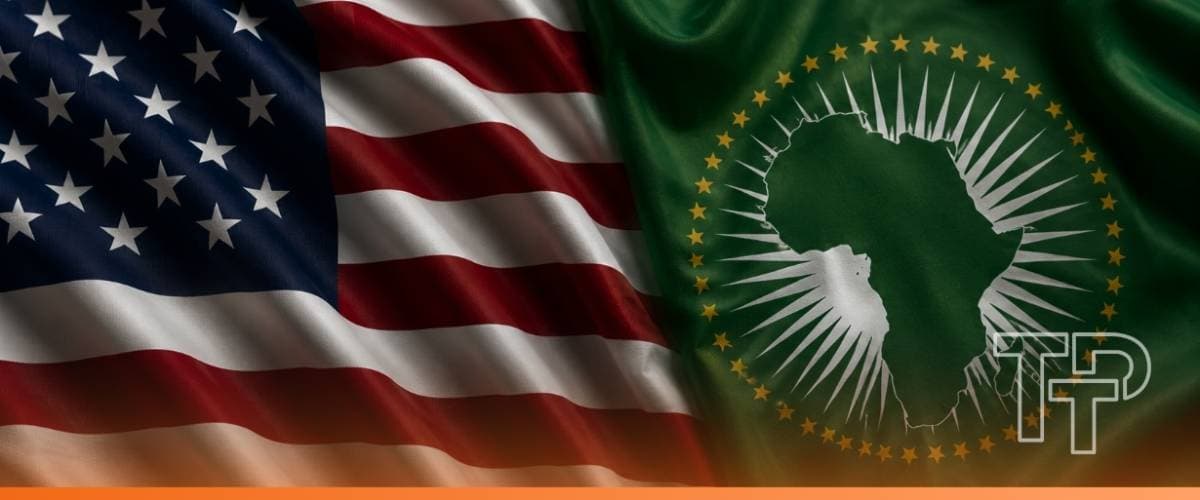
There is an interesting concept of hyperbolic discounting. It refers to the fact that many times, decision-makers tend to prioritise immediate benefits over long-term gains. This behavioural tendency often leads to short-term political and economic considerations overshadowing the enduring importance of sustained partnerships, such as in the case of the African Growth and Opportunity Act (AGOA), which has an uncertain future beyond this year.
AGOA has been an important part of US trade policy with sub-Saharan Africa since 2000. It allows eligible African countries to access the US market without paying taxes on their goods. The goal here is to increase exports, create jobs, and support economic growth.
Last year, AGOA was extended for a year and is now five months away from expiry. With that, the program faces serious questions about its relevance and effectiveness.
How do countries become eligible for AGOA?
AGOA includes 32 eligible countries in sub-Saharan Africa out of a total of 49 that could qualify. Each year, the US President decides who is eligible based on their trade and investment policies, governance, worker rights, human rights, and how closely they align with US foreign policy interests.
The 2025 annual review, which began in May 2025, was reauthorised in February 2026 (till December 2026) but is not finalised as of August 2026. For 2025, 17 countries were deemed ineligible for various reasons such as rule of law deficiencies (Burkina Faso, Gabon), political violence (Burundi, South Sudan), human rights concerns (Cameroon, Ethiopia), income graduation (Seychelles), and others never having been eligible (Somalia, Sudan). Currently, it is active until December, due for renewal.
Rwanda has lost benefits for its apparel exports since 2018 because of higher tariffs on used clothing imports from the US. Some policy experts have suggested that South Africa should be suspended from AGOA due to bilateral economic competition and foreign policy considerations.
AGOA’s main benefit is the nonreciprocal duty-free treatment of eligible products imported into the US from beneficiary countries.
This eliminates most-favoured nation tariffs on thousands of goods, helping African economies compete with lower-cost producers globally.
The preferences include all products covered by the Generalised System of Preferences (GSP), plus products excluded from GSP such as automobiles and certain textiles and apparel. Eligibility for GSP is a prerequisite for AGOA participation. GSP is a US trade program that provided duty-free access for certain imports from eligible developing countries to promote economic growth and export diversification. It expired on December 31, 2020, and its reauthorisation is pending. However, AGOA beneficiaries retain access to both programs even during lapses in GSP authorisation, which last occurred in January 2021.
AGOA enhances the GSP by providing extra trade preferences for sub-Saharan African countries. Other developed nations also have similar initiatives to support developing economies through trade.
What AGOA has achieved so far
AGOA opened the door for African exporters to access the US market without tariffs on thousands of products. This was a huge boost, especially for textiles, agriculture, and manufacturing sectors.
In 2024, US imports under AGOA were $8 billion, a 13% decline from $9.3 billion in 2023. Imports remained concentrated among a few countries and sectors, though diversification has increased since the early 2000s.
South Africa led non-crude oil imports under AGOA in 2024, with passenger vehicles and parts accounting for 64% of its exports.
Crude oil imports under AGOA stood at $2 billion, about 25% of total AGOA imports, with Nigeria as the top crude oil exporter ($1.6 billion).
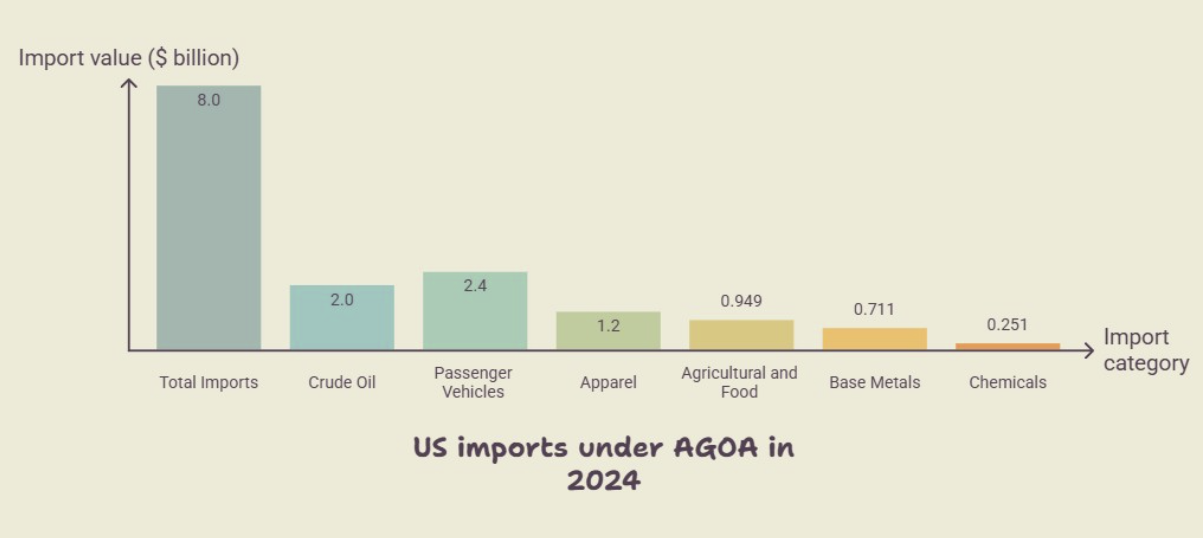
Non-energy imports included passenger vehicles ($2.4 billion), apparel ($1.2 billion), agricultural and food products ($949 million), base metals ($711 million), and chemicals ($251 million).
Countries such as Kenya, Lesotho, and Mauritius have benefited from increased apparel exports, which created jobs and helped integrate their economies into global supply chains.
Kenya has been very successful with AGOA. Its clothing industry has grown a lot because of duty-free access to the US market. Around 90% of its apparel products to the US are duty-free. As of 2024, the textile and apparel industry employed approximately 80,000 people directly and 250,000 indirectly, with 70% of them being women. As of last year, the sector contributed about 2% to Kenya’s GDP.
Lesotho’s apparel sector has also benefited substantially from AGOA. The country’s garment exports to the US increased dramatically after AGOA’s enactment, with the textile industry becoming the largest employer, accounting for about 36% of formal employment.
Brands such as Levi Strauss & Co. and PVH Corp. have sourced garments from Kenyan factories while H&M and Woolworths have sourced clothing from Lesotho, attracted by AGOA’s preferential tariffs.
Mauritius leveraged AGOA to diversify its economy beyond sugar production, specifically by building a strong textile and apparel sector. Exports under AGOA increased steadily, with CMT (Cut, Make, Trim) factories supplying US retailers. Mauritius serves as a model for small island economies, showcasing how preferential trade access under AGOA can help build manufacturing industries and create jobs, especially for women.
Despite these successes, AGOA’s benefits have been uneven across Africa. Countries such as Nigeria and South Africa, with large economies and diverse industries, have not fully capitalised on AGOA preferences, partly due to eligibility restrictions and supply chain challenges.
For instance, Nigeria, Africa’s largest economy, has struggled to expand its non-oil exports under AGOA. In 2024, Nigeria’s total exports to the US amounted to approximately $3.8 billion, with mineral fuels and oils constituting the vast majority of this figure. However, beyond crude oil and mineral fuels, Nigeria’s exports include smaller volumes of fertilisers, lead products, raw cocoa and cocoa preparations, plastics, and rubber. However, these non-energy exports remain marginal compared to the dominance of the energy sector in Nigeria’s trade with the US.
South Africa is also excluded from third-country fabric provision under AGOA due to higher economic development. The same is the case for Ethiopia, as the country cannot benefit the textile industry under AGOA.
When asked about any policy adjustments to ensure AGOA supports industrialisation and diversification beyond commodity exports, Dr Tedd George, Founder & Chief Narrative Officer of Kleos Advisory Limited, said, “There is a huge opportunity to expand AGOA’s remit beyond commodities, textiles, and apparel to include a wider range of value-addition industries in Africa.”
However, he noted that “the Trump administration looks in no mood to see other countries build up industrial capacity at the expense of US manufacturers, so it’s hard to see any meaningful reform until there is a change in the US government.”
The third-country fabric rule: A boon and a curse
Apparel products under AGOA receive special attention due to their high US tariffs and the sector’s potential for job creation in developing countries.
The third-country fabric provision allows least-developed AGOA countries to export apparel made with fabrics sourced outside AGOA countries (Kenya using Chinese fabrics) duty-free, enhancing competitiveness.
This provision has been critical in supporting apparel exports from countries such as Kenya and Lesotho, enabling them to access the US market despite limited local fabric production.
However, this same provision is also one of the biggest hurdles for African textile producers. The third-country fabric rule requires that garments exported to the US under AGOA be made from fabric sourced either in the US or eligible African countries.
The intention was to encourage local fabric production and regional integration.
In reality, this rule has limited African manufacturers’ ability to compete. The global textile supply chain is dominated by Asian producers who can offer fabrics at lower costs and higher volumes.
African producers often cannot access affordable fabric that meets the rule’s criteria, raising their production costs and reducing competitiveness.
The US must recognise Africa as a partner rather than a third-world economy
AGOA was designed in a different era. Congress established AGOA in 2000 and has extended and modified it multiple times. The latest reauthorisation came through the Consolidated Appropriations Act, 2026 (P.L. 119-75), extending AGOA through December 2026 and retroactively covering duty-free benefits from September 2025.
As AGOA’s authorisation extends only through 2026, its long-term future remains uncertain. Additionally, AGOA-eligible imports are not exempt from US tariffs imposed in 2025, which include 10%-30% “reciprocal” tariffs on most African goods.
Today, Africa’s economy is changing. For example, the African Continental Free Trade Area (AfCFTA), launched in 2021, now unites 54 African countries into a single market of over 1.3 billion people with a combined GDP exceeding $3.4 trillion. AfCFTA aims to boost intra-African trade and strengthen the continent’s negotiating power globally.
Additionally, other economies are also expanding into Africa. For instance, at the dawn of the 21st century, the US dominated trade with Africa, with its trade volume more than three times that of China’s. In 2000, two-way trade between the US and Africa stood at $39 billion, while China’s trade with the continent was $11 billion. In 25 years, this dynamic reversed dramatically.
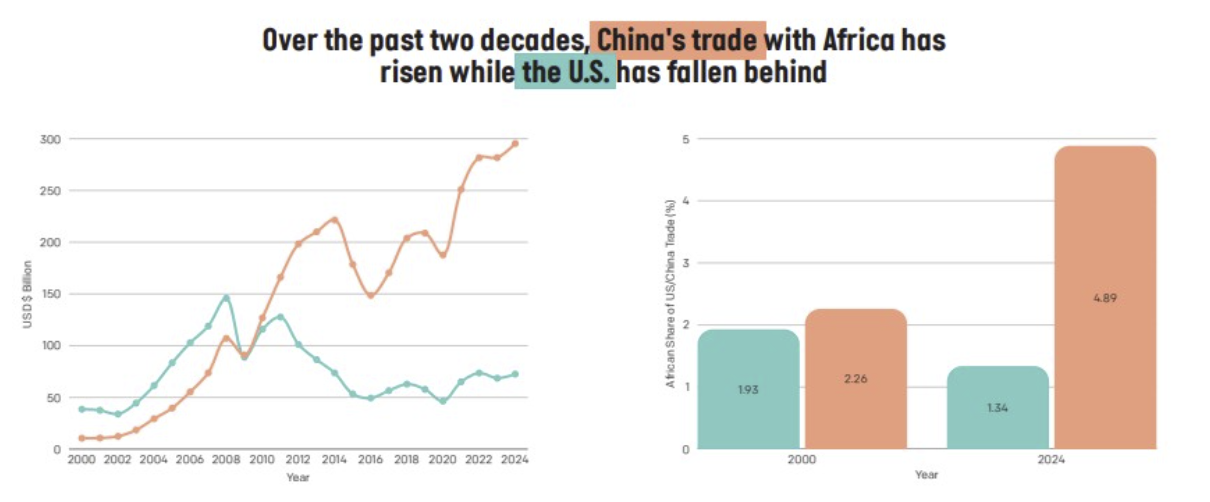
Africa has become a more significant trading partner for China than for other major economies. Between 2000 and 2024, Africa’s share of China’s total global trade more than doubled, from 2.3% to 4.9%. In contrast, Africa’s share of total US trade declined from 1.9% to 1.3% during the same period.
In 2024, US-Africa trade had grown by 88% to $73 billion, but China’s trade surged nearly 25-fold to reach $295 billion.
There is also the case of tariffs. The US imposes 10–15% tariffs on many African countries, while China announced a zero-tariff policy for all African countries, excluding Eswatini in 2024.
China’s investments in infrastructure, manufacturing, and resource extraction through initiatives such as the Belt and Road Initiative have deepened its influence across the continent.
Other global powers, including the European Union, India, and Turkey, have also increased their engagement with Africa, intensifying competition for economic partnerships.
AGOA alone cannot address these shifts. African countries are pushing for more reciprocal trade agreements that offer predictable, comprehensive market access and support industrialisation.
For the US to maintain relevance and build a meaningful partnership, it must adapt its trade strategy.
This includes considering reciprocal agreements, aligning with Africa’s regional integration goals, and supporting industrial policies that enable African countries to move beyond raw commodity exports toward higher value-added manufacturing and services.
Without such adjustments, the US risks losing influence in a continent set for significant economic growth and global strategic importance.
If the programme is not extended beyond this year, many businesses in Africa dependent on US market access would encounter suddenly increased costs, disrupting mutually beneficial trade ties.
This would lead to higher prices for American consumers and businesses, and job losses for African workers, especially women in textiles and agriculture. Also, the US would lose a vital, cost-effective means to strengthen economic ties with Africa.
It would also send a signal to the world how the US is unreliable as a trade partner, which is already quite the norm since 2025’s counter-tariff saga.
There are several considerations that the US can take into account for the extension.
Modifying AGOA. Legislative proposals seek to amend eligibility criteria, review processes, and graduation requirements to better reflect current realities.
Trade negotiations. There is potential for Congress to direct the Administration to pursue reciprocal trade negotiations or other initiatives with African countries.
Supply chain resiliency. With the US aiming to strengthen supply chains in strategic sectors including critical minerals, Congress may explore how AGOA can support Africa’s integration into global value chains.
The future of US-Africa trade
Reforming AGOA is going to be a give-and-take challenge. The US needs to address domestic labour and environmental concerns while pursuing strategic goals in Africa. African nations seek guarantees that new agreements will promote industrial growth without heavy restrictions.
AGOA has been a valuable tool for US-Africa trade, but it is no longer enough on its own. To remain effective, it must evolve to meet today’s realities and Africa’s ambitions.
Relaxing restrictive rules, broadening participation, and embracing reciprocal partnerships can unlock new opportunities.
(Note: In mid-August, AGOA received the US Senate approval for a three-year extension to 31 December 2028.)