On 26th November 2025, S&P Global Ratings downgraded Tether’s stablecoin USDT to a “5 (weak)” rating, the lowest possible, from the previous “4 (constrained)” rating. This change reflects Tether’s increased investment in risky assets and ongoing issues with transparency and disclosure.
Even though USDT is the longest-standing and largest stablecoin by volume, this downgrade raises concerns about Tether’s ability to keep its value equal to the U.S. dollar.
Reasons behind the downgrade
S&P’s assessment highlights a rise in Tether’s holdings of riskier assets over the past year.
Bitcoin now makes up about 5.6% of the total USDT in circulation, which is higher than the 3.9% overcollateralisation margin. This means that the reserve might not be able to fully protect against a drop in Bitcoin’s value. If several high-risk assets lose value at the same time, there is a greater risk of undercollateralisation.
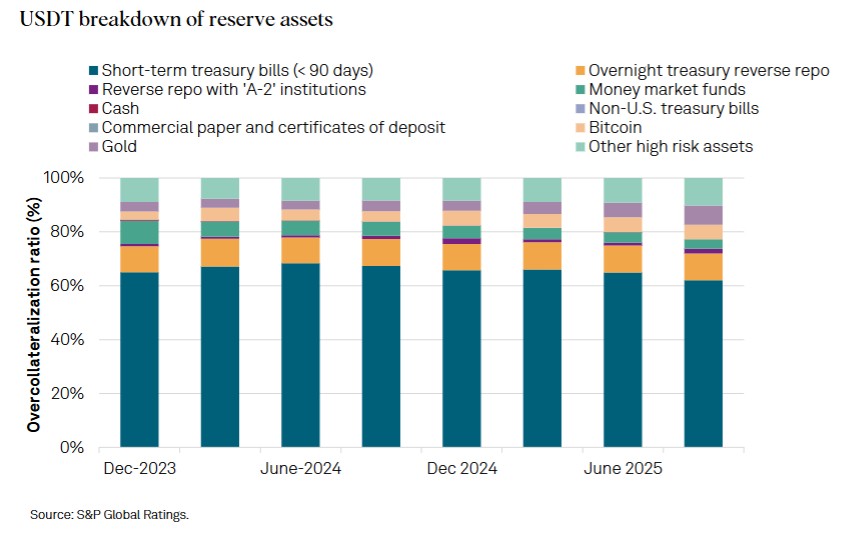
Other investments include gold, secured loans, corporate bonds, and more, all of which come with credit, market, interest-rate, and foreign-exchange risks.
According to S&P, approximately 60% of Tether’s reserves are held in cash and cash equivalents, with U.S. Treasury bills comprising a significant portion, which offers some stability. However, the remaining 40% includes the higher-risk assets.
Disclosure gap is another concern
The rating agency also pointed to persistent limitations in Tether’s disclosure practices, particularly regarding the creditworthiness of custodians, counterparties, and bank account providers. Additionally, there are four main concerns, including i) limited transparency on reserve management and risk appetite ii) lack of asset segregation to protect against issuer insolvency iii) absence of a robust regulatory framework iv) limitations in USDT’s primary redeemability.
Despite these concerns, S&P acknowledged that Tether has maintained a “notable level of price stability” even amid volatile crypto market conditions. However, the downgrade focuses on the risk profile and lack of transparency regarding Tether’s reserve assets.
Tether disagrees with S&P’s assessment, claiming the agency is using an outdated framework that fails to capture the essence of digital money.
The company emphasised its resilience, transparency, and global utility. It stated that it has processed billions in redemptions while staying stable during market fluctuations.
Tether also highlighted its systemic importance in emerging markets, where USDT functions as a form of money, underscoring its critical role beyond traditional cryptocurrency use cases.
What are the implications for the stablecoin market
Tether is the leading stablecoin, with about $184 billion in circulation. The downgrade shows the difficulties stablecoins face in managing reserves while also ensuring transparency and managing risk.
Tether’s increasing allocation to higher-risk assets may be an attempt to optimise returns but introduces greater volatility and credit risk. This raises concerns for investor confidence, regulatory scrutiny, and potential market volatility. It may also push competitors to enhance their transparency and risk measures to stand out in a competitive market.