
Exporter compliance programmes rely on rules of origin to determine eligibility for preferential tariffs, enforce trade remedies, and support defensible customs declarations across jurisdictions.
Rules of origin (ROO), as defined by the WCO’s Annex K of the Revised Kyoto Convention are: ‘the specific provisions’ which are set by countries to determine the origin of traded goods (in other words, their economic nationality) and are an integral element of free trade agreements (FTAs). Alongside Harmonised System, customs valuation, and Incoterms®, they are fundamental to trade and customs compliance.
There are two types of rules of origin. The first (the ‘non-preferential’) is mainly used for trade statistics purposes but also for origin labelling, anti-dumping/countervailing, and sanctions measures (if the country applies the WTO rules).
The second type is ‘preferential’ rules of origin, which are used for free trade agreement purposes. If managed and applied correctly, they offer monetary savings to importers by reducing or eliminating duties. While rules of origin promote international trade and attract investment (WCO Rules of Origin—Handbook), their complexity often leads to misinterpretation by businesses seeking duty savings.
The legal wording can be difficult to navigate, and products must meet specific origin criteria to qualify as ‘originating’ and benefit from preferential treatment.
Leaving products’ preferential origin calculations aside, businesses must also meet regulatory requirements and be able to present the ‘proof of origin’ defined by the FTA text to ensure the legal application of duty mitigation under preferential ROO.
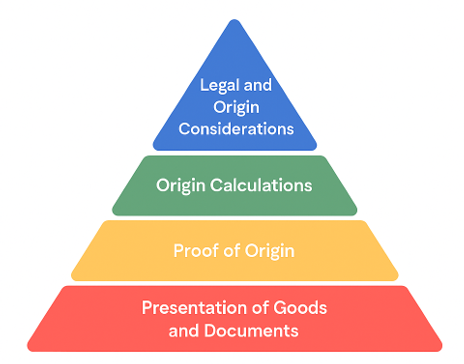
This and the ensuing pages will identify and address the regulatory and operational challenges faced by traders, and offer practical recommendations on how to navigate the ROO complexities. They will cover legal and origin determination considerations, origin calculations, proof of origin, and the presentation of goods and documents.
For deeper insight into rules of origin, preferential trade compliance, and exporter obligations across global markets, explore the full Exporters Guide here