Structural barriers to women entrepreneurs and women-owned enterprises accessing trade finance (TF) and supply chain finance (SCF) is a main contributor to the fact that women-led businesses account for only 15% of exporting businesses globally.
The financing gap for formal women-owned small and medium-sized enterprises (SMEs) stands at $1.9 trillion – effectively 76% of the estimated $2.5 trillion global trade finance gap.
In its 2024 report, “Banking on Women Who Trade Across Borders”, the International Finance Corporation (IFC) identified three main obstacles that prevent women from accessing bank finance in emerging markets: collateral requirements, which are disproportionate for short-tenor trade finance; high interest rates and fees due to gender-based biases; and limited access to information, products, markets and platforms.
The structural gap carries an significant economic cost, said Nathalie Louat, Global Director, Trade and Supply Chain Finance, IFC, speaking at the Women in Trade and Supply Chain Finance Network Roundtable in Lisbon on 24 March.
“Women-led SMEs employ their family members, they anchor local supply chains, and when they are properly financed, they can grow and create jobs for other women and the entire community,” said Louat. “The distance between what women contribute and what they receive from the formal financial system is one of the most consequential misallocations in development finance today – this has compelled us to do something.”
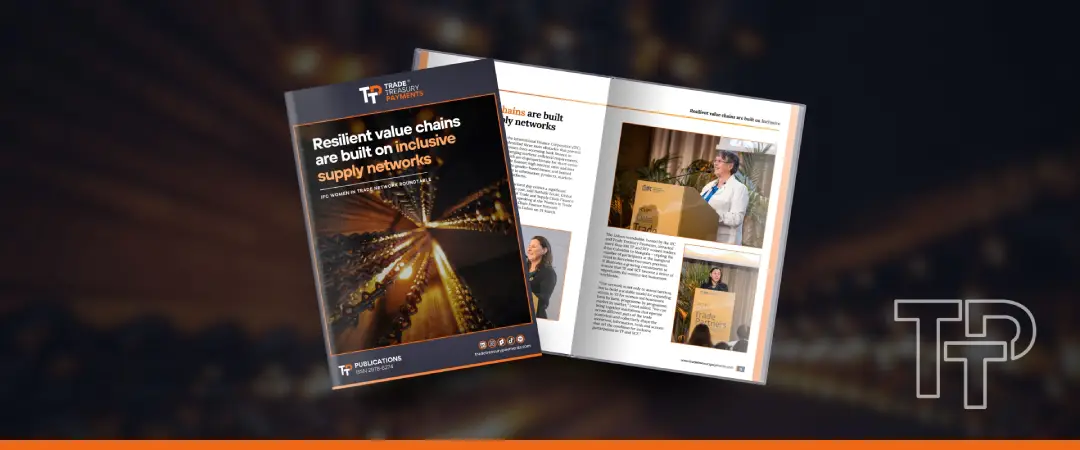
The Lisbon roundtable, hosted by IFC and Trade Treasury Payments, attracted more than 100 TF and SCF women leaders from Colombia to Mongolia – tripling the number of participants at the inaugural event in Barcelona two years previous. It illustrates a growing commitment to ensure that TF and SCF become a driver of opportunity for women-led businesses worldwide.
“Our network is not only to assess barriers, but to build a scalable model for expanding access to TF for women-led businesses, bank by bank, programme by programme, market by market,” Louat added. “We can bring together institutions that operate across different parts of the trade ecosystem and collectively shape the incentives, information, tools and actions that set the condition for inclusive participation in TF and SCF.”
Increasing funding for women entrepreneurs
Accessing the finance that SMEs need to achieve their full potential is far harder for women-led businesses and entrepreneurs than it is for men, stressed Dorothy Tembo, Deputy Executive Director at the International Trade Centre (ITC), in her keynote address.
Two years ago, ITC and the World Trade Organization Secretariat launched the Women Exporters in the Digital Economy Fund (WEIDE), in response to a growing demand from women entrepreneurs to make the digital transition. The digital shift experienced during the Covid-19 pandemic could potentially help women overcome some physical obstacles to trade, such as travelling long distances to market, and progressively expand their business, generate more income and provide for their family, communities and beyond.
“We realised that if we didn’t act to address the barriers that women face in accessing finance to adopt digital technologies and tools, then women-led businesses would miss out on one of the greatest technological revolutions in human history,” said Tembo.
WEIDE’s investors include the governments of the United Arab Emirates and Bahrain, as well as the FIFA World Cup Qatar 2022 Legacy Fund. Business support organisations in the Dominican Republic, Jordan, Mongolia and Nigeria are piloting the fund’s implementation. WEIDE is getting ready to disperse an initial amount of $1.7 million in grants to women-led businesses in these countries.
In addition to grants, the ITC provides women entrepreneurs with market intelligence, supports them with regulatory compliance and sustainability standards. Its capacity building includes working with them to increase productivity, quality and volumes, as well as packaging and digital marketing.
“We also take care of the next step by facilitating their presence at international trade fairs and direct business-to-business meetings, mentoring and advising them. Grants, skills and networking opportunities must all be a part of the package if women-led SMEs are going to be finance and investor ready,” said Tembo.
She believes that it’s time to scale the ITC’s partnerships with regional development banks and commercial banks. The ITC is increasing its global network of gender smart investors.
“Today, we have a strong pipeline of women-led businesses across economic sectors and regions that are export ready, have built linkages to new markets and have bankable projects. They export agricultural commodities, food products, beauty products, software and IT solutions, tourism services, fashion products, home decor and many more other areas,” said Tembo.
She highlighted women’s creativity and innovation, their commitment to employing more women and persons with disabilities, opening supply chain opportunities to thousands of producers, and staying ahead of sustainability challenges – all this while raising children and supporting their communities.
“They have the skills and no shortage of ideas on how to scale or innovate. We have the networks, the experts and the partnerships to help them make the most of future financing opportunities. What we need is to now work with financial institutions like yourselves to bring these efforts over the finish line and ensure that these women-led firms can access financing that can transform entire societies,” she added.
Legal barriers to success
But it’s not just access to finance that prevents women entrepreneurs and women-led businesses from being successful. It is the operating environment in each country, which includes institutions, laws and how the laws are implemented.
Montserrat Ganuza, Senior Operations Officer, Financial Services Sector, IFC, presented results from the 11th edition of the World Bank’s Women, Business and the Law report, which tracks the progress of women’s economic participation and rights in 190 countries on an annual basis.
The 2026 report expanded its scope beyond measuring laws (de jure) to present a framework built on three pillars: legal frameworks, supportive frameworks, and enforcement perceptions (de facto).
According to the report: “Less than 5% of women worldwide live in economies that provide anything close to full legal equality, and not a single economy has secured all
legal rights needed for women’s full economic participation.”
On average, economies score 67 out of 100 on the report’s index measuring laws that support women’s economic equality. But when it comes to enforcing these laws, the average index score is 53. And when the systems or institutions needed to implement those rights are assessed for adequacy, the average index score is just 47.
Ganuza focused on two sets of indicators. First, the number of economies that have equal rights when opening and operating a business. “While 99 out of 190 countries have an explicit clause in the law that prohibits discrimination in access to credit by gender, not even half of them have full implementation,” she highlighted.
The second indicator is how many countries have a clause embedding gender-responsive procurement processes in law. Only 53 of the 190 countries have such a clause, yet many haven’t fully implemented the law.
“This data is important because it shows us which countries need further reform and for greater coordination with the colleagues in the public sector, as well as which countries are ready for financial innovation. It also explains why the pipelines of women-led businesses are so thin. It shows that even when the law is in place, weak supporting frameworks persist,” said Ganuza. “On the positive side, it is going to help us to connect the dots between financial institutions with supply chain finance and policy reforms, so that together we can move the women from the margins to compete in the global markets.”
Stronger together
Commercial banks have an important role to play in better identifying and championing women entrepreneurs and women-led SMEs, as well as redesigning risk and finance models to dismantle structural barriers and expand access to working capital that enables opportunity. In a fireside chat, Natasha Condon, Global Head of Trade Sales at J.P. Morgan, and Professor Neema Mori, Board Chairperson, CRDB Bank in Tanzania, discussed major shifts in global supply chains affecting women-led suppliers, metrics for success and the importance of collaboration.
Mori highlighted the impact of geopolitical developments, technology, sustainability requirements, and buyers’ behaviour, which all require greater support for women-led businesses. CRDB Bank’s 2023-2027 strategy is focused on assisting and supporting women-owned businesses to grow. To measure its success, the bank is tracking metrics such as loans, grants through its social investment foundation, and deposits.
“We are developing specific products for women with special rates because they can use their deposits as collateral,” said Mori. “We’re also measuring the number of women-owned businesses that we are helping build capacity. We know finance is key, but it’s not the only need for the women-owned enterprises.”
Condon also picked up on technology change, confident that emerging solutions – such as legal entity identifier (LEI) initiative – will help solve the data asymmetry that SMEs face when trying to access financing. “It’s much harder for small businesses to provide required know-your-customer information, as they don’t have investor relations, a legal team, etc. Plus, they need sufficient cross-border knowledge, such as sustainability requirements, when they look to export,” she explained.
Greater collaboration among global and regional banks will help to improve access to finance. “As a large global bank, J.P. Morgan can’t work with SMEs in every market, but we can create the global network and share technology solutions that allows us to work together with another bank to support those businesses. And the more we work together, the less of a headache for that individual company to deal with all these different providers,” said Condon.
Multilateral development banks (MDBs) also have a role to play in collaboration and diversification, according to Condon. “It’s difficult for a woman-owned business in Tanzania to provide a global bank with enough information to make it comfortable lending to her. However, 1000 women-led SMEs with a 50% guarantee from the IFC, for example, is an investable proposition. It gives me assurance when the IFC, Asian Development Bank or other MDBs are involved,” she said.
Mori agreed that collaboration between commercial banks and MDBs is a critical component. In addition, CRDB Bank has established partnerships with mobile network operators (MNOs) and digital network operators (DNOs), which have extensive penetration across Africa, as well as non-governmental organisations who are focused on supporting women.
Practical suggestions
The audience joined small roundtables to brainstorm, share best practice and experiences, and discuss suggestions for further work together across the Women in Trade and Supply Chain Finance Network.
Many agreed that blended finance, where public capital is used to de-risk and attract private investment, could help dismantle several systemic barriers that women face when trying to access funding. “Increasing collaboration between private, public and philanthropic funds could allow to mitigate the perceived risk of women-led businesses, because it’s more a perception of higher risk than a real higher risk from these businesses,” said one participant.
Another highlighted the need to develop data standards that can help prove woman-led businesses are statistically more secure than man-led businesses. She suggested creating a trade repository for women-led businesses to start aggregating data.
An attendee from Ukraine talked about the difficulties of operating in a war zone, where many women have become business owners not by choice but by circumstance. “Many businesses were run by men who are either dead or fighting on the front lines. Women found themselves in a situation where they came into business where they had no desire, ambition or strength to do it, but they have to do it in time of war. But at the same time, women’s social role hasn’t changed,” she explained. “In this situation, it’s not the lack of collateral, but a lack of understanding how to run a business in such volatile times. It’s supporting women’s transition into that role and supporting their ambition to make it successful.”
Another share best practice around working with the national chamber of commerce to label women-owned businesses, to raise their profile in the market and attract investment. Her institution also introduced a specific business loan for women, which is 10% lower than the standard business interest rate. This increased the portfolio of business loans to woman by 16% year on year. The bank tracked the non-performing loan ratio of women-run businesses compared to the average business loan, which was 1.1% versus 2.5%.
Call to action
Claudia Conceicao, Regional Director, IFC, concluded the event with a rallying call to participants to design products that work for women, embedding inclusion into how finance is structured, delivered and scaled.
“Everyone here has influence, within banks, institutions and markets, that shapes our capital flows. With that influence, we can champion solutions that work across the entire supply chain, push for transparent pricing and accessible platforms, challenge outdated assumptions about creditworthiness, and open doors for suppliers who have been overlooked, not because of lack of ability, but because of lack of opportunity,” she said.
“We don’t just navigate the system. We shape it through the decisions we make, the risks we approve and the opportunities we choose to unlock. Because when our capital reaches women entrepreneurs, our markets become stronger, our systems more complete and our impact truly scalable.”
LINKS
https://www.adb.org/publications/adb-global-trade-finance-gap-survey
https://www.ifc.org/en/insights-reports/2024/banking-on-women-who-trade-across-borders