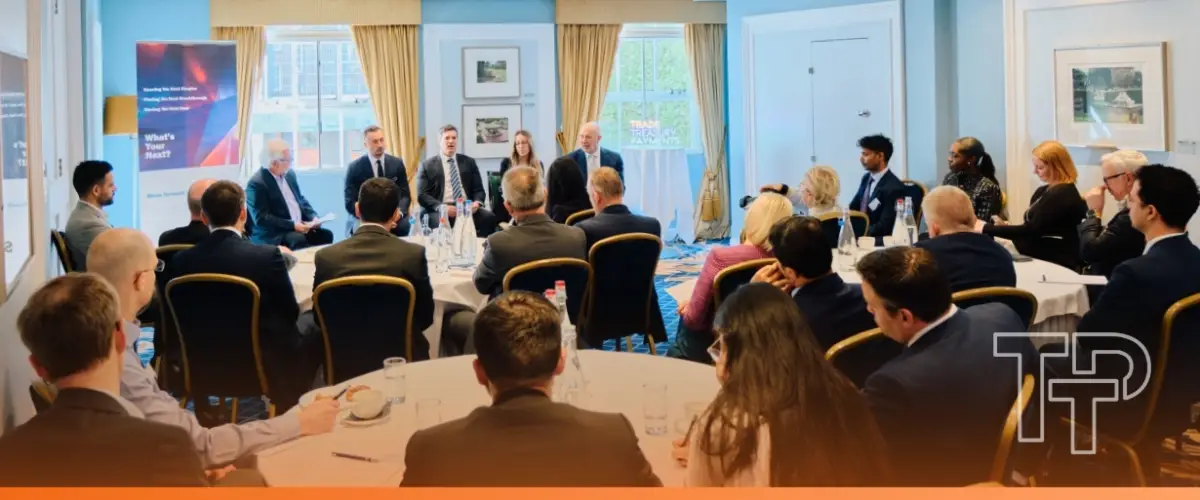

Trade finance fraud cannot be entirely eliminated (at least not yet), but it can be made harder to execute, easier to detect and less damaging when controls fail. At a recent TTP Breakfast Club session, experts argued that the major challenge is not a lack of fraud-busting tools, but whether the industry can take coordinated action before fraud risk further constrains liquidity.
| Moderator: Geoffrey Wynne, Partner, Sullivan Panellists: – Robert Parson, Partner, Sullivan– Neil Shonhard, CEO, MonetaGo– David Cuckney, Director, ICC Commercial Crime Services– Antia Martinez, Associate Director, Working Capital Solutions Europe, WTW |
It would be easy to leave a fraud-focused discussion with the impression that trade finance is a high-risk minefield. In reality, the overwhelming majority of transactions are properly documented, properly performed, and fraud-free. Frauds make headlines precisely because they are exceptional – and because, when they do surface, they tend to involve very large sums of money.
That distinction between impression and reality matters. Treating every transaction as inherently suspect would make compliance expensive, obstructive, and ultimately self-defeating. Yet the opposite risk is just as real. Become too comfortable with familiar clients, familiar documents, and familiar routes, and the same old frauds find new ways through.
The challenge, then, is to stay alert without becoming paralysed – to maintain, as one panellist put it, “zero tolerance to fraud” while accepting that some fraud risk is unavoidable if trade finance is to function at all.
Fraud is suppressing SME lending
Arguably the strongest reframing of the morning came from Neil Shonhard, CEO of MonetaGo, who moved the discussion beyond loss prevention and into the economics of SME finance. Fraud is not merely an operational nuisance for lenders, he stressed, but one of the forces shaping how much working capital reaches smaller businesses in the first place.
Take the UK, for instance, where trade finance fraud is a much greater issue than in France (see table). Big five bank lending to UK SMEs fell by 18% in 2023 – from £29.6bn to £24.3bn – with risk aversion cited as the primary driver. Measured against GDP, the UK’s SME loan book stands significantly smaller than its European counterparts. “At the very least,” Shonhard said, “fraud is contributing to a larger structural problem for SME finance in the UK.”
India provided a useful point of comparison here. Shonhard highlighted a centralised, state-governed registry that enables comparison of risk analytics across the lending ecosystem, making duplicate financing and invoice re-ageing far harder to conceal. Around 30 countries, he noted, are implementing variations of the same model.
Since January 2023, India has seen a 319% increase in MSME funding because sub-1% fraud risk makes small-business lending genuinely attractive. “There are banks in this room right now lending to small businesses in India,” he said, “because there’s less than 1% fraud and it’s a good return.” By contrast, he added, less capital is flowing into equivalent UK opportunities because fraud levels are materially higher.
E-invoicing may help the UK move in the right direction, said Shonhard. But it is not the same as a comprehensive registry. A one-time tax declaration does not prove whether a receivable has already been financed, or who holds security interest in it. It is a necessary condition, not a sufficient one.
Old frauds, new disguises
David Cuckney, Director of the ICC Commercial Crime Services, was direct on the central question. Can we beat the fraudsters? No – not definitively, not permanently. “Money is such a powerful incentive. Where there’s money, there’s always going to be fraud.” But he was also clear that this is not the end of the story. Fraud can be made harder, and that starts with understanding what has changed in recent years.
The core mechanics remain familiar, he said. Namely fake documents, multiple financing, misappropriation, impersonation, inflated receivables. What changes is the presentation. Fraud is better dressed, more coordinated, and increasingly supported by collusion between parties that should, in theory, be independent.
Cuckney offered a revealing example: a central bank representative who was confident a shipment had taken place because a vessel-tracking website showed the ship had moved from A to B. But modern fraud is rarely that crude. The question is no longer simply whether a vessel moved. It is whether the documentation, counterparties, and supply chain relationships make sense as a whole – in other words, moving beyond KYC into what many now describe as KYCC, or knowing your customer’s customer.
“The frauds now are far more nuanced,” he said. “It is not about just making sure a vessel has gone where it is meant to. It is about the documentation – within supply chain finance, is your client, or their client, actually playing a legitimate role?”
Here, his practical advice was to review client portfolios and internal risk frameworks regularly, use layered compliance rather than relying on a single tool, and make sure everyone understands their role in the process. After all, a control only works if someone waits for the result, reads it, and acts on it.
Know your fraudster
Meanwhile, Robert Parson, Partner at Sullivan, brought the discussion back to a human truth that can be uncomfortable in relationship-led finance: fraud is often committed by people already inside the circle of trust. Recent cases may differ in detail – from false collateral and forged credit support to fabricated invoices and double-pledged assets – but they often share a common pattern. Many are not businesses created solely to defraud. They are businesses that were once legitimate, later came under pressure, and found fraud available as an exit route.
“The guy that defrauded you was probably the person you invited to dinner three weeks ago. You played golf with him on Wednesday and on Friday, he defrauded you. That is simply the way that fraud manifests itself.”
Taking this into consideration, he stressed that KYC cannot be a static onboarding exercise. It has to be an ongoing assessment of whether the person or entity being financed is still behaving like the business the lender originally agreed to support. For this, Parson has developed a shorthand: KYC is really KYF – know your fraudster.
Behavioural monitoring is where early signals often appear, such as changes in payment patterns, shifts in transaction rationale, unexpected urgency, altered routes, or financial explanations that no longer quite fit the market. Customer visits also remain an underrated tool. Parson recalled an earlier fraud involving a warehouse in East Africa that should have contained large quantities of coffee. Inspectors visited, saw bags with the right labels, and left satisfied. They were sent back the following day, and the bags bore a different set of bank labels. Fraud was detectable – but only because someone went twice.
Legal documentation matters for the same reason. Covenant triggers, representations, ongoing credit monitoring, and physical trade checks are not decorative boilerplate. Used properly, they are the mechanisms that surface early signs of deterioration.
Insurance has benefits, but also limits
Antia Martinez, Associate Director, Working Capital Solutions Europe at WTW, then introduced the question, ‘what happens when everything else fails’? “For banks, fraud is a balance sheet risk. When controls fail and fraud is identified, the loss is already there.”
Traditional trade credit insurance does not typically cover fraud, she explained. Standard policy wording usually excludes any receivable arising from a fraudulent set-up, regardless of which party initiated it. Banks can negotiate some flexibility – an exception where they had no knowledge of or involvement in the fraud – but most traditional credit insurers do not readily grant it.
As such, the product gaining notable traction among European banks, according to Martinez, is seller cover. This is insurance not on the receivable itself, but on the seller’s behaviour under the financing agreement. Rather than asking whether the buyer has paid, the question becomes whether the seller has honoured its obligations. That scope can extend to cover disputes, commingling risk, ineligible receivables, and – critically – both seller fraud and debtor fraud, including the recourse provisions in limited-recourse structures. Although the product has been used in the US market for several years, it is now moving firmly into European practice.
Despite its growing popularity, the caveats are real, she cautioned. Seller cover is not a blank cheque. And if the bank knew about the fraud, there is no claim. What’s more, if the bank has waived its rights, there is no claim. And if the obligation was not legally enforceable, again, there is no claim. Governance still matters – but the risk can be transferred, which means the ultimate loss need not sit on the bank’s balance sheet. As Martinez put it: “Fraud will continue to evolve and controls will continue to fail. The real question is who bears the loss when it happens.”
AI is adding to the arms race
Elsewhere, the arrival of AI into the fraud conversation brought the panel into territory where certainty is even harder to sustain. Cuckney was clear that AI has not created new fraud types per se – the mechanics remain the same – but it has lowered the cost and raised the quality and sophistication of fraudulent documentation, impersonation, and coordination.
Acceleration of collusion risk is the biggest challenge, in Cuckney’s view. Logistics providers who should be independent of financial transactions are being leant on, influenced, or in some cases owned outright by fraudsters, making verification of bills of lading increasingly unreliable. “If you’ve got two parties where the intention to default is there from the outset, it becomes quite challenging to stop.”
Sharing a cautionary tale, Shonhard pointed to Singapore (a jurisdiction with advanced digital infrastructure and a strong reputation for institutional integrity), where AI-generated phone calls and voice impersonation are contributing to significant scam losses. The sophistication of the defender does not automatically outpace the sophistication of the attacker. Many of the successful frauds in that market exploited not technical gaps but human susceptibility – a reminder that the threat model is not purely technological.
Martinez took things a step further and framed AI as “an arms race”. Insurers are investing in AI to detect fraud patterns that humans would miss. Fraudsters are using AI to generate false data that humans would struggle to detect. “Let’s see who wins,” she quipped. Meanwhile, Parson added a crucial qualification that technology is a constant race, and fraudsters will find their way around any algorithmic defence eventually. “Back to the drawing board, produce something that gets rid of that – and then back to the drawing board again.”
An information asymmetry issueSullivan
Closing the session, Geoff Wynne, Partner at Sullivan, returned to a theme that had run beneath the surface throughout, namely that the ‘success’ of fraud compounds itself through secrecy. Banks that have priced fraud into their margins may have limited incentive to disclose losses publicly. Confidentiality obligations and GDPR create genuine barriers to data sharing. As a result, fraudsters often operate with the informational advantage. They share intelligence, while their targets often do not.
“If we could share data more easily, we could more quickly and easily stop the fraudsters. They play upon the secrecy,” Wynne noted. Cuckney agreed, confirming that fraudsters absolutely share information. They even identify the financial institutions that do not ask the right questions and target them accordingly!
Interestingly, that asymmetry could be the industry’s most difficult problem in the fight against fraud. Technology, insurance, legal frameworks and human oversight all have roles to play. But without a better way to share what is known, each lender sees only a small part of the bigger picture. Major failures are rarely unknowable in advance. More often, the warning signs exist in fragments across different parts of the market. A system capable of joining those pieces together could significantly change the risk calculus.
Note: The panel discussion was on the record while audience Q&A was held under Chatham House rule. Speaker attributions above reflect on-the-record panel contributions only.