
Marsh and IFC: Enabling $4bn of additional insurance capacity
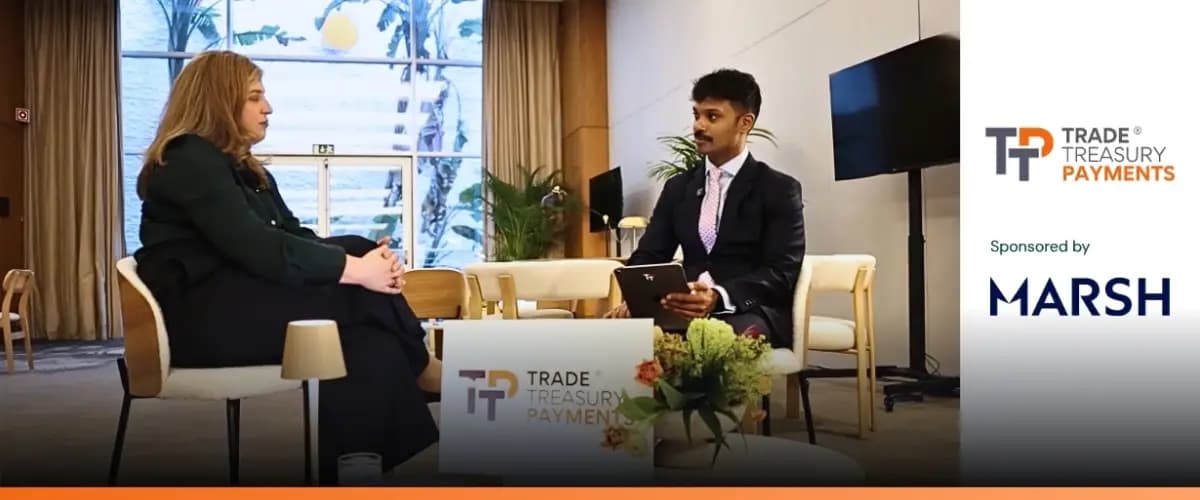
At the IFC Global Trade Partners Meeting in Lisbon, Trade Treasury Payments (TTP) spoke with Stephanie Pariot, Managing Director and Global Placement Leader for Credit Specialties at Marsh, to explore the role of credit risk insurance in supporting trade finance and mobilising capital.
Pariot said, “Credit risk insurance plays a surprisingly important role in the real economy. It frees up capital, it frees up the ability to trade, and credit risk insurance ultimately enables banks to lend more money to their clients.”
At its core, credit risk insurance allows financial institutions to transfer risk to insurers, enabling them to optimise balance sheets and extend additional financing. This has implications not only for banks, but also for multilateral development banks (MDBs) and development finance institutions (DFIs), which rely on similar mechanisms to scale their impact in emerging markets.
Innovation is also shaping how insurance is deployed. One example is Marsh’s FastTrack facility, which the company designed to streamline the placement process and expand available capacity without introducing additional complexity.
Pariot said, “FastTrack is a fast follow facility that Marsh developed in the past three years. It allows for up to 10% of additional capacity to be attached to any policy with a lead insurer. The policy attaches on the same terms as the lead insurer, so it leads to a faster placement.”
While credit risk insurance has historically been associated with relatively straightforward transactions, insurers are increasingly willing to support more complex and structured deals.
Pariot said, “One of the biggest misconceptions is that everything needs to be a plain, vanilla, single risk to be sent to the market. Insurers regularly work with Marsh and with clients to develop innovative solutions to meet their needs.”
This can be seen through changes in the market itself, where what began with commodity traders purchasing political risk insurance has gradually expanded to become much more sophisticated. Pariot said, “Banks worked with the insurance sector to develop a comprehensive non-payment insurance product to meet their needs in order to obtain capital relief and risk mitigation and to help them support their clients.”
Today, banks use credit risk insurance to mitigate risk and to manage regulatory capital and internal limits. By substituting the credit profile of a borrower with that of a highly rated insurer, institutions can free up capacity to support additional lending.
The role of private insurers is also becoming increasingly important in supporting development finance. Through its long-standing collaboration with the International Finance Corporation (IFC), Marsh has helped mobilise additional capacity into markets that might otherwise struggle to attract private capital.
Pariot said, “Private insurers have a big role to play in helping mobilise capital behind IFC that they wouldn’t normally do for frontier markets on their own.”
According to Marsh’s latest Political Risk Report, businesses are placing greater emphasis on geopolitical risk. “We’re in a world where there’s heightened regionalisation,” Pariot said, “where previously there was more of a focus on globalisation.”
Against this backdrop, credit risk insurance should be viewed as a mechanism for enabling trade to continue flowing in more complex and fragmented markets.
Key Topics
- The role of credit risk insurance in freeing capital and enabling lending
- Innovation in insurance placement, including Marsh’s FastTrack facility
- Growing insurer appetite for complex and structured transactions
- The contribution of private insurers to development finance
- Rising geopolitical risk and the shift towards regionalisation
Key Insights
Expert Analysis
Credit risk insurance is no longer a niche instrument but a central component of modern trade finance. Its ability to free capital, support regulatory objectives and extend lending capacity makes it indispensable for banks and development institutions alike. As Stephanie Pariot emphasised, “Private insurers have a big role to play in helping mobilise capital behind IFC that they wouldn’t normally do for frontier markets on their own.” In a world marked by regionalisation and heightened geopolitical risk, the strategic value of insurance backed risk transfer continues to grow.
Key Findings
- Credit risk insurance has become integral to balance sheet optimisation and regulatory capital management.
- Market innovation is enabling greater capacity without added complexity.
- Insurers are actively supporting structured and non vanilla transactions.
- Collaboration between Marsh, private insurers and IFC is mobilising capital into markets that traditionally attract limited private sector appetite.
- Regionalisation and geopolitical uncertainty are driving increased demand for risk mitigation tools.
Implications
- Banks can unlock additional lending capacity by substituting borrower credit profiles with those of highly rated insurers.
- MDBs and DFIs can scale their activities in emerging markets by leveraging private insurance capacity.
- Faster placement mechanisms such as FastTrack can improve execution speed and support more efficient capital deployment.
- The expanding scope of insurable structures allows institutions to manage risk across a wider range of transactions.
- Heightened geopolitical risk increases the strategic importance of credit risk insurance as a stabilising mechanism for global trade.
Key Takeaways
- Credit risk insurance is a critical enabler of trade and capital mobilisation.
- FastTrack demonstrates how innovation can expand capacity while simplifying placement.
- Insurers are increasingly supporting structured and complex transactions.
- Private sector capacity is essential for scaling development finance.
- Rising geopolitical risk reinforces the importance of insurance as a stabilising force in global trade.