
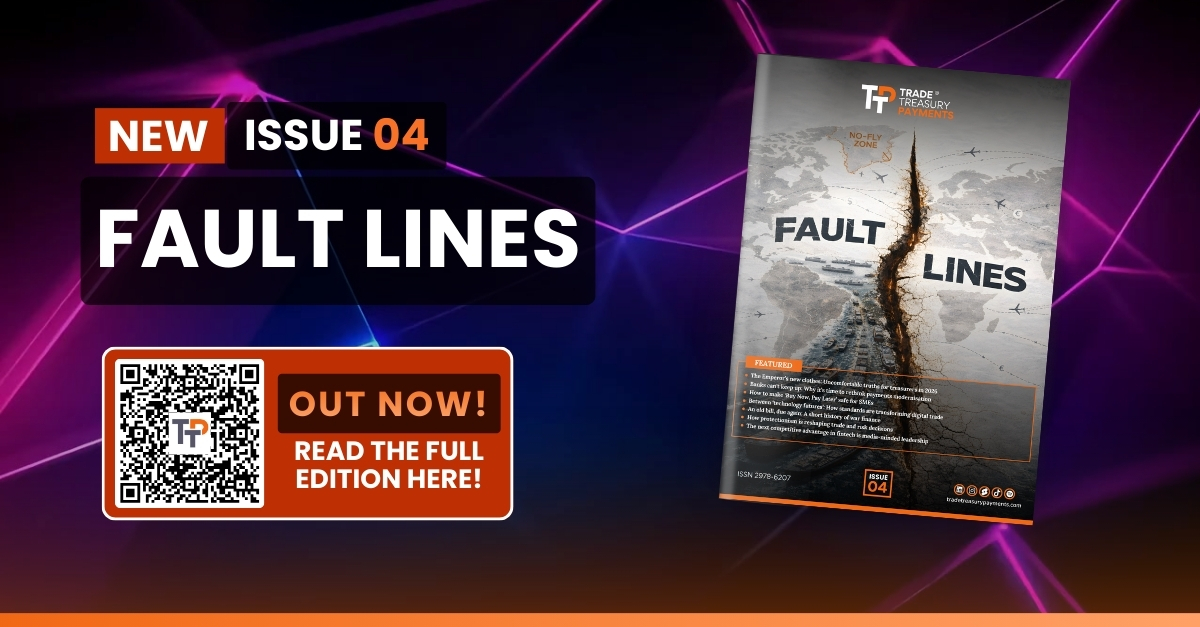
Trade Treasury Payments (TTP) launches Fault Lines, a new magazine edition analysing the pressures reshaping cross-border finance

Carter Hoffman
Deputy Editor, Trade Treasury Payments
Published 28 Jan 2026
Live Updates
Trade Treasury Payments (TTP) has released the latest edition of its flagship magazine, titled Fault Lines, a thematic deep dive into the underlying forces at play in global trade, treasury, and cross-border finance.
At a time when headlines are dominated by tariffs, conflicts, payment innovation, and supply chain disruption, the new issue argues that current events alone rarely explain what is really happening beneath the surface. And it tends to be those underlying conditions that tell the real story.
The edition takes its name from geology. Fault lines form where large forces meet and push against each other over time, creating pressure that can build for years before eventually shifting. Today’s trade and payments ecosystem looks much the same. Large forces continue to move simultaneously, shaped by different priorities and moving at different speeds. The shared boundaries where these forces meet comprise the fault lines of our industry.
For example, countries are trading more with each other than ever before, with businesses today relying on long supply chains that cross many borders. But at the same time, those borders seem to be becoming increasingly more prevalent, with more rules, checks, and tariffs lengthening the psychological distance between trading partners.
The same thing happens with the tools we use. Older systems are still deployed because they are stable and trusted, while newer tools promise faster payments, better data, and constant access. Since both old and new tools are used side by side, pressure builds where they connect and overlap.
It can be easy to think of fault lines as dangerous places because, for many of us, they only really enter our consciousness during the most extreme events. As a result, they become closely associated with moments of destruction and loss of control.
But those are the exception to the norm. Most of the time, fault lines are simply there. They are something to be aware of, certainly, but not something to fear in and of themselves. The pressure they hold does not cause harm on its own. What matters is noticing when that pressure starts to change, and understanding what those changes might be telling us.
“The most important changes in our industry rarely happen overnight,” said Deepesh Patel, Editor-in-Chief at Trade Treasury Payments. “They build gradually at the seams of the system. This edition is about helping practitioners recognise those pressure points early, rather than only reacting once disruption hits.”
This edition of the magazine aims to draw attention to the points in many different systems where the forces at play may be moving away from a stable state of coexistence, and towards something more dangerous. The earthquake-esque disruptions that we need time to prepare to defend against.
“We’re not trying to forecast the next rupture,” says Carter Hoffman, Trade and Technology Editor at TTP. “We’re inviting readers to think like seismologists by watching for the small shifts and stresses that may indicate larger changes to come.”
Designed for trade finance, treasury, and payments professionals, the edition combines policy insight, market intelligence, and practical perspectives from banks, fintechs, multilaterals, and corporates worldwide.
Fault Lines is available now as a free digital edition on the Trade Treasury Payments website here.