

Breaking news: Demand for trade finance set to increase amid supply chain shifts, ADB survey finds

Devanshee Dave
Reporter, Trade Treasury Payments
Published 15 Jan 2026
Live Updates
The global demand for trade finance is anticipated to grow as companies pursue market diversification, enhance intra-regional commerce, and restructure supply chains, according to findings from the latest Global Trade Finance Gap Survey published by the Asian Development Bank (ADB).
The 2025 Survey estimates the global trade finance gap at $2.5 trillion in 2025, unchanged from 2023. This gap is around 10% of global trade flows, a slight decline from 10.6% two years earlier. Despite this marginal improvement, the persistent gap continues to restrict firms’ access to essential financing, limiting their ability to capitalise on emerging trade opportunities and impeding inclusive economic growth.
“Trade is central to economic development and has helped to lift millions of people from poverty. Without sufficient trade finance, the global economy risks missing out on growth opportunities. We must redouble our efforts to close the trade financing gap to unlock the full potential of trade-driven economic development to transform lives in this region and beyond,” quoted Isabel Chatterton, Director General for Private Sector Operations at ADB.
ADB is a leading multilateral development bank dedicated to fostering inclusive, resilient, and sustainable growth in Asia and the Pacific.
The 9th edition of the survey, conducted in 2025, includes data and views from over 110 trade finance providers from 2023 to 2025. They account for about one-third of the global trade finance market. Here are key highlights from the survey.
1. Focus on SMEs
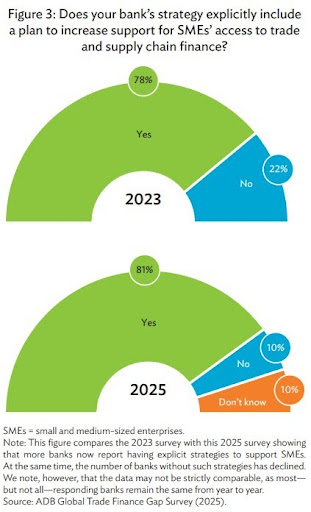
Small and medium-sized enterprises (SMEs) remain a critical focus area. 81% of banks have clear plans to support financing for SMEs.
Rejection rates for SME trade finance applications are now 41%, which is very close to the 40% rate for larger corporate clients.
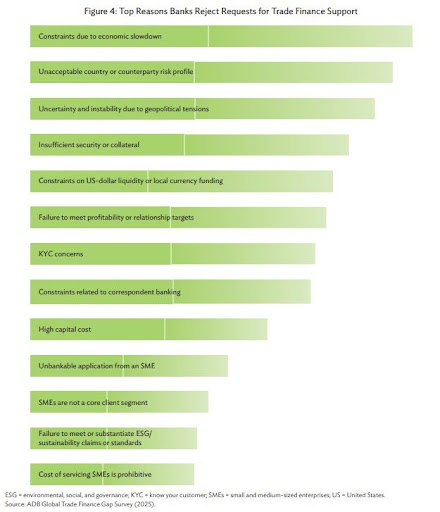
While this shows some progress, more research is required to understand issues such as discouraged demand and changing bank risk preferences.
2. ESG considerations persist
89% of banks continue to integrate ESG factors into trade finance decision-making, which was 70% in the last survey. However, capital outflows from ESG-focused funds have reduced the potential for these pools to significantly narrow the trade finance gap. ESG is a vital risk management tool and a driver for product innovation within the trade finance sector.
3. AI adoption accelerates
A survey shows that more than 85% of banks use artificial intelligence (AI) to prevent fraud and analyse risks. About 56% are looking into ways to use AI to increase their financing capacity.
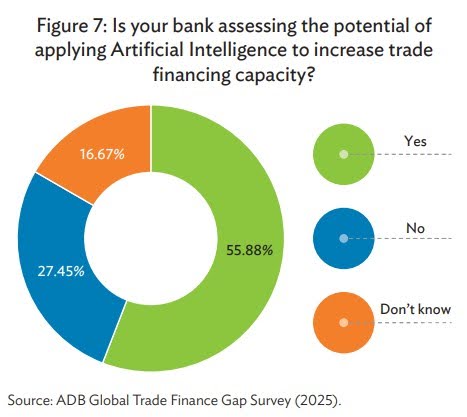
AI can help banks follow regulations, predict risks better, and lower operational costs, making it an important tool for closing gaps in trade finance.
4. Digitalisation as a strategic priority
Digital transformation of trade processes by 2030 is identified as a top priority. Transitioning from paper-based to electronic trade documentation is expected to reduce trade costs by 8%, increase global exports by nearly $900 billion (12.6%), and improve wages and producer prices.
In developing economies, trade costs could fall by up to 15%, while exports could rise by over 25%.
ADB’s Digital Standards Initiative, in partnership with the Government of Singapore and the International Chamber of Commerce (ICC), aims to facilitate interoperable electronic trade documents to enable seamless cross-border trade.
5. Innovations in supply chain finance
The survey states that supply chain finance innovations, especially those targeting lower-tier suppliers, are crucial to closing the trade finance gap.
Payables finance has grown by 8% globally year-on-year, with Africa and Europe experiencing growth rates of 14% and 12%, respectively. However, pre-shipment finance and deep-tier supply chain finance (DTSCF) remain underutilised despite their potential to extend liquidity to smaller suppliers traditionally excluded from formal financial markets.
DTSCF leverages the creditworthiness of anchor buyers to provide financing deeper into supply chains, fostering resilience, inclusivity, and transparency. The current global trade environment faces issues such as geopolitical tensions and uncertain tariffs. This highlights the need for strong trade finance frameworks.
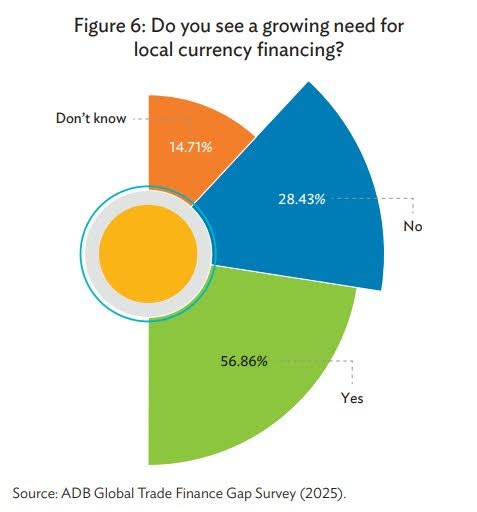
The survey also highlights rising demand for local currency financing, particularly in emerging markets, as firms seek to mitigate foreign exchange risks and better align liabilities with revenues.
Measures for improvement and path forward
Despite a decade of incremental progress, the global trade finance gap remains a persistent structural challenge.
To identify where meaningful advances can be made, the survey evaluated 12 potential activities to increase the availability of trade financing.
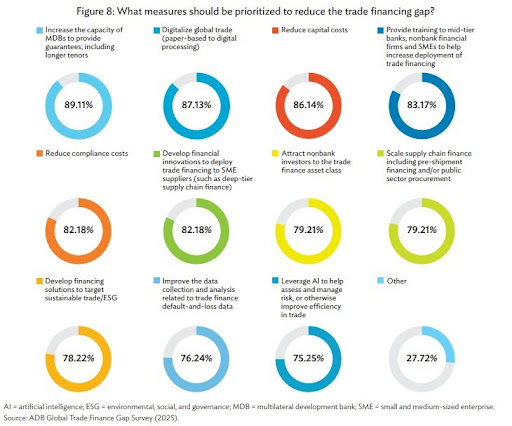
Among the identified priorities, the top 3 are i) attracting new investors to the trade finance sector ii) reducing compliance costs while scaling supply chain finance, including pre-shipment financing iii) fostering financial innovation, such as DTSCF.
Beyond these key areas, the report emphasises the need for coordinated action among multilateral development banks, financial institutions, and policymakers to overcome persistent structural barriers.
Supported by its AAA credit rating, ADB’s private sector operations play a pivotal role in facilitating trade finance. In 2025, ADB supported $5.7 billion in trade through guarantees and loans delivered via nearly 300 partner banks.
ADB remains committed to leveraging its financial strength, strategic partnerships, and innovative solutions to help close this gap. These efforts contribute significantly to diversifying trade globally.
Read the full report here.