
Beyond borders: Innovating together. Updates from London at the BAFT Europe Bank to Bank Forum

Deepesh Patel
Editor in Chief, Trade Treasury Payments
Published 4 Mar 2026
Developing story
Live Updates
Good morning from London!
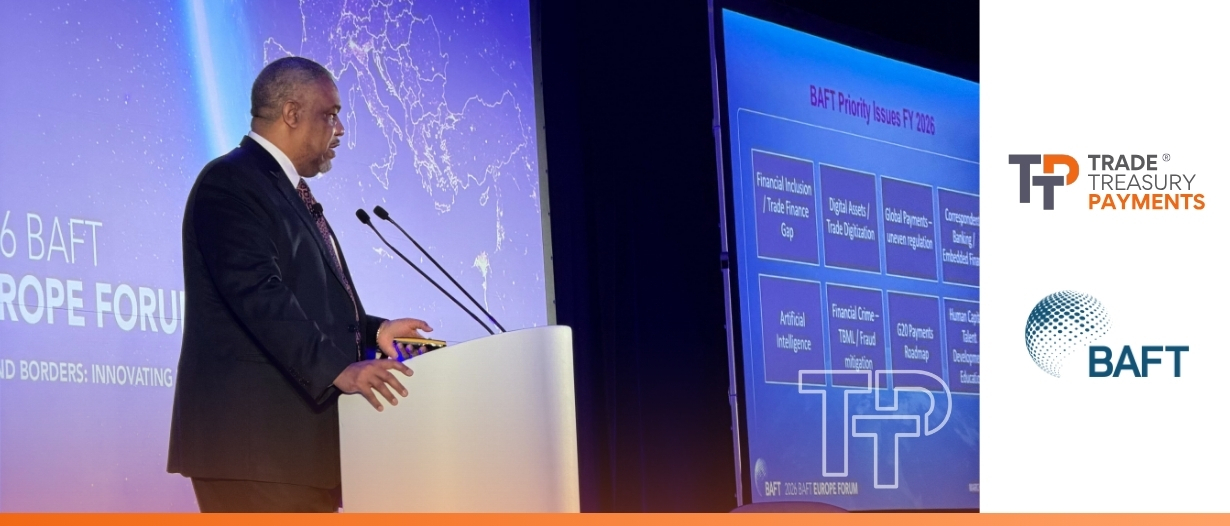
We’re delighted to be media partners of the BAFT Regional Bank to Bank Forum in Europe this week, with President and CEO, Tod Burwell, TTP Editorial Board Member opening up the conference.
Key priorities for 2026:
- Financial inclusion and the trade finance gap
- Digital assets and trade digitalisation
- Uneven regulation in global payments
- Correspondent banking and embedded finance
- Artificial intelligence across trade and payments
- Fighting financial crime and trade-based money laundering
- The G20 payments roadmap
- Developing human capital, and nurturing talent in the industry
Follow Trade Treasury Payments for the latest updates!
Meet the Trade Treasury Payments team at BAFT Europe!
We look forward to speaking to you at BAFT! Grab a copy of our latest magazine and freebies, stop by our stand for a coffee, or talk to our editorial team for a catch up.
Joy Macknight, Transaction Banking and Payments EditorEleanor Hill, Treasury EditorBen Fitch, Commercial DirectorDeepesh Patel, Editor in Chief
Joy Macknight will be moderating the panel: “Sustainability in Trade Finance – Deepening Commercial Rationale to Create Responsible Business’s”, with Caroline Haas (NatWest), Sven Schmidt (Commerzbank AG) and Charlie Bronks (Crown Agents Bank).
Eleanor Hill and Joy Macknight will also be MC’s of our joint BAFT Women in Transaction Banking and Trade Treasury Payments International Women’s Day event on 5th March, which all ticket holders for the Europe forum are freely invited to attend!
Europe’s competitiveness challenge came into sharp focus in a keynote fireside chat between Fabrizio Campelli and Tod Burwell.
Three structural gaps stood out in this discussion at the BAFT Europe Bank to Bank Forum in London: energy, innovation, and the single market.
Europe still pays far more for energy than other blocs around the world — electricity costs have been around 80% higher than in the U.S., and natural gas up to three times higher. At the same time, the innovation gap is widening: the U.S. produces 60% more patent applications, 10x more venture capital, and seven times more unicorns than Europe.
But perhaps the most interesting point from the discussion was addressing internal fragmentation. Barriers within the EU are estimated to be equivalent to a 45% tariff on goods and 110% on services, a reminder that competitiveness isn’t just an external challenge.
As Campelli noted, Europe remains a stable and resilient investment environment, and unlocking capital through deeper capital markets could still release significant growth.
Is Europe hearing the wake-up call loudly enough?
Trade Treasury Payments are delighted to be media partners of this event.

Cross-border payments are evolving quickly but the path forward still raises difficult questions.
In a discussion at the BAFT Europe Bank to Bank Forum, moderated by Sebastien Racinais of Crédit Agricole CIB, speakers including Adam Bealey of Swift, Moulika Atluri of Citigroup, and Arunan Tharmarajah of Wise plc-LA explored whether innovation is solving fragmentation or creating new forms of it.
The G20 roadmap has set clear targets for faster, cheaper and more transparent cross-border payments by 2027. Progress is visible, we can see that the adoption of ISO 20022 is expanding globally, payment systems are being modernised, and more than 75% of payments on the SWIFT network now reach the creditor bank within 10 minutes.
At the same time, the ecosystem is experimenting rapidly, from DLT-based settlement and programmable payments to new payment rails and infrastructure upgrades.
New rails may solve specific use cases such as 24/7 liquidity movement or programmable money, but fragmentation risks persist, particularly around regulatory divergence, interoperability and inconsistent domestic implementation.
As one speaker noted, the end user ultimately cares about something much simpler:
that the money arrives quickly, transparently and at low cost, regardless of which rails are used underneath.


A decade of digitisation in trade and supply chain finance has produced both progress and some lessons to be learned.
In a panel at BAFT’s Europe Bank to Bank Forum, moderated by Mansour Davarian of Lloyds Banking Group, speakers included Merisa Lee Gimpel of Enigio, Alex Pritchard-Smith of Komgo, and John Anderson of C2FO. Panelists reflected on what the past decade of digital trade transformation has really delivered.
One emerging theme was that technology has rarely been the main barrier for adoption and scale.
Platforms, standards and digital documentation have advanced rapidly, but scaling adoption remains a “behavioural” challenge. Trade is inherently collaborative, meaning digitalisation only works when every participant in the ecosystem, including banks, corporates, suppliers and logistics partners, moves together.
Network effects were also mentioned as critical for adoption. Suppliers are significantly more likely to participate in supply chain finance programmes when multiple buyers operate on the same platform, reinforcing the importance of scale and ecosystem participation.
Speakers also reflected on the lessons from earlier platform failures, many struggled not because of technology limitations, but because onboarding, user experience and incentives were poorly aligned.
The next phase of digital trade will depend less on building new platforms, and more on interoperability, simpler user journeys and embedding digital processes into everyday workflows.
Trade Treasury Payments are media partners of the BAFT Regional Bank to Bank Forum in London.

Digital assets are moving rapidly from experimentation toward core financial infrastructure, but scaling them will depend on solving three persistent challenges: trust, interoperability and legal certainty.
In a panel moderated by Igor Mikhalev of EY-Parthenon, speakers including Ed Budd of Partior, Nicole Sandler of UBYX, Otto Heinz of the European Central Bank, and Mohamad Zaraket of BNY explored what will determine institutional adoption, at the BAFT Europe Bank to Bank forum.
Fragmentation is less a technology problem than a market structure problem.
Multiple tokenised assets, stablecoins and bank-issued digital money may appear similar to users, but without trusted clearing mechanisms and shared infrastructure, they remain fragmented.
Speakers noted that in traditional finance, different bank deposits function seamlessly because they ultimately clear through trusted central infrastructure, a model which digital assets may need to replicate.
Regulators are also increasingly focused on sovereignty and financial stability risks. As noted during the discussion, much of the global payments system still relies heavily on infrastructure and currencies outside Europe, reinforcing the importance of initiatives such as central bank digital currency research and new settlement architectures.
The next phase of digital asset development will therefore depend not just on new technologies, but on shared standards, interoperable ledgers and credible trust frameworks.
In other words, the challenge is no longer proving digital assets can work, but ensuring they can work together across borders and institutions.


Sustainability may have slipped from the headlines, but the strategic importance of responsible trade has not disappeared.
In a panel moderated by our Transaction Banking and Payments Editor, Joy Macknight, speakers including Caroline Haas of NatWest Group, Sven Schmidt of Commerzbank, and Charlie Bronks of Crown Agents Bank discussed how sustainability in trade finance is evolving in a more complex geopolitical environment.
While ESG backlash and geopolitical crises have shifted attention, speakers noted that material risks, from climate exposure to supply chain vulnerability and labour standards, remain central to how banks assess risk and structure financing.
Speakers also pointed to the continued relevance of global frameworks such as the United Nations Sustainable Development Goals, and frameworks such as the ICC’s Sustainable Trade Finance Principles, which still provide a common reference point for aligning and defining terms, with a focus on environmental and social objectives.

Europe’s competitiveness debate is increasingly shaped by geopolitics, and the risks facing global energy and trade flows.
In a discussion at the BAFT Europe Bank to Bank forum, moderated by Simon Wells of HSBC, speakers including Andrew McDougall of Barclays and Ben Pott of BNY explored how current geopolitical tensions are intersecting with the competitiveness agenda highlighted in the Mario Draghi report on Europe’s economic future.
A key theme was the extent to which crisis accelerates structural change. As noted during the session, many major policy shifts in Europe, from energy diversification to industrial policy, have historically been triggered by geopolitical shocks.
Current tensions in the Middle East could once again test Europe’s resilience, particularly through energy markets and supply chains. Europe remains sensitive to disruptions in oil and gas flows, with price volatility feeding directly into inflation, manufacturing competitiveness and broader economic performance.
Speakers also highlighted the uncertainty surrounding the wider geopolitical landscape, including US politics, China relations and regional conflicts, all of which complicate policymaking and investment decisions.
Will these shocks simply increase urgency, or will they actually accelerate the reforms needed to strengthen Europe’s long-term competitiveness?


At the BAFT Europe Bank to Bank Forum in London this week, where Trade Treasury Payments is a media partner, industry leaders explored how innovation is reshaping the future of foreign exchange in transaction banking.
In a session moderated by Vanessa Manning of MUFG, speakers including Dirk Bullmann of CLS Bank, Marc Tuehl of HSBC, Dominic Ho of Visa and Luke Spiers of StoneX examined the growing complexity of the FX ecosystem.
As payments infrastructure accelerates toward T+0 settlement, 24/7 markets and embedded FX, the panel highlighted how risk management and operational frameworks must evolve alongside technological innovation.
While new rails, including distributed ledger infrastructure, stablecoins and tokenised assets, are gaining traction, the discussion emphasised that FX risk does not disappear simply because settlement becomes faster.
Another theme was the role banks may play as aggregators of an increasingly fragmented ecosystem.
With corporates facing a proliferation of payment, FX and liquidity solutions, banks are increasingly being asked to integrate and orchestrate multiple providers across treasury, ERP and payment infrastructures.
The panel also discussed the operational implications of instant settlement, from liquidity management and collateral processes to reconciliation challenges across jurisdictions with different market hours and regulatory frameworks.
Questions from the audience reflected the same tension; whether innovations such as tokenised settlement, G20 cost targets and faster rails will truly reduce friction, or simply reshape where complexity sits in the global FX market.

At the BAFT Europe Bank to Bank Forum in London this week, where Trade Treasury Payments is a media partner, a panel explored whether the long-promised digital transformation of trade finance is finally within reach.
Moderated by TTP Editorial Board Member Geoffrey Wynne, of Sullivan & Worcester, the panel featured Marissa Adams of HSBC, Anastasia McAlpine of Finastra, and Dave Frye of Traydstream.
An audience poll set the scene; 55% of participants believe fully digital global trade finance is still around a decade away, while 34% think it may never happen.
Speakers noted that the industry has moved beyond purely paper processes but has not yet reached true digitalisation. Much of today’s activity remains what one panellist described as a “middle state”, where paper documents are digitised or scanned rather than created and exchanged natively in digital form.
Three persistent barriers emerged.
First, regulatory fragmentation. Legal frameworks governing digital trade documents still vary significantly across jurisdictions, limiting seamless global adoption.
Second, commercial incentives. Trade finance has historically worked reasonably well for many participants, reducing the pressure for rapid transformation.
Third, interoperability. Rather than a single dominant platform, the industry is now moving toward a model where multiple platforms and ecosystems must connect and exchange data seamlessly.
Technology, including AI-driven document processing and digital trade platforms, is advancing quickly. But as the panel emphasised, the challenge is less about building tools and more about aligning banks, corporates, regulators and platforms across complex global supply chains.