

Stablecoins have transitioned from niche digital assets to essential components of the global financial infrastructure. Their role in cross-border payments, liquidity management, and treasury operations is expanding rapidly. Yet, despite the global economy’s multi-currency nature, stablecoin markets remain overwhelmingly dominated by USD-backed tokens, which account for more than 98% of total market capitalisation according to the “Beyond concentration: Where non-USD stablecoins can scale” report by Standard Chartered in partnership with Zodia Markets.
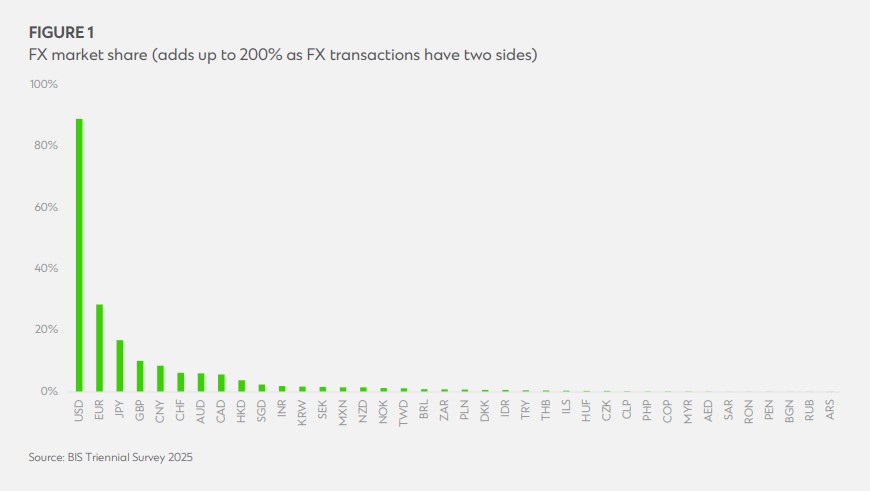
This contrasts sharply with the US dollar’s roughly 50% share in global cross-border payments. This shows a huge gap between how much stablecoins are used and the actual flow of currency.
The diversification gap is a structural mismatch
USD-backed stablecoins dominate, but this doesn’t represent the reality for many regions.
Yes, the dollar is the primary global reserve currency, but a significant share of international trade and remittances is conducted in other currencies.
This creates a clear opportunity for stablecoins pegged to local currencies to better serve regional payment needs and reduce reliance on the dollar.
The report ranks countries by their potential demand for local-currency stablecoins, considering trade volumes in non-USD currencies, remittance inflows, and currency volatility.
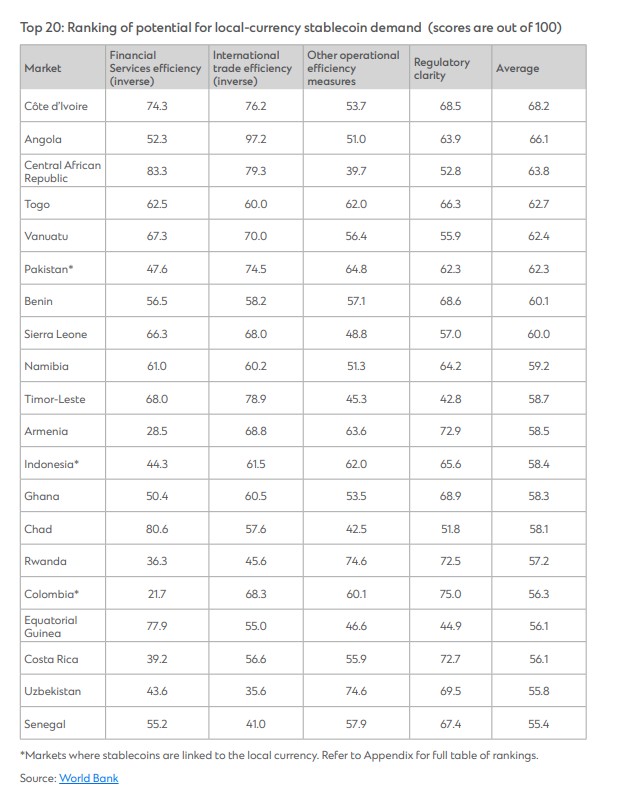
The table ranks 20 markets by potential local-currency stablecoin demand, scoring four factors out of 100: financial services inefficiency, international trade inefficiency, other operational inefficiencies, and regulatory clarity.
Côte d’Ivoire scores highest overall (68.2), with strong trade inefficiency (76.2) and financial inefficiency (74.3).
Angola follows with a 66.1 average, driven by very high trade inefficiency (97.2). The Central African Republic and Togo score 63.8 and 62.7, respectively, with notable financial and operational inefficiencies.
Regulatory clarity ranges from 28.5 (Armenia) to 75.0 (Colombia). Markets with higher inefficiencies and moderate to strong regulatory clarity rank higher, indicating structural demand for local stablecoins where traditional systems face friction.
Regions with fragmented or costly financial infrastructure stand to benefit from stablecoins that offer faster and cheaper settlement alternatives.
Pillars for scaling: Accessibility, speed, and stability
The report says that stablecoins rely on three pillars to scale effectively – accessibility, speed, and stability.
Accessibility is crucial, particularly in areas with limited banking infrastructure. In many emerging markets, there are strict requirements for opening local-currency accounts. They often require physical presence and extensive documentation.
In contrast, accessing major currency accounts such as the euro or the dollar offshore is comparatively easier. This leads us to a compelling case for adopting local-currency stablecoins. Why? Because it can offer programmable, cross-border access to domestic currencies. However, weaker financial systems may fuel greater demand for such digital solutions.
Speed is equally critical. While crypto markets settle transactions almost instantly, traditional banking systems, particularly outside USD corridors, often operate with delays due to limited hours and legacy infrastructure. These settlement mismatches introduce operational and currency risks. Stablecoins combine fiat currency stability with blockchain’s rapid settlement, reducing liquidity friction and hedging costs for businesses spanning multiple time zones.
Stability is key. Stablecoins reduce volatility risks by allowing quick transactions and minimising currency fluctuation exposure.
In volatile markets, local stablecoins can compete regionally by offering stability and supporting trade connections, instead of trying to challenge the dollar on a global scale.
The path forward is collaboration and integration
Digital payment solutions are advancing, and stablecoins are becoming part of daily global financial transactions. In this, those who overlook these developments may find themselves lagging in new trade routes and markets.
Moving away from relying solely on the dollar is no longer just a trend; it’s becoming a lasting shift. Even small steps toward using other currencies can build deeper, more resilient markets.
The institutions that move first to support the issuance, custody, and cross-border use of local stablecoins will gain a clear edge. The real question now isn’t if the dollar will lead, but which local currencies will find their footing in this new digital world.
Policymakers face the challenge of harbouring innovation while safeguarding financial stability, and cross-border cooperation on standards and interoperability will be essential to avoid fragmentation.
Access the full report here.