
By: Tim Staheli
Trade securitisation has a reputation problem and a jargon problem, and the two feed each other. The word ‘securitisation’ still means 2008, and the machinery (SPVs, tranches, true sale opinions, credit enhancement) sounds designed to keep outsiders out. To get past both, Trade Treasury Payments’ Deepesh Patel sat down with Sanjeev Ganjoo, formerly of Citi and a member of TTP’s Global Advisory Panel, and asked him to explain the whole thing from the beginning: what gets securitised, who owns what, who loses money first when things go wrong, and what any of it costs.
His starting point is that the market has changed shape. “Trade securitisation is no longer a funding tool,” Ganjoo said. “It is becoming a marketplace, where you have capital, you have liquidity, and you have a distribution strategy.”
Why corporates stopped bringing banks the cherries
“Prior to COVID, it used to be mainly a cherry-picking business between a corporate and a lender,” Ganjoo said. “If I’m a corporate and I had an issue on a particular obligor, or a risk, or a geography, I would take that piece to the bank, and the bank would cherry-pick: okay, I can do this country, I can do this obligor.” Cherry-picking suited the banks. It left the corporate holding everything the bank turned its nose up at, usually the exposures it most wanted funding for. And it came with a second irritation: the funding had a habit of drying up four times a year. Regulators require banks to hold capital in proportion to what they lend; the running tally is called risk-weighted assets, or RWA. But the tally that counts is not taken continuously. It is taken when the books close each quarter: the regulator photographs the balance sheet, and the capital rules apply to what the picture shows.
“Some banks are basically running short on RWA at quarter end,” Ganjoo said. “They want to start selling it off.” Supervisors know their subjects tidy themselves up for the camera, but a company does not stop shipping goods in the last week of the quarter because its bank is running short on capital.
So after the pandemic stretched supply chains and lengthened trade cycles, treasurers changed the offer. “Companies started coming to banks with their entire balance sheet,” Ganjoo said. “This is my entire portfolio. It was a concept of either do everything or none.” One pool means diversification, larger limits, year-round funding and one blended price: a non-investment-grade portfolio that might cost 3 per cent funded piecemeal might pay 1.5 per cent as part of a diversified whole, in his illustration.
Securitisation is how a lender buys the whole orchard rather than just the cherries. The smallest Ganjoo has seen is $100 million. “You will never do a trade securitisation for a $25, $30, $50 million deal.” From there they run into the billions. Where banks once ran their trade books overwhelmingly on a deal-by-deal basis, he now puts the split at roughly half bilateral, half securitised.
One word, two structures
One term, though, covers two different structures, and even a careful listener can end up holding a contradiction. It happened in this interview. Ganjoo had described assets being sold to a special-purpose vehicle so that neither the corporate nor the bank would own them. Then he mentioned that most bank deals are recorded on the bank’s balance sheet. Patel stopped him: you said it’s a true sale, so the bank doesn’t own the assets; now you’re saying the bank is the legal owner. Which is it?
The answer is both, depending on the flavour. “In a synthetic securitisation, which most of the banks do, there is no SPV,” Ganjoo said. “It’s on the bank’s balance sheet, so the bank is the legal owner of those receivables. For synthetic, there is no need to get it rated; as there are no notes issued, .” The bank buys the portfolio, holds it, carves up the risk, and shares it privately, with participating banks or with credit insurers. “Banks manage it between themselves , the client, and a few distribution partners.” A standard securitisation goes the other way. The assets are sold to a bankruptcy-remote special-purpose vehicle and leave the bank entirely; the structure is rated by an agency; notes are issued; and outside investors subscribe to them. “It is just a matter of whether you are creating an SPV and issuing notes, or doing it on the bank’s balance sheet and holding it on your own record.”
The one thing both flavours share is the part that matters most: the risk is sliced into layers, called tranches, and somebody agrees in advance to lose money first. “Whether it’s synthetic or standard, risk tranching has to be there.”
The walled orchard: what an SPV is for
The standard structure begins with the underlying nature of the trade assets: receivables, supply chain finance, standby letters of credit, loans, inventory, factoring, in one mixed portfolio. The bank’s first job is archaeology. “Under the securitisation rules, the due diligence has to go back historically up to five years,” Ganjoo said. “That means your ageing, your dilution, defaults, commercial disputes, frauds. What has been the portfolio’s benchmark?” Five years of digging through which invoices were paid late, which were disputed down, and which were never real. Most of the work in a securitisation happens here, before any structure exists.
What survives the vetting is transferred to a bankruptcy-remote special-purpose vehicle, or SPV: a company created for this one job, incorporated in a tax-friendly jurisdiction, such as Delaware, Luxembourg, Ireland, Jersey, or the Cayman Islands. “These SPVs are created solely to manage this portfolio,” Ganjoo said. “They are not running their own individual business.” Why those postcodes? Not concealment – arithmetic. “We don’t want to create a funding tool and end up paying huge amounts of taxes.” Layer tax on top of a structure built to shave basis points off working capital and the numbers stop working.
The SPV’s purpose is the wall. The sale to it is a ‘true sale’: the assets legally leave. “Tomorrow, anything happens to the corporate, these assets remain with the SPV,” Ganjoo said. “Neither the corporate nor the bank: it is purely the SPV that owns these assets.” If the corporate collapses, its creditors cannot reach into the orchard; if the bank collapses, likewise. The investors funding the portfolio are exposed to only one thing: whether the buyers of the goods pay their invoices. That isolation is what lawyers mean by ‘bankruptcy remote’, and it is why anyone builds the structure at all.
The true sale has a side effect worth being plain about. Money raised this way does not sit on the corporate’s balance sheet as debt. “Investors will look and say: this company has never borrowed. But technically they did borrow. They were able to do it through a true sale mechanism,” he said. Whether a transfer qualifies is not the corporate’s call. The accounting rules on both sides of the Atlantic demand that substantial risk genuinely moved, and the lawyers must opine that the sale is real. Keep too much of the downside, take on too large a first-loss position, and the opinion is refused.
Tranching decides who loses money first
Once the portfolio is walled off, the risk is sliced, and the slices form a queue: junior at the front, then mezzanine, then senior. “Junior is the first one who will get hit,” Ganjoo said. “Any first losses which happen, it is the junior piece. So junior is always high risk, high yield.” Above it sits mezzanine, “medium risk, medium yield, and that’s where you find private credit and the hedge funds”. Above that sits senior capital, typically 70 to 90 per cent of the structure: lowest risk, lowest yield, highest rating, and home to the most patient money.
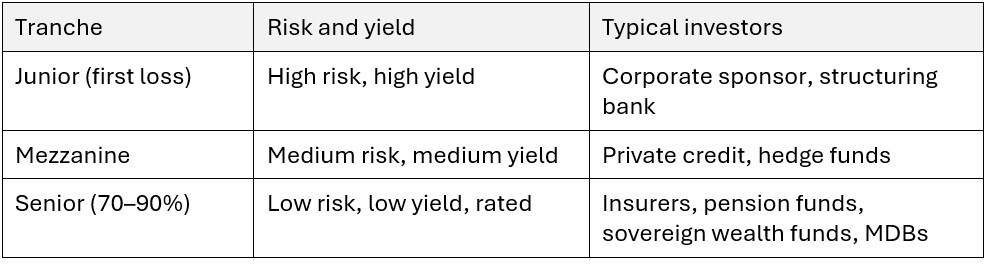
How big is the first loss? Ganjoo’s rule of thumb: two to three times the largest single-buyer concentration. A portfolio where the largest buyer accounts for 3 per cent needs a first loss of 6 to 9 per cent, more in concentrated markets such as parts of Latin America. The logic is diversification in reverse. A hundred buyers do not all go bust at once, so the layer that absorbs the plausible failures can stay thin, but only if no single name is thick.
Then Patel asked the question the whole structure exists to answer: if everything goes wrong, who pays what? Take a $100 million deal, total loss: every buyer defaults, which is the thought experiment, not the expectation. The corporate, holding a $3 million junior piece, pays first and is wiped out. The mezzanine investors pay the next $6 million. The senior capital absorbs the remaining $91 million. Nobody argues about it afterwards, because everybody priced their place in the queue before a dollar moved.
Securitisation did time for someone else’s crime
Ganjoo still meets investors who believe securitisation caused the 2008 crisis, and that trade assets are therefore suspect. “That was never the case. Poor underwriting standards created the financial crisis, and it was related to subprime mortgages. Trade finance is never subprime mortgages.” The structures that failed in 2008 were stuffed with 25-year mortgage risk that nobody could see through. US asset-backed commercial paper peaked at almost $1.2 trillion in mid-2007 and shrank by nearly 30 per cent before the year was out as investors refused to roll it. A trade receivable is the opposite animal: a defined commercial flow between a named buyer and seller, self-liquidating in 60 to 90 days. “You can track the flow.”
The numbers back him. The ICC Trade Register puts default rates across trade finance products persistently below 0.3 per cent, on data covering more than $25 trillion of exposures. It is not a census of the market, but it is the best default record the industry has. And demand outruns supply: the Asian Development Bank’s survey-based estimate puts unmet demand for trade finance at $2.5 trillion a year as of 2025. An asset class this short, this safe and this undersupplied is precisely what the senior tranches were built to carry.
Greensill and First Brands broke in opposite ways
Both come up whenever trade assets are pitched to investors, and they failed in opposite ways. Greensill, which failed in March 2021 when its credit insurer declined to renew $4.6 billion of cover and Credit Suisse froze the $10 billion of funds built on its assets, is what Christoph Gugelmann called in these pages “the whole architecture stated in the negative”: receivables tied to no completed trade, concentration hidden inside a supply chain finance label, insurance standing in for diligence. Each is the inversion of a component Ganjoo has just described: the five-year audit that demands real trading history, the concentration limits that size the first loss, the insurance wrap that sits on top of vetting rather than in place of it.
First Brands, the North American auto-parts group that collapsed last autumn, failed at the other end: after the purchase, not before it. “Securitisation is not a one-party play,” Ganjoo said. “There are lenders, investors, obligors, agents, law firms. Everybody’s responsibility is clearly defined. Sometimes people think the other person is doing their job. That is where the recent fraud happened. The due diligence was missed, and fake invoices got plugged in.” His answer is the unglamorous part of the machine: the lead bank’s year-round exposure monitoring, semi-annual re-rating of the portfolio, and behavioural analytics that continue long after the deal goes live. Neither collapse was a rated, tranched trade securitisation of the kind described here. Both are what its components exist to prevent.
A mortgage, not an overdraft
Setting up is expensive: a true sale opinion covering a global portfolio along with accounting opinions and rating costs can run to $1–2 million in legal fees, and regulatory requirements vary awkwardly across jurisdictions. But once running, the structures hold on to their clients. Corporates that would shop a standby letter of credit around for ten basis points stay put once a securitisation is in place, and wind-downs are rare and orderly: the receivables flow every 60 to 90 days, so the last churn simply runs off. With the US Basel III endgame reproposal of March 2026 pressing banks towards capital-efficient structures, private credit hunting short-dated assets, and $2.5 trillion of demand still unmet, Ganjoo expects convergence: banks, insurers, and institutional capital in one marketplace. The whole orchard is for sale, and the buyers are queuing up.