The latest edition of SWIFT’s RMB Tracker, released this week and based on July’s data, confirms that the renminbi (RMB) held its position as the sixth-most active currency worldwide, accounting for 2.88% of payments by value. In cross-border payments excluding the Eurozone (a distinction that captures true international usage rather than intra-European transfers), the RMB also held the sixth position, with 2.11% of flows in this category.

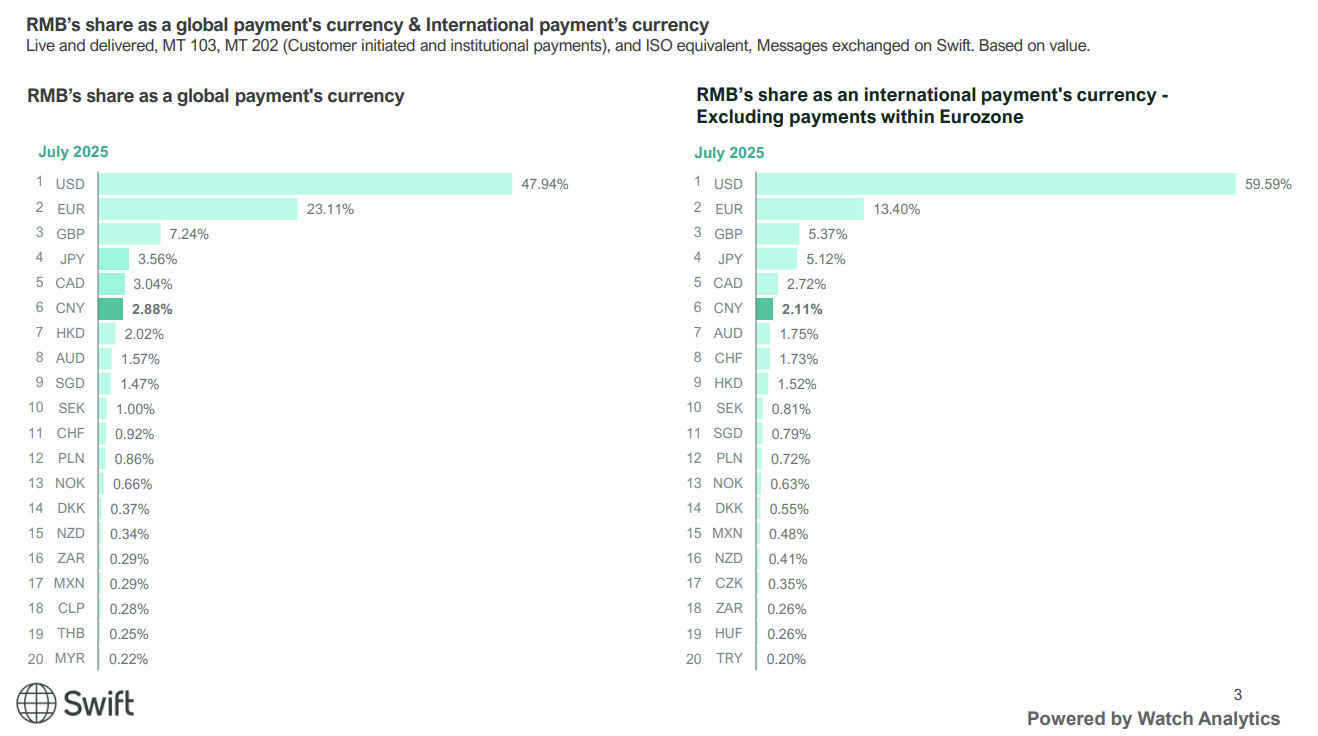
Still, the RMB’s global market share remains modest compared to the US dollar or euro, which sit at 47.94% and 23.11% of total global payments by value, respectively.
Month-on-month, RMB-denominated payments grew by 5.82%, broadly in line with the overall increase in global payments of 5.99%.
In July 2025, the RMB represented 7.70% of trade finance instruments, up from 7.02% in the previous month. This places the renminbi firmly within the top three leading currencies for trade-related transactions, well behind the dominant USD (which has a 79.62% share), but close to the EUR (which has a 7.70% share).
The increasing reliance on the RMB in this space suggests that corporates, banks, and counterparties are more willing to denominate commercial instruments (such as letters of credit) in China’s currency.
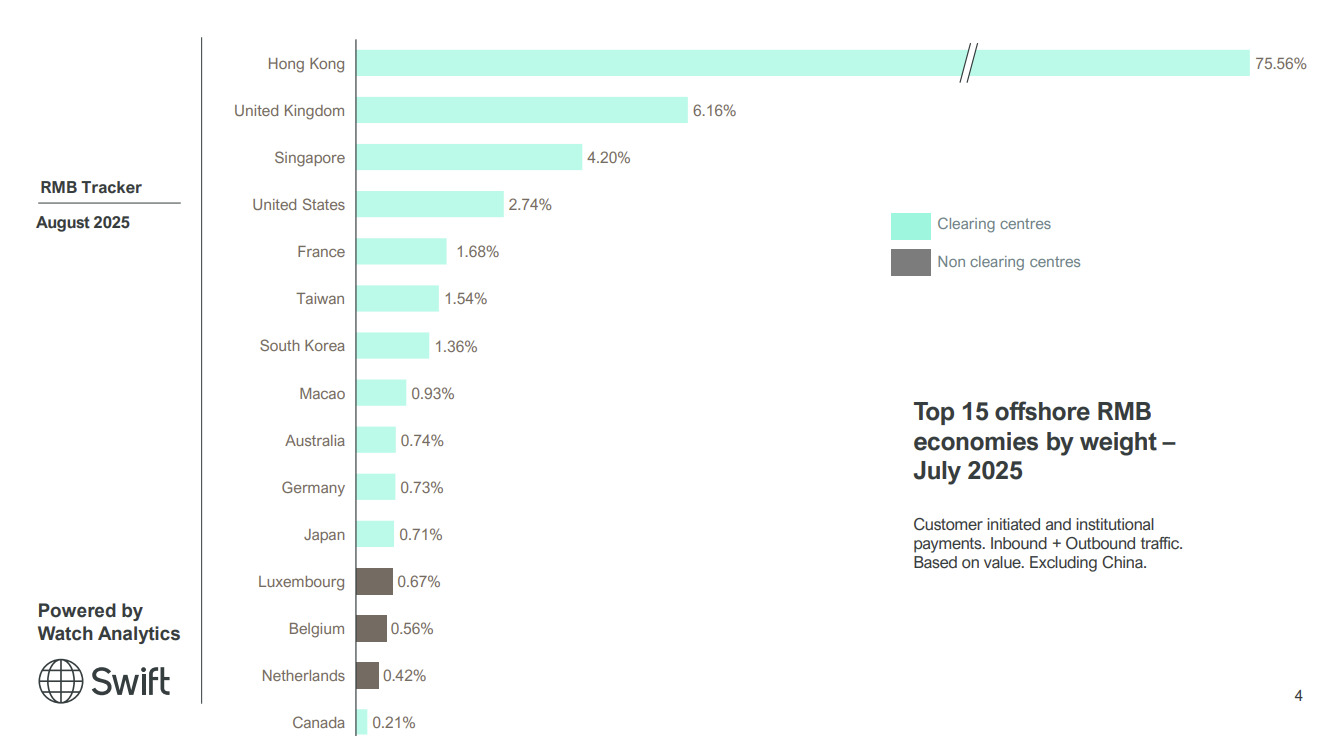
According to the Tracker, Hong Kong, the United Kingdom, and Singapore remained the top three offshore economies by volume of RMB payments in July 2025. Each is a key hub linking Chinese flows to international markets, with Hong Kong unsurprisingly dominating due to its role as the primary offshore clearing centre.

The evolution of offshore RMB payments since 2020 reveals some volatility, with the share oscillating between roughly 1.65% and 4.74%. By July 2025, offshore activity was around 2.88%, consistent with the currency’s share of global payments.
The latest RMB Tracker continues a familiar narrative where the RMB is not surging up the global currency rankings, but it is consolidating its position. With 2.88% of global payments, a rising 7.70% share in trade finance, and an established role in FX markets, few can argue that the renminbi has not become a fixture in international flows.
To explore the data in greater depth, including regional breakdowns and monthly trends, you can access the full SWIFT RMB Tracker (August 2025 edition) here.