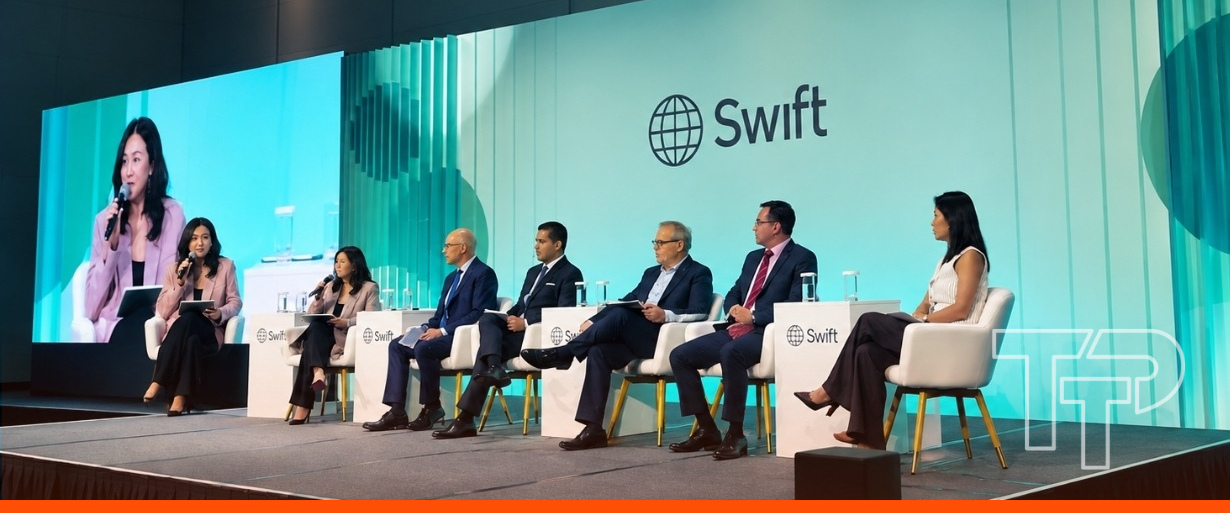

On the final day of Sibos, Julia Streets of Streets Consulting moderated what might arguably be the most significant panel conversation of the event. Data, AI, and policy are redefining the dynamics of global trade. On the horizon, and indeed already begun, is a rapid growth and transformation of both technology and people within the industry.
There was a lot to discuss and explore in this spirited discussion with Natasha Condon of J.P. Morgan, Vinay Lawrence Mendonca of Finastra, Emmanuelle Petelle from Société Générale, and Makiko Toyoda of the International Finance Corporation (IFC).
Data, data everywhere…
Condon opened the discussion by stressing the importance of data and data ownership in what is arguably an increasingly fragmented world. After all, technological tools like agentic AI are only as good as the data that feeds them. New AI models and agents are being fed from data all around the world, and indeed accurate data from clients and stakeholders is crucial to realising their potential role in trade finance. Regional data regulations, however, are frequently an early challenge encountered when entering a new market.
But these technologies undeniably have transformative potential. We’re now seeing solutions emerging that can solve the challenges that have prevented trade digitalisation from becoming a reality up to now. The old impassable barriers of consistency and connectedness are a thing of the past in the face of tools that can work with and interpret data from disparate sources without the need for new centralising infrastructure.
Realising the potential of technology, according to Petelle, is a matter of ensuring data is properly structured and organised. This can enable AI agents, for example, to operate efficiently and reduce operational mistakes. This view was echoed by Mendonca, who observed that data organisation, governance, and infrastructure are nothing new, but precisely how data is organised moving forward has changed in the face of the new challenges of data interoperability.
If these challenges can be overcome, however, and data qualified, it can become a monetised asset. The next frontier for AI is a canonical, semantic way to connect and contextualise the unstructured data found in policy documentation, Bills of Lading, and the like. The role of AI is not about perfect standardisation of data, but perfect interpretation.
Underpinning all of this, the panel agreed, must be trust. Trade is based on trust, and data must have verifiable identity and authority. This is crucial to mitigating fraud risk and maintaining client trust in banks. As Condon observed, AI agents need to fundamentally be held to the same standards as a person would be when instructing banks.
An era of innovation
Despite these exciting possibilities, Toyoda made certain to remind that not everyone is on a level playing field. In lower income countries, there is significantly less access to technology like AI due to the lack of reliable data and digital infrastructure. Even pilots looking to improve digital infrastructure are being outpaced in their progress by the growth of emerging technologies. If this is not addressed, there is a danger that a widening tech divide could grow the $2.5 trillion trade finance gap.
For those with access, though, the capabilities of emerging technologies can fundamentally change much of how trade and trade finance operates. Mendonca pointed to fraud monitoring and risk management as an example; operations that have previously looked to historic incident data. Modern data flows and AI operations mean real-time, always on risk monitoring is a possibility, powering better analysis and pricing.
Data and AI can also allow banks to embed products in the emerging markets where buyers and sellers are operating. Banks can go to where the trade is happening, rather than waiting for customers to come to them. This means technological innovation also has huge potential to help close the $2.5 trillion trade finance gap.
Indeed, better data from emerging markets means better access to trade finance. Limitations in real data visibility has perhaps negatively impacted risk evaluation of businesses in emerging markets in the past. This can now change. If all the data is available and being properly processed in real time, there is also less need at the grass roots level for businesses to submit exhaustive reports or operational documentation. This, along with innovations like tokenisation, can help expand trade finance access for SMEs in emerging markets and unlock their potential.
Humans in the loop
As technology can increasingly be relied upon to complete the mundane, process-driven tasks long associated with trade finance, professional roles can change. The work can get more fun for one, as Condon puts it. When document checks that might previously have taken hours can be completed automatically in seconds, experts can apply their skills and knowledge to higher-level analysis.
This is changing the role of corporate treasurers. Gone are the days of a narrow focus on balance sheet mechanics or foreign exchange. With AI tools, treasurers can (and increasingly, must) analyse supply chain visibility, working capital optimisation, and operational risk. Their role is evolving from one of cash management to commercial strategy, and AI is accelerating this evolution.
Petelle reinforced this idea of evolving job roles as she warned that we cannot afford to lose the pools of experts as process automation takes over more of the grunt work. Data can only tell us so much; the analysis and opinions of real people on the ground will always be invaluable.
Getting the full picture of regional risk, for example, might mean calling someone within your network who is physically in the local area who can cross-reference and properly contextualise the data with what they are seeing – the real risk they are ‘feeling’. For this reason, correspondent banks will likely still have an important role, even if technology makes instantaneous cross-border payment a reality. You will always need a human in the loop, even as technology takes on more automated processes.
Indeed, in such an environment it is the human element that is perhaps most important for organisations, as Mendonca explains. Technology, in particular AI, can be a great leveller. Individuals with valuable professional insight can now create technical solutions for problems that previously would’ve required an entire data analytics and technical development team to realise. In this technologically democratised world, how do you stand out? With your people. It is the human element that will allow organisations to differentiate themselves, which means people will arguably be an even more crucial asset as technological innovation expands.
Key takeaways to close out Sibos
As the discussion drew to a close, the consensus was clear – the technologies that are emerging can have a transformative impact on trade and trade finance. They can be a game changer for SMEs in emerging markets and help upskill and unlock the true potential of industry professionals. Data is now taking us to another level above what we’ve seen before and can help those in trade finance operate as enhanced bankers, in Petelle’s words.
Through all this, though, we need to remain prudent, if not strictly cautious. Data operations need to be kept transparent and safe to avoid potentially costly mistakes. This is a moment to ensure that stakeholders are communicating and getting together to think about how we use data and AI to realise its true benefits. Regulation and documentation, particularly with regards to agentic AI, need to be major considerations as we move forward.
We will need to work with guardrails and there will be small bumps in the road. While remaining mindful of this, we also need to keep our foot on the gas, Mendonca argued. If we can navigate this road properly, we can – as Streets put it in her closing remarks – put the world in the right place to do business, unlock capital, and get trade done.