Trade across the Middle East and North Africa is shaped by a diverse set of markets, each with its own regulations and financing needs. While this creates complexity, it also underpins significant trade flows and opportunities for banks able to operate consistently across the region.
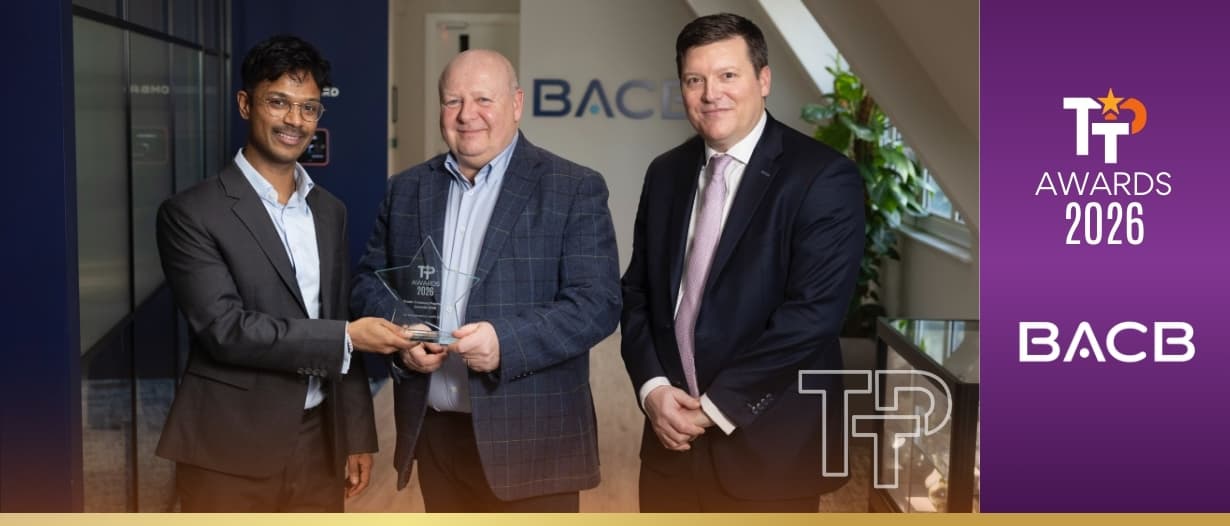
It is against this backdrop that British Arab Commercial Bank was named Best Trade Finance Bank – Middle East & North Africa at the Trade Treasury Payments Awards.
Following receipt of the award, Trade Treasury Payments (TTP) spoke with Damian Austin, Chief Banking Officer at BACB, about how the bank supports trade across North Africa.
TTP: What does it mean to you to have been selected as the Best Trade Finance Bank of the Year for Middle East & North Africa at the TTP awards?
DA: Supporting clients in our core markets in the Middle East and North Africa is at the heart of what we do at BACB, and we’re pleased to see our efforts recognised by such an expert advisory panel as the one selected by Trade Treasury Payments.
International trade is absolutely vital to these markets, and we are very proud of the role we play in facilitating trade flows in the region. Our thanks go to all our clients for their continued trust, and to the hard work and dedication of the BACB team both here in London and on the ground in the region.
TTP: North Africa remains underserved by many international banks due to political and regulatory complexity. How does BACB navigate these sensitivities to operate consistently across all of the region’s six markets?
DA: The challenges that you mention are real, and they have contributed to a significant trade finance gap in the region that limits trade and economic growth. BACB’s approach to tackling these hurdles – evidenced by a long track record of safely working in specialist and challenging markets – is based on the strength of our local relationships, understanding the trade flows we support, and our ability to mitigate cross-border risk via the trade products we offer.
Our trade finance offering is supported by our extensive correspondent banking network and is always consistent with our compliance-led approach. BACB benefits from the strong support of our shareholders in Libya, Algeria, and Morocco, and our representative offices in Tripoli, Algiers, and Abidjan work alongside a team of multilingual staff based in London who are underwriting and managing our North African trade finance business end-to-end. This physical presence proves invaluable in providing clients with crucial support throughout economic uncertainty.
We are proud that BACB is one of the few international banks to handle trade finance transactions across all North African nations, and in 2025, the bank facilitated more than $2 billion of trade transactions in the region.
TTP: BACB also distributes trade assets to partner banks and insurers to expand liquidity. How important is that syndication and distribution model to scaling trade finance into higher-risk or capacity-constrained markets?
DA: One of our core missions at BACB is to improve access to liquidity for African economies. Syndication and trade asset distribution are central to expanding liquidity into higher-risk or capacity-constrained markets. By originating and distributing trade assets to partner banks and insurance providers, BACB helps create additional risk appetite for markets that may otherwise struggle to access international financing.
By leveraging its international network, BACB is effectively able to mobilise wider pools of capital, share risk and support larger transaction volumes in African markets. In 2025, BACB distributed a total of $1.5 billion of direct African assets originating from 14 African countries. By connecting international liquidity providers with opportunities in Africa, BACB supports financial inclusion while ensuring sustainable growth in trade finance capacity across the region.
The full list of award winners is now available on the TTP Awards Winners page