
The business case for trade registries
Video not playing? Watch via Youtube.
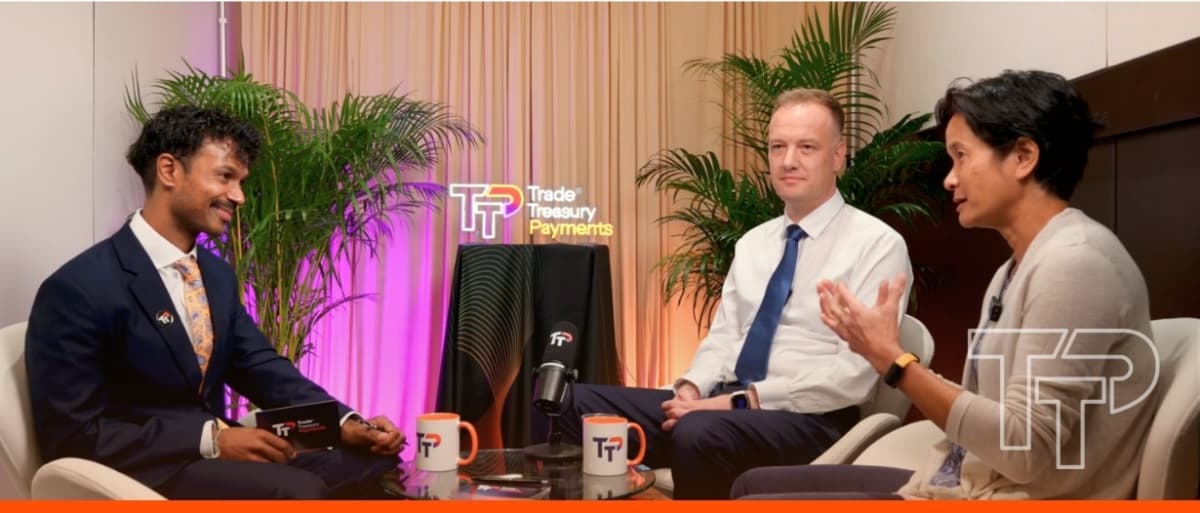
At the Commonwealth Business Summit in Namibia, Trade Treasury Payments (TTP) spoke with Neil Shonhard, CEO of MonetaGo, to discuss the role of digital public infrastructure in derisking trade and unlocking liquidity across the Commonwealth, particularly in Africa.
Shonhard said, “We build national-level infrastructure that derisks trade and finance transactions. The benefit of that is straightforward since derisking promotes more liquidity, which in turn accelerates economic growth.”
With more than a third of Commonwealth member states located in Africa, the region is central to ongoing trade policy efforts. Shonhard noted that while 80% of businesses across the Commonwealth are MSMEs, in Africa, the proportion is even higher, yet access to finance remains severely constrained by perceived risk.
“If we see exponential growth of SME liquidity in Africa,” he said, “we’ll see a great deal of economic growth across the Commonwealth as a whole.”
That growth, however, will depend on closing structural financing gaps. Trade registries and invoice data infrastructures (known in development circles as “digital public infrastructure”) are one such tool. These systems aggregate transaction-level information to reduce fraud, support transparency, and increase lender confidence.
“Having a tool at the national level that can pool transaction information and do analytics to prevent fraud promotes liquidity by derisking sectors, derisking trade, and derisking the country,” said Shonhard.
The results have already begun to materialise. In India, MonetaGo’s infrastructure has helped enable $50-60 billion in liquidity for micro and small businesses. In Singapore, real-time fraud detection is helping restore lender confidence following a series of high-profile incidents in the commodities sector. And in the GCC, these systems are aligned with national Vision 2030 objectives, particularly around financial inclusion and SME growth.
“In India, 20% more financiers register on platforms like the TReDS each year because they know it’s a much safer liquidity tool,” said Shonhard. “In Singapore, we’ve caught a great deal of fraud. That’s really instilled confidence in the commodity sector after some of the issues it had a few years ago.”
MonetaGo’s approach reflects a shift in how both governments and multilaterals are thinking about trade development, placing national digital infrastructure at the heart of broader financial inclusion goals. Shonhard explained that MonetaGo is now working with stakeholders in Mauritius, South Africa, and across the Commonwealth to expand the model continent-wide.
Looking ahead, success will be measured by the number of system deployments and the impact that they have. “For us, it’s about how much fraud we prevent,” he said. “Because that’s what promotes the liquidity that isn’t there.”
With deployments underway in the GCC, Africa, and Europe, including integration with Oracle’s global trade software, MonetaGo is making digital registries a core instrument of economic enablement.
“We’re working with commodity funds, factors, financial institutions, and governments. It’s the whole ecosystem that benefits,” said Shonhard.
As more countries seek to expand their trade base, the business case for trade registries is becoming clearer. Derisking through transparency builds the confidence needed to lend, trade, and grow.
Key Topics
- Digital infrastructure for trade and finance
- Reducing risk in trade finance
- Access to finance for SMEs and MSMEs
- Growth of intra African and Commonwealth trade
- The role of data in preventing fraud
Key Insights
Expert Analysis
Neil Shonhard, CEO of Monetago, sets out a clear case for why digital infrastructure is becoming essential to modern trade finance. His focus is on building national systems that bring greater visibility to transactions, allowing risks to be identified and managed more effectively. In markets where access to finance has traditionally been constrained, this approach is already delivering results. In India, for example, improved transparency has unlocked substantial new liquidity for smaller businesses. In Singapore, similar systems have helped detect and prevent fraud, restoring confidence among lenders. The underlying principle is straightforward. When risk is better understood, it becomes easier to manage. As a result, more institutions are willing to provide financing, particularly to SMEs that were previously underserved. Shonhard also highlights the importance of collaboration. Governments, banks and development institutions all have a role to play in building and scaling these systems. In regions such as Africa, where the trade finance gap remains wide, coordinated efforts will be key to achieving meaningful progress.— Neil Shonhard
Key Findings
- Perceived risk remains a major obstacle to accessing trade finance, particularly in emerging markets.
- Tools such as invoice registries can significantly improve transparency and reduce the likelihood of fraud.
- When confidence increases, more lenders enter the market and liquidity improves.
- Experiences in countries like India and Singapore show that these systems can deliver measurable results.
- Modernising trade finance does more than support business. It contributes to wider economic development and improved livelihoods.
Implications
- Greater use of digital trade infrastructure is likely to speed up trade flows across Africa and the wider Commonwealth.
- As transparency improves, financial institutions will be more willing to lend, increasing the availability of working capital.
- Smaller businesses stand to benefit the most, with better access to finance supporting expansion and job creation.
- Partnerships between public and private sectors will become more important in building effective trade ecosystems.
- Countries that move early to adopt these systems may strengthen their position as trade and investment hubs.
Key Takeaways
- Reducing risk is one of the most effective ways to unlock trade finance.
- Digital infrastructure is no longer optional. It is becoming a core part of how trade is conducted.
- SMEs are central to economic growth and need better access to funding.
- Africa will play a major role in shaping the future of Commonwealth trade.
- Building trust through transparency leads directly to greater market participation.