Updates from International Women’s Day, by BAFT and TTP

Deepa Sinha
Senior Vice President, Payments & Financial Crimes, BAFT
Published 5 Mar 2026
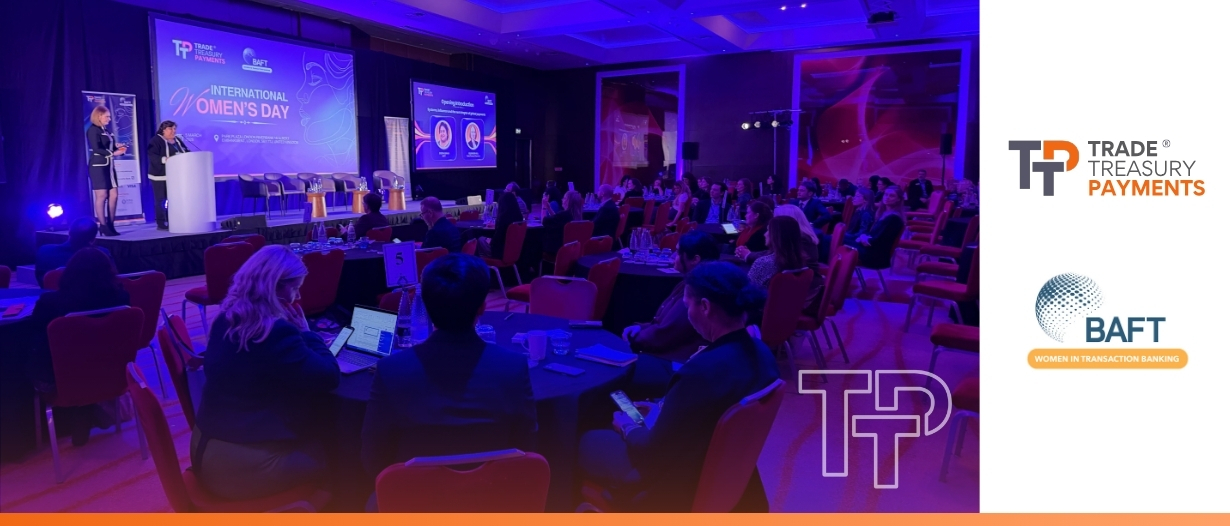
Coverage from BAFT Women in Transaction Banking and Trade Treasury Payments International Women's Day event
Live Updates
It’s a wrap!
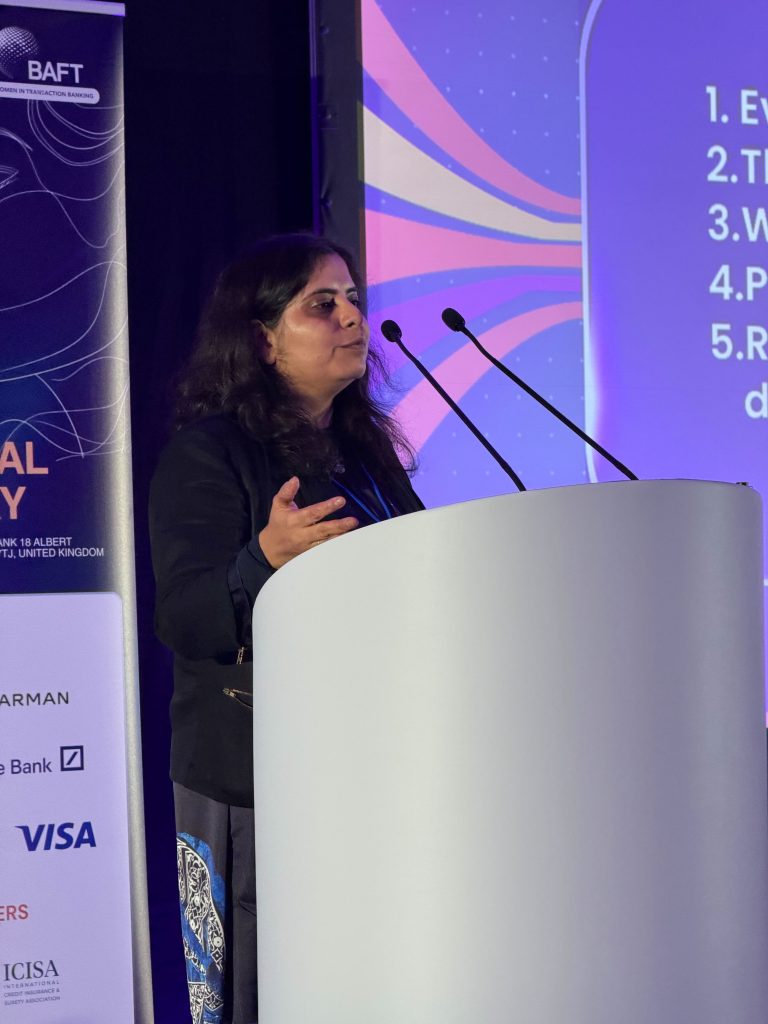
We are delighted to close our International Women’s Day event with a roundup and reflections from Shikha Kalra (FIS), Eglė Skomskytė (SWIFT), Merisa Lee Gimpel (Digital Trade Works), Henrietta Oram (Sullivan), and Ana Koritz (SAP Fioneer) on the future of cross-border payments and trade, and what we can do to keep the momentum on initiatives to #givetogain.
From discussions around parental leave to being intentional, the importance of being your authentic self to bringing others with you on their journey, a lot was uncovered, but there’s always more to do.
Thank you for joining us on this journey, from BAFT and Trade Treasury Payments!
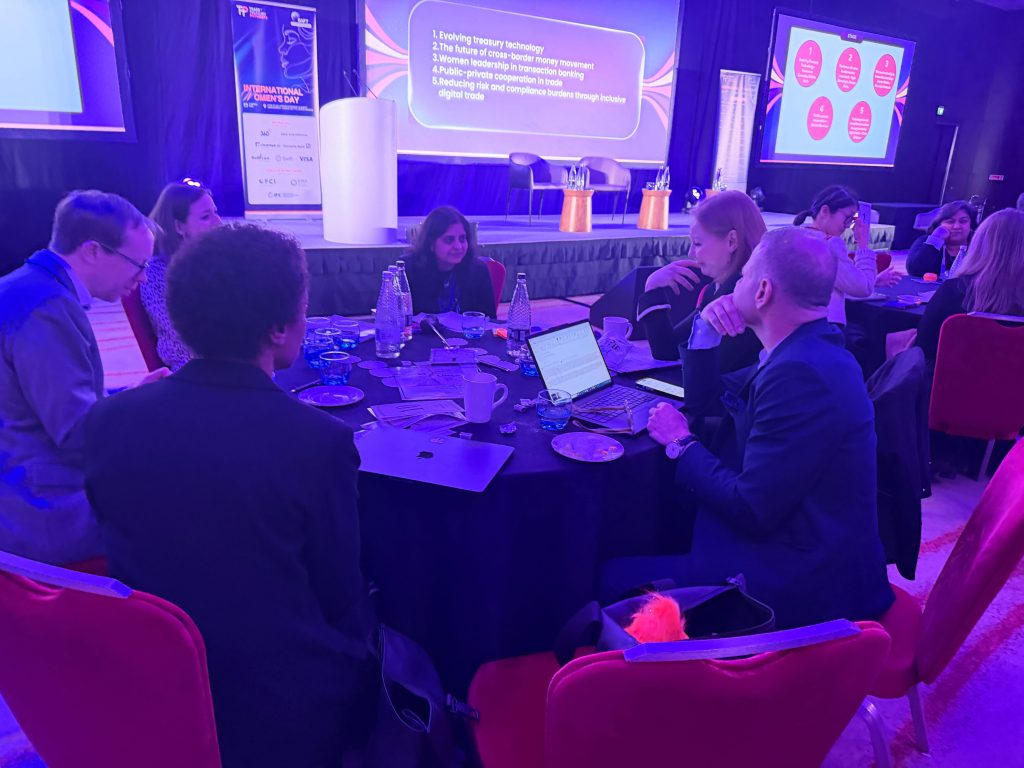
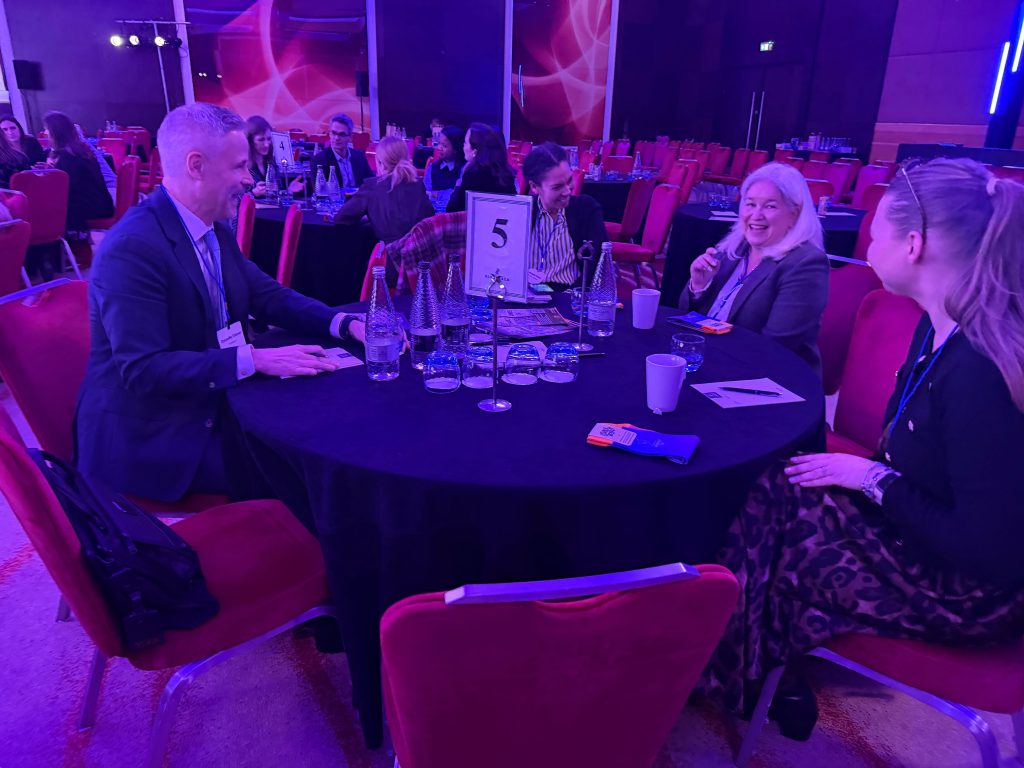
It’s roundtable time at the Trade Treasury Payments x BAFT International Women’s Day event in London!
We’re exploring the following themes, in a series of roundtables and intimate discussions:
- Evolving treasury technology
- The future of cross-border money movement
- Women leadership in transaction banking
- Public-private cooperation in trade
- Reducing risk and compliance burdens through inclusive trade
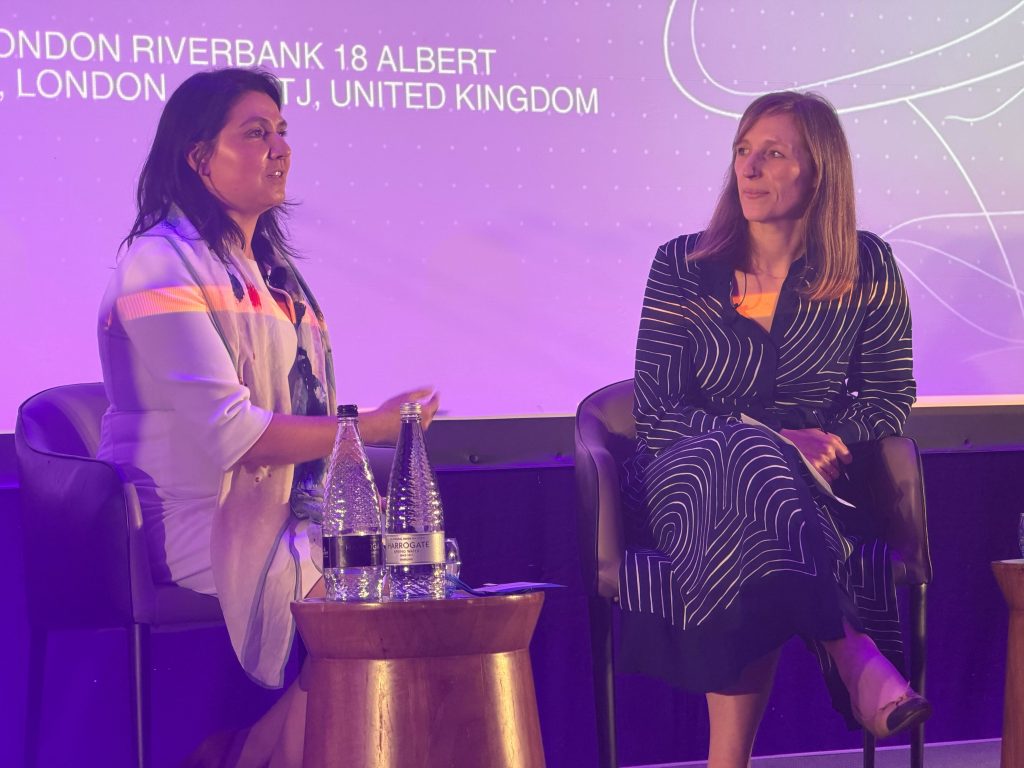
Public-private partnership: driving export development and inclusive tradeAt the TTP and BAFT Women in Transaction Banking conference in London, a fireside conversation examined how public-sector capital is shaping cross-border trade in an increasingly fragmented global economy.The discussion between Daniela Barrdear and Victoria d’Sylva explored the evolving role of export credit agencies (ECAs) in supporting exporters, strengthening supply chains and advancing broader development goals.A central theme was the balancing act ECAs face between commercial discipline and policy mandates. Institutions such as UK Export Finance must support viable transactions while also advancing government priorities including economic development, strategic supply chains and export diversification.The conversation also examined how export credit is increasingly being used to support resilient supply chains and industrial capacity, particularly as governments place greater emphasis on economic security and strategic industries.
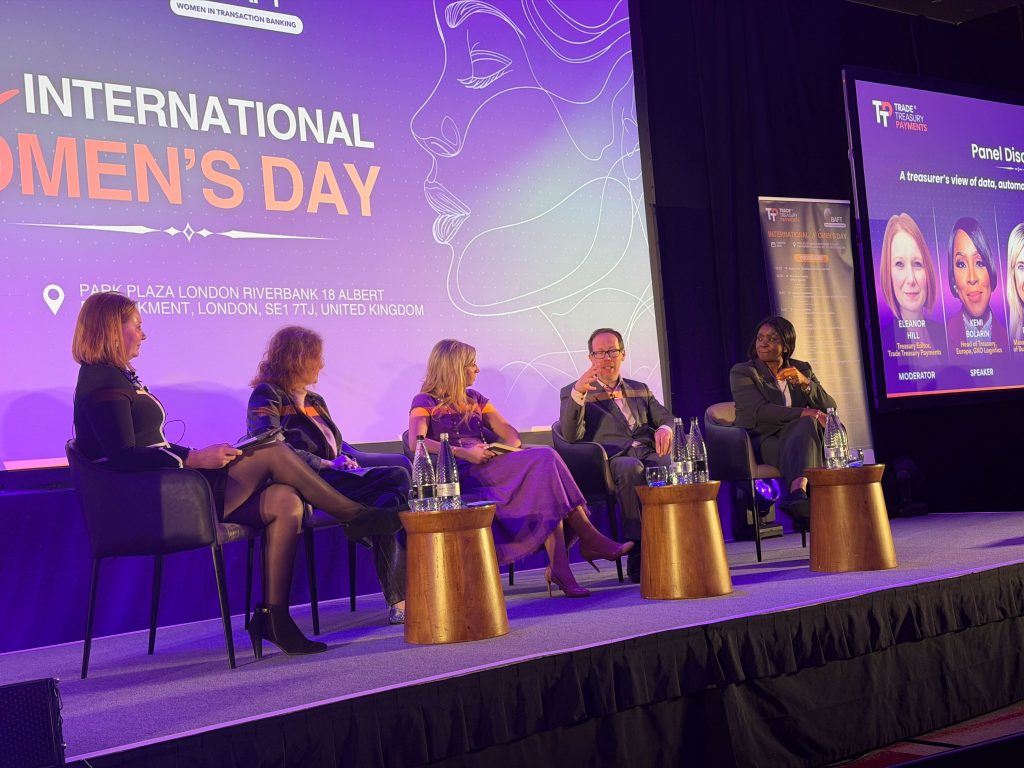
A treasurer’s view of data, automation and organisational change
At the TTP and BAFT Women in Transaction Banking conference in London, a panel moderated by Eleanor Hill explored how corporates are applying automation, AI and data-driven forecasting inside large treasury functions.
The discussion featured Kemi Bolarin, Rita King, Vanessa Manning and James Kelly.
A central theme was the gap between the strong narrative around automation and AI and the practical reality inside many organisations. The main barriers are rarely the technologies themselves but fragmented data environments, legacy systems and organisational readiness.
Large corporates often operate multiple ERP systems and inconsistent data structures following years of mergers and acquisitions, limiting the ability to automate processes or deploy AI-driven forecasting at scale.
Panellists also highlighted “pilot fatigue” among corporates testing multiple AI or automation solutions from different banking partners. With many organisations working with dozens of banks, running parallel proof-of-concepts can quickly become impractical.
The discussion pointed to the importance of standardisation, APIs and industry coordination to improve straight-through processing (STP). Initiatives such as ISO 20022 migration, utilities from SWIFT, and regulatory developments including confirmation and verification of payee frameworks (CoP/VOP) were cited as steps towards more consistent data and payment infrastructure.
The panel concluded that the next phase of treasury transformation will depend less on new tools and more on clean data, interoperable infrastructure and organisational change across corporates and banks.
Meet the women building the foundations of modern financeAt the TTP and BAFT Women in Transaction Banking conference in London, senior founders and product leaders discussed the shifts reshaping payments, treasury technology and financial infrastructure, and why women continue to remain underrepresented in building and funding the next generation of fintech.The panel featured Dr Ruth Wandhöfer, Adizah Tejani, Sara Castelhano, Yasemin Swanson and Zeynep Sayin.Opening the discussion, panellists noted that financial services infrastructure has historically been built around legacy structures and product assumptions shaped largely by male-dominated markets. As a result, supposedly gender-neutral financial products often fail to reflect the distinct financial realities and behaviours of women.Despite evidence that female-led fintech ventures frequently deliver strong returns, access to capital remains a major barrier, with many women founders citing funding constraints as the primary challenge when scaling businesses.Several themes emerged:
- Artificial intelligence is likely to drive the next wave of financial infrastructure innovation, with banks significantly increasing investment in AI-driven automation and analytics
- Real-time payments infrastructure continues to expand globally, with central banks accelerating domestic instant payment networks and linking them to cross-border initiatives
- Stablecoins and programmable settlement rails are creating new possibilities for faster value transfer and financial orchestration across platforms
- Identity, trust and cybersecurity will become increasingly central as commerce and payments move further into digital ecosystems
Panellists also highlighted the practical challenges of scaling B2B fintech ventures, particularly fragmented regulation across jurisdictions, operational resilience requirements, and the need to balance rapid innovation with risk management.
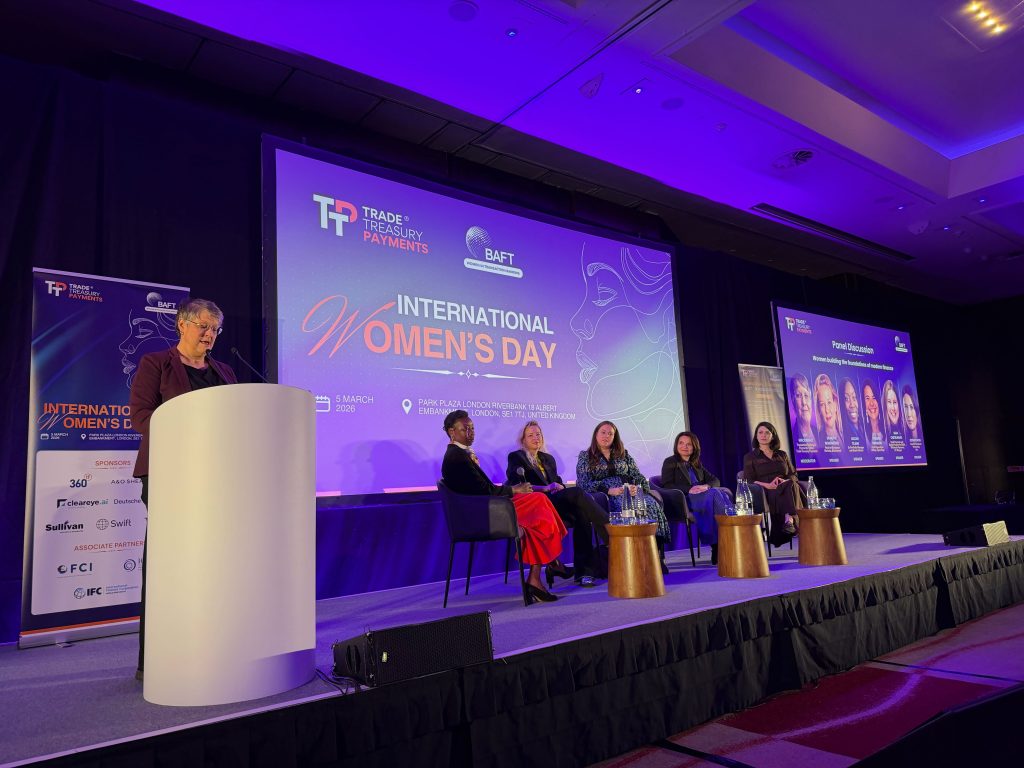
At the Trade Treasury Payments and BAFT International Women’s Day event in London, the keynote address was delivered by Nicole Sandler, Ubyx, who spoke on “Liquidity and the new economics of speed.”
Opening with a personal reflection, Sandler recalled that when she first began speaking at industry conferences more than a decade ago she was often one of only a handful of women in the room, sometimes the only woman on a panel. While progress has been made, she argued that diversity is not about optics but about improving decision, making in a global financial system.
“The problems we are trying to solve are global and cross-border,” she noted, adding that infrastructure decisions benefit from perspectives shaped by different markets and experiences.
Turning to the evolution of payments infrastructure, Sandler compared today’s correspondent banking system to traveller’s cheques — once a trusted mechanism for moving value across borders that was ultimately replaced by faster and more scalable alternatives such as card networks.
Correspondent banking has successfully moved trillions of dollars for decades, she said, but it was designed for a world of batch processing and T+2 settlement, whereas financial markets are increasingly moving towards real-time payments and liquidity.
For corporate treasurers, this shift could reshape how liquidity is organised. Rather than managing hundreds of bank accounts across jurisdictions, future treasury models could see operational cash concentrated in enterprise wallets holding tokenised deposits, stablecoins and digital money market instruments.
Sandler emphasised that achieving this will require institutions to compete on services while collaborating on shared infrastructure, particularly around standards, governance and interoperability. 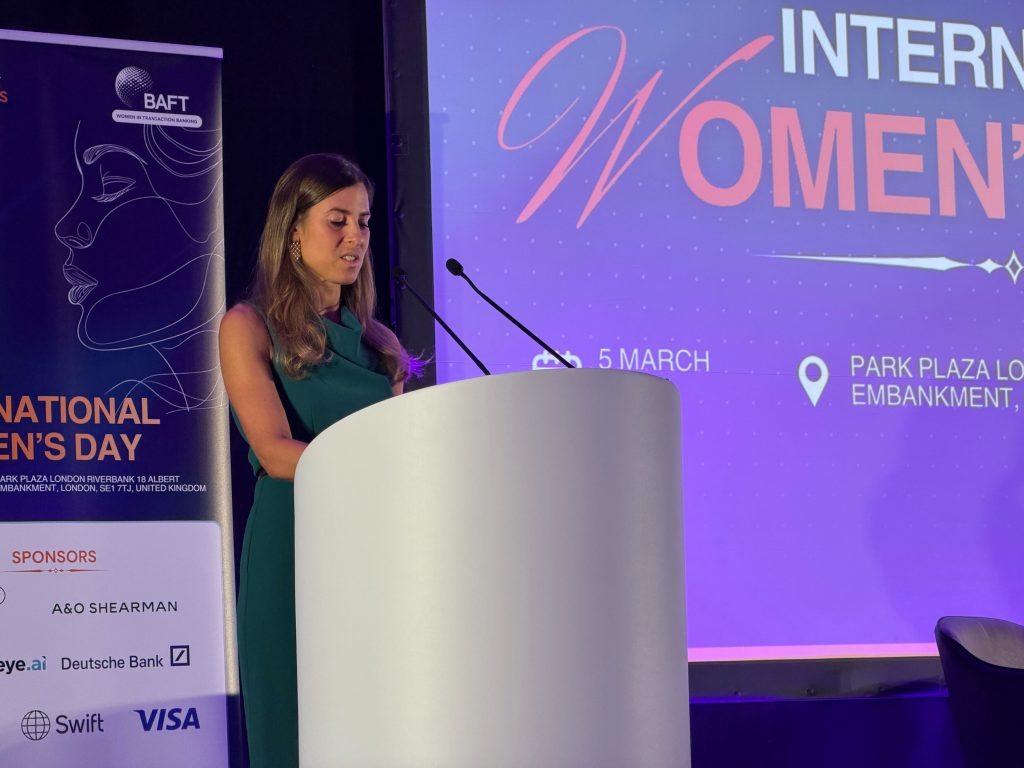
It’s a full house, at the Trade Treasury Payments, BAFT event in London: International Women’s Day.
Joy Macknight, Transaction Banking and Payments Editor, and Tod Burwell, President and CEO of BAFT, and TTP Editorial Board Member, open the conference.
Stay tuned for updates!
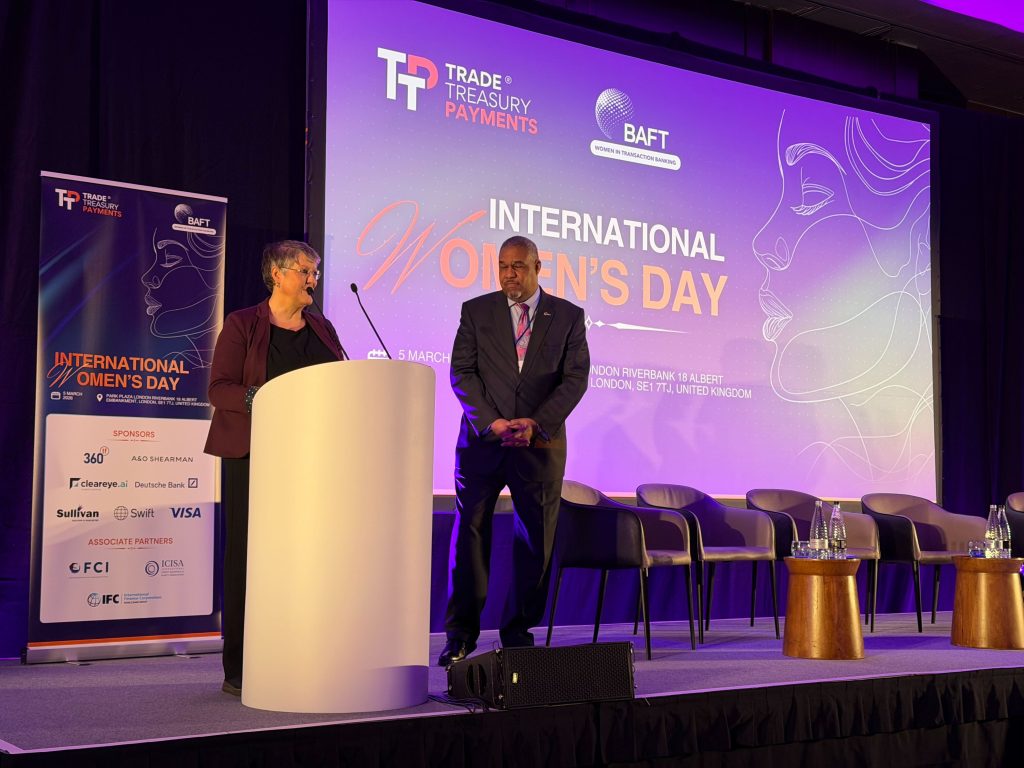
International Women’s Day event at Trade Treasury Payments opened with remarks from Deepa Sinha, BAFT, and Eleanor Hill, reflecting on why such initiatives have been established and how the industry must continue amplifying diverse voices across trade, treasury and payments.
Hill noted that when Trade Treasury Payments launched last year, the aim was to support independent publishing that contributes to wider societal gain, including creating space for a broader range of perspectives across the sector.
She also highlighted that significant disparities remain. Globally, women perform over 60% more unpaid labour than men, while financial services continues to exhibit one of the widest gender pay gaps, estimated at 27.2% globally, compared with 12.8% across UK industries overall.
The narrative is not solely about challenges. Women are increasingly shaping the future of financial services, from innovation in payments and fintech to leadership in treasury and cross-border finance.
We’ll be uncovering key themes covered throughout the afternoon including:
The impact of real-time settlement and faster payments on liquidity management and treasury strategy
Leadership challenges and opportunities for women working across payments, treasury technology and supply chain data
The growing importance of data, automation and organisational change within corporate treasury functions
How state-backed capital and export finance can support development, resilience and more inclusive global trade
Moderated breakout discussions exploring cross-border finance, technology, and leadership in a changing financial landscape
There are encouraging signs for the future, including research showing that around 40% of AI engineers in financial services are women, highlighting the role female talent is already playing in shaping the next phase of industry innovation.
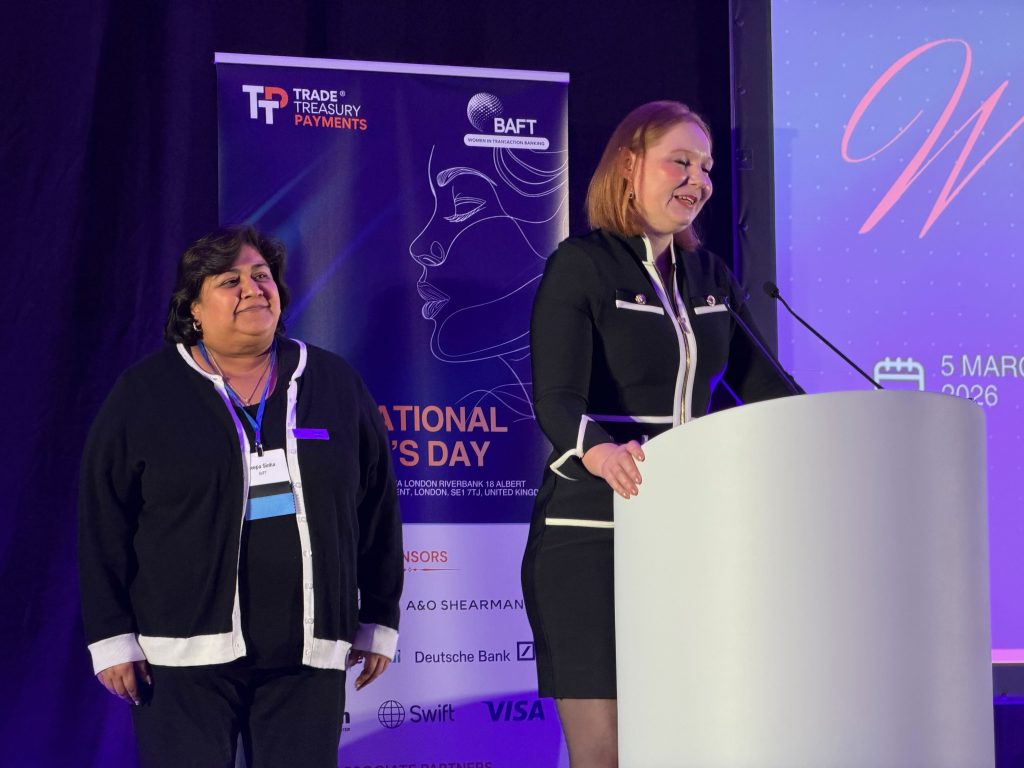
In this short video, Eleanor Hill and Joy Macknight reflect on the significance of International Women’s Day and its importance to the global trade, treasury and payments community.
They also share a brief look at what to expect from the TTP and BAFT Women in Transaction Banking event, highlighting the themes and conversations shaping the programme.