
India and New Zealand’s ‘once-in-a-generation’ free trade agreement

Devanshee Dave
Reporter, Trade Treasury Payments
Published 29 Apr 2026
Live Updates
India and New Zealand have formalised a landmark free trade agreement (FTA) described by New Zealand’s Prime Minister as a “once-in-a-generation” pact.
Signed in New Delhi on 27 April 2026, this agreement is a milestone in bilateral economic relations and opens new avenues for trade and investment for the two nations.
India and New Zealand signed a trade deal after nearly a decade of negotiations, aiming to strengthen economic ties in a changing global trade environment. The agreement was signed by India’s Commerce and Industry Minister Piyush Goyal and New Zealand’s Trade and Investment Minister Todd McClay during a ceremony with business leaders from both countries.
Negotiations began in March 2025 and were finalised in December 2025, making this one of the fastest concluded FTAs in India’s trade history. The expedited timeline shows the urgency felt by both nations to secure stable and diversified trade partnerships amid rising global trade tensions and disruptions.
A glance at the key provisions and market access
The agreement allows India duty-free access for all its exports to New Zealand, while New Zealand will eliminate or reduce tariffs on 95% of its exports to India.
This reciprocal market access will boost bilateral trade, which was valued at approximately $2.15 billion in the year through June 2025.
Indian sectors that will benefit from expanded market access include textiles and apparel, engineering goods, leather and footwear, and marine products. Meanwhile, New Zealand is expected to boost exports in horticulture, timber, coal, wool, and meat.
India has excluded dairy and certain agricultural products from the deal to protect its domestic agriculture.
Investment and labour mobility commitments
A feature of the agreement is New Zealand’s commitment to invest $20 billion in India over the next 15 years.
This would support manufacturing, infrastructure, services, innovation, and job creation, further strengthening economic ties.
The pact also facilitates labour mobility by allowing up to 5,000 Indian professionals to work in New Zealand at any given time, with visa stays permitted for up to three years. This provision aims to enhance people-to-people connections and support skills exchange between the two countries.
Tariff rate quotas and safeguards for agricultural products
The agreement establishes Tariff Rate Quotas (TRQs) and Minimum Import Prices (MIPs) to protect sensitive domestic agricultural sectors.
It also allows New Zealand agricultural products access to the Indian market.
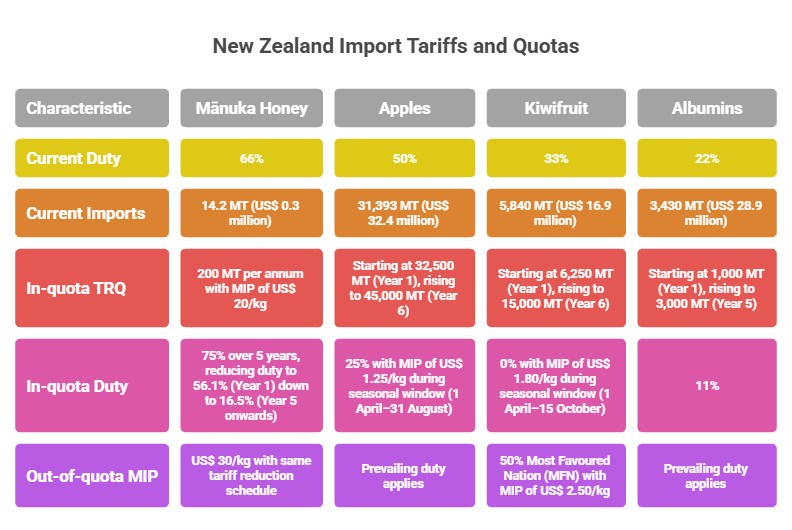
All TRQs for these products are paired with delivery on Agriculture Productivity Action Plans and monitored by a Joint Agriculture Productivity Council (JAPC).
This council ensures a balance between market access and the protection of domestic farmers, supporting sustainable agricultural growth.
What is the strategic significance amid global trade challenges?
The deal comes at a time when India is actively diversifying its export markets to offset the impact of steep tariffs imposed by the United States and disruptions in global shipping and energy routes due to geopolitical conflicts.
For New Zealand, the agreement is part of a broader strategy to reduce reliance on China, its largest trading partner, and to expand economic partnerships in the Indo-Pacific region.
Commerce Minister Piyush Goyal described the agreement as a “defining milestone,” emphasising that India and New Zealand have “chosen each other” as reliable partners during a period when the global economy is being reshaped.
He quoted, “The India–New Zealand Free Trade Agreement marks a defining milestone in India’s engagement with the developed world. It reflects Prime Minister Narendra Modi’s vision of global economic partnerships for our farmers, women, youth, artisans and entrepreneurs. This is India’s 9th Agreement in the past few years- with 38 developed countries. At the heart of the agreement is the empowerment for exports, agricultural productivity, student mobility, skills, investment and services. The investment commitment of USD 20 billion from New Zealand signals strong confidence in India’s growth story. It places special emphasis on strengthening MSMEs, fostering innovation, and enabling women-led enterprises to thrive in global markets.”
Todd McClay characterised the pact as a “once-in-a-generation” opportunity to deepen economic ties amid rising global trade uncertainties, highlighting the importance of strong, reliable partnerships.
While the agreement has received support from New Zealand’s opposition Labour Party, it faces opposition from the coalition partner New Zealand First, which criticises the deal for conceding too much on immigration and insufficient returns for New Zealanders.
The FTA now awaits ratification by the New Zealand Parliament, with expectations that it will pass given the Labour Party’s backing.
“The India–New Zealand Free Trade Agreement was concluded in nine months and marks a key milestone in India’s engagement with developed economies, aligned with the vision of Viksit Bharat 2047. India is signing its seventh FTA in the last three and a half years, with plans for agreements with the European Union and the United States, taking the total to nine FTAs with 38 advanced economies, covering nearly 65–70% of global GDP,” said Mr Goyal.
He also highlighted expected US$20 billion investment inflows under the agreement and said New Zealand has opened access in 118 sectors, with MFN commitments in 139 sectors.
Experts note that while the India-New Zealand FTA is relatively small in scale, it serves as a symbolic framework for India to expand its export options and adapt to a rapidly evolving global trade environment where traditional rules-based systems are under strain.