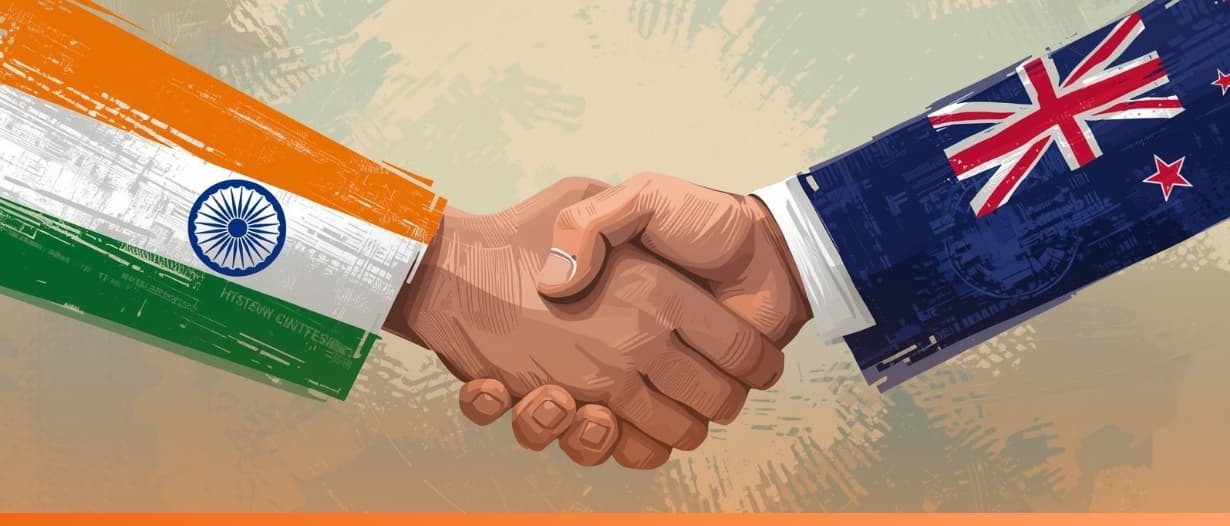
India and New Zealand have finalised a comprehensive free trade agreement (FTA) on 22nd December 2025. Prime Ministers Narendra Modi and Christopher Luxon announced the deal during a virtual ceremony, marking a significant development in bilateral economic relations.
The agreement grants India zero-duty access for all its exports to New Zealand. This covers textiles, apparel, leather products, footwear, marine products, gems, jewellery, handicrafts, engineering goods, and automobiles.
New Zealand secured duty concessions on 70% of India’s tariff lines, covering 95% of its current exports to India. Nearly 57% of New Zealand exports will become duty-free in India “from day one,” with remaining reductions implemented in phases over periods ranging from immediate elimination to 10-year transition periods.
The FTA will create valuable opportunities for exporters from both countries, supporting New Zealand’s goal of doubling export value in 10 years. India currently ranks as New Zealand’s 12th largest goods and services export market, accounting for 1.5% of New Zealand’s exports.
Current bilateral merchandise trade stands at $1.3 billion in 2024-25, with total goods and services trade at $2.4 billion in 2024.
Investment commitments and benefits for Indian talent
New Zealand has pledged to invest $20 billion in India over a 15-year period, focusing on agricultural technology, renewable energy, and infrastructure development. This follows a framework similar to the European Free Trade Association model, targeting manufacturing, infrastructure, services, innovation, and job creation.
The labour mobility provisions are also a significant breakthrough. For the first time, New Zealand has signed an Annexe on Student Mobility and Post Study Work Visas with another country. The arrangement guarantees Indian students the right to work 20 hours per week during studies. Post-study work visas extend up to three years for graduates with bachelor’s degrees in Science, Technology, Engineering and Mathematics, up to three years for master’s degree holders, and up to four years for doctoral graduates.
The agreement also simplifies visa processes for skilled Indian professionals and recognises qualifications in information technology, healthcare, and engineering sectors.
Services: A new frontier in trade
New Zealand has offered market access in 118 services sectors and sub-sectors and extended Most Favoured Nation treatment in 139 services sectors. India, in turn, has granted New Zealand market access in 106 service sectors and MFN treatment in 45 sectors.
The agreement includes an annexe on health and traditional medicine services to promote trade in these areas.
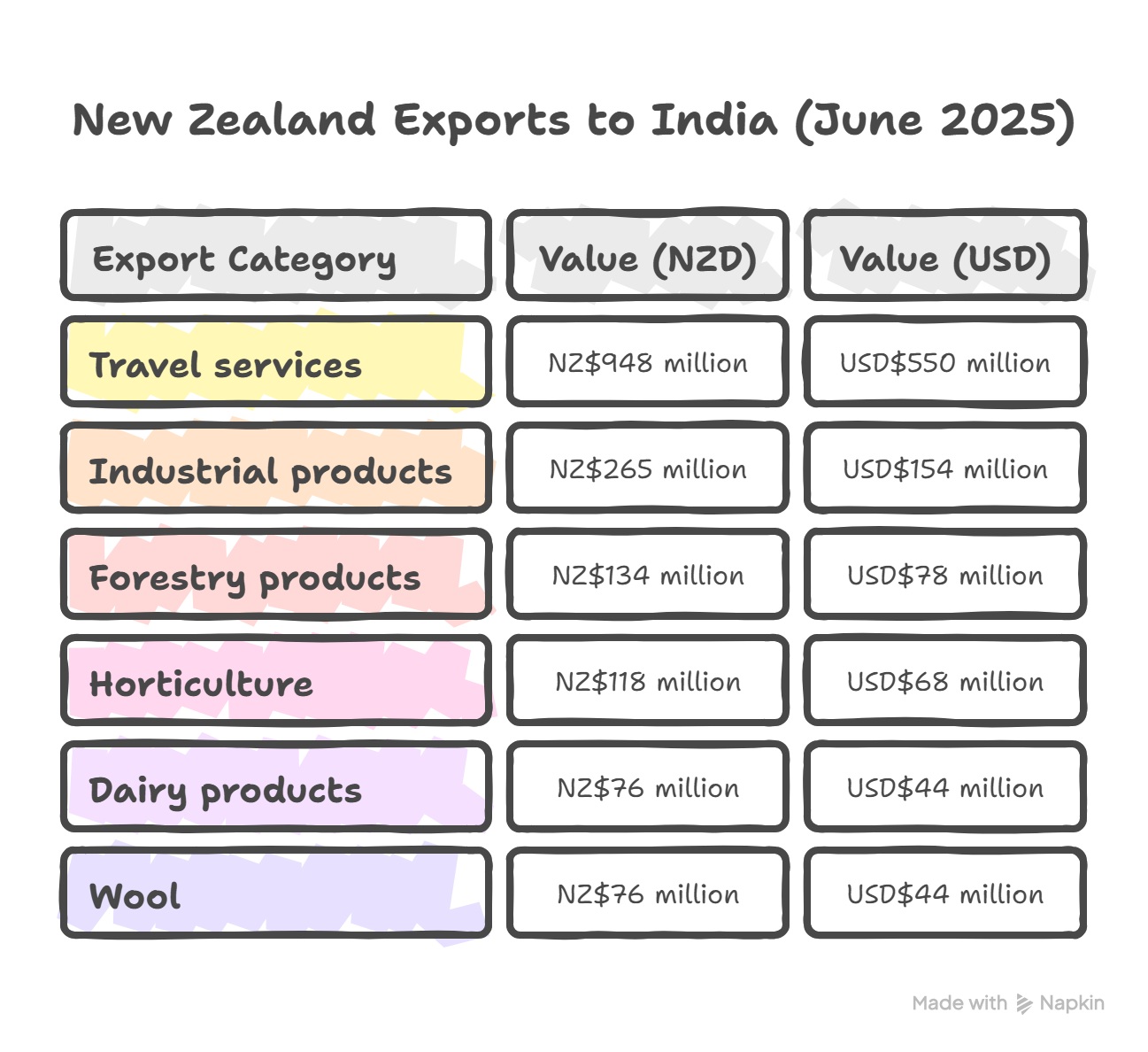
New Zealand’s key exports to India in the year ending June 2025 included the following.
Tariff reductions and economic benefits
The agreement will eliminate tariffs immediately on day one for more than half of New Zealand’s exports and for over 80% once the FTA is fully phased in. The average tariff applied to New Zealand’s current exports will drop to just 3%.
Estimated tariff savings on day one amount to $43 million, growing to $62 million based on current trade levels. These savings are expected to increase with the anticipated growth in trade resulting from the FTA.
In services and wine, gains are future-proofed with a commitment that any better outcome offered to India’s FTA partners will be automatically extended to New Zealand. Similarly, the FTA contains a consultation commitment for dairy should India offer tariff concessions to a comparable economy in future.
The agreement includes streamlined customs processes at the border, reduced transaction costs, increased transparency, and greater certainty for exporters. Under the terms, India Customs will release all goods within 48 hours, and in the case of perishable goods and express consignments, endeavour to do so within 24 hours.
Seeds of cooperation: Agricultural partnership
India has carefully excluded several sensitive agricultural products from tariff liberalisation, which includes i) dairy products: milk, such as cream, cheese, yoghurt, whey, caseins ii) agricultural goods such as coffee, onions, sugar, spices, edible oils. Other protected items include rubber, precious metals (gold and silver), precious-metal scrap, and copper cathodes.
These exclusions protect India’s agricultural sector, which employs a significant portion of the country’s workforce.
However, the deal also offered New Zealand secured duty-free access for sheep meat, wool, coal, and nearly all forestry and wood exports. Its dairy industry gained duty-free pathways only for ingredients and preparations meant for re-export from India.
The agreement places strong emphasis on agricultural cooperation. Indian farmers will gain improved access to New Zealand’s market for products such as fruits, vegetables, coffee, spices, cereals, and processed foods.
Through initiatives such as the Agricultural Productivity Partnership, Centres of Excellence, and access to New Zealand’s advanced agricultural technologies, farmers are expected to benefit from higher productivity, improved quality, and increased incomes. Targeted measures for horticultural products, including honey, kiwifruit, and apples, aim to support sustainable growth in the sector.
India, New Zealand, and the US: What is the strategic context?
This agreement follows India’s recent deals with the United Kingdom in July and Oman earlier this month, part of Modi’s trade diversification strategy amid rising global protectionism.
The deal comes as the United States, under Trump, imposed tariffs up to 50% on Indian goods exports, including 25% duties for India’s purchases of Russian oil. After these August tariffs, India’s exports to the US fell nearly 12% in September and 8.5% in October before growing 22.6% in November.
Indian Commerce Minister Piyush Goyal emphasised that the FTA aims to double bilateral trade over the next five years, calling it “balanced and equitable” that “creates new opportunities for Indian businesses while protecting sensitive sectors.”
For New Zealand, India is a strategic priority because of its growing global influence, economic scale, and regional importance. The partnership helps New Zealand support a stable, rules-based trading order and advance shared interests in security and prosperity. India’s 300,000-strong diaspora in New Zealand forms what officials call a “living bridge” that strengthens cultural, commercial, educational, and social connections.
What is the implementation roadmap?
India is the fastest-growing G20 economy and by 2030 is expected to become the world’s third-largest economy (with a GDP of US$7 trillion) and to have a middle class of more than 700 million. This presents significant potential for growth not only for New Zealand’s premium food, beverage, and consumer goods exports but also for tech and services exporters in sectors like gaming, education, tourism, and fintech.
The agreement establishes a Joint Commission of ministerial representatives meeting annually, with specialised working groups addressing technical barriers, sanitary measures, and customs procedures.
As with New Zealand’s other trade agreements, the FTA includes a Treaty of Waitangi exception that protects the New Zealand Government’s ability to adopt any policy it considers necessary to fulfil its obligations to Māori.
New Zealand Prime Minister Luxon projected his country’s exports to India will increase by $1.1-1.3 billion annually over the next two decades.
As global trade faces geopolitical tensions and economic nationalism, this agreement represents a strategic move by both countries to secure their economic interests in an uncertain international environment.
The formal signing will occur in the first quarter of 2026, followed by ratification in both countries. A review clause allows adjustments after one year of implementation.