
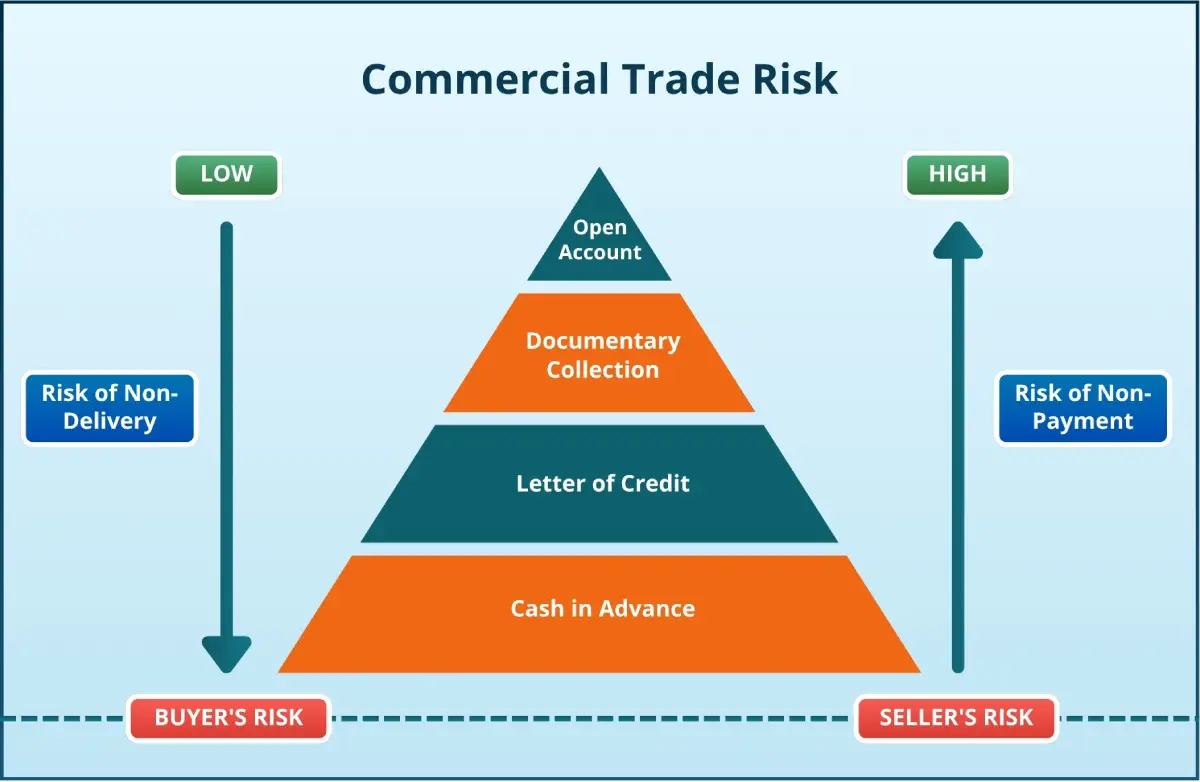
Documentary Collections (“Collections”) occupy a distinctive position within the landscape of international trade finance. They sit between open account trading, where goods and documents flow with minimal banking involvement, and Documentary Credits, where banks assume a central and risk-bearing role.
For many exporters and importers, Collections offer a pragmatic balance: greater control over documents than open account, but at a lower cost and with fewer formalities than a Documentary Credit.
Historically, Documentary Collections have been widely used in established trading relationships where a degree of commercial trust exists, but where the seller may be able to retain documentary control over the release of goods. By channelling shipping and financial documents through the banking system, Collections provide a structured mechanism for payment or acceptance, without requiring banks to issue independent payment undertakings. This makes them particularly attractive in markets where cost sensitivity is high, or where the transaction does not justify the complexity of a Documentary Credit.
At the same time, Collections are often mischaracterised as a form of “light” trade finance. In reality, they are governed by a welldefined international framework, the Uniform Rules for Collections (URC 522), which describe the specific roles, responsibilities, and procedural disciplines for the banks involved. Understanding those roles, and the limits of what Collections do and do not provide, is essential for exporters, importers, and bankers alike.
Unlike Documentary Credits, Collections do not shift commercial risk onto the banking system. The seller remains exposed to the buyer’s willingness and ability to pay, and the banks act primarily as intermediaries, handling documents in accordance with instructions. This distinction shapes everything from document examination standards to risk management expectations and dispute resolution.
This paper sets out the fundamentals of how Collections operate, the key parties involved, and the typical release conditions used in practice. It also highlights important areas of confusion, including the use of terminology such as “collecting” and “presenting” banks, and the circumstances in which banks may assume a more active role through instruments such as avalised drafts or promissory notes.
In preparing this guide, reference has been made to the BAFT Collections Manual (2018), published by the BAFT Commercial Letter of Credit Committee. That manual remains a valuable industry resource, particularly in its treatment of U.S. market practices and its comprehensive coverage of clean, cheque, and documentary collections. In contrast, the present guide takes a more internationally oriented perspective and focuses exclusively on collections.
In contrast, the present guide takes a more internationally oriented perspective and focuses exclusively on collections. While drawing on certain elements from the BAFT Collections Manual (2018), this publication narrows the scope to the documentary process itself, its practical application under URC 522 and eURC 1.1, and the operational considerations most relevant to exporters, importers, and trade professionals engaged in goods related transactions.
By understanding what Collections are designed to achieve, and just as importantly, what they are not, practitioners can use them more effectively, manage risk more realistically, and avoid misplaced expectations about the protection they offer.