
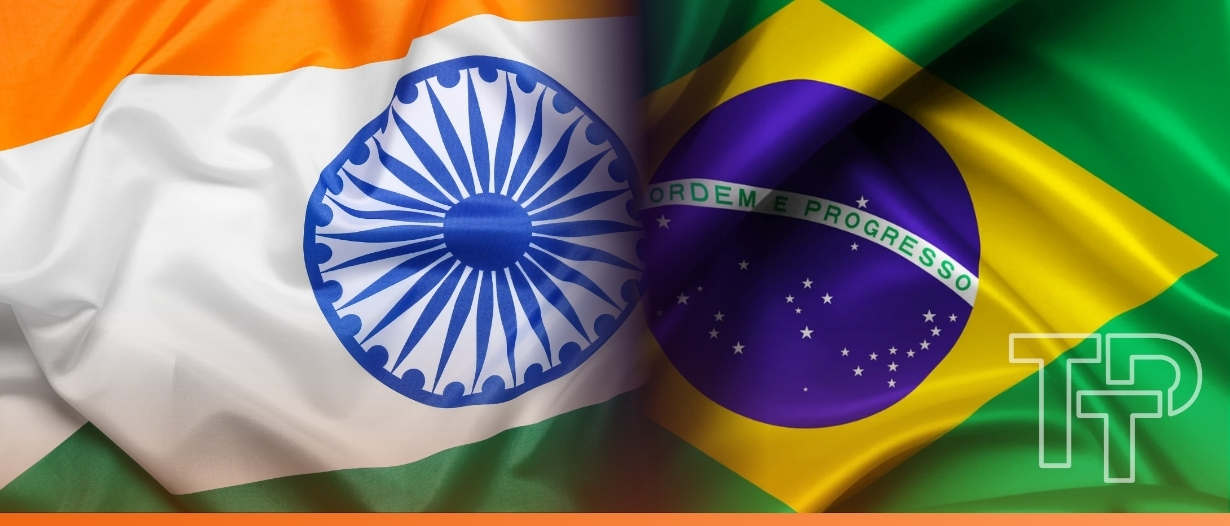
India and Brazil sign MoUs on critical minerals, pharmaceuticals, and trade

Devanshee Dave
Reporter, Trade Treasury Payments
Published 23 Feb 2026
Live Updates
India and Brazil have strengthened their strategic partnership through the signing of five key Memoranda of Understanding (MoUs) during Brazilian President Luiz Inácio Lula da Silva’s state visit on 21 February 2026.
The MOUs focus on key sectors including MSMEs, pharmaceuticals, steel, postal services, and trade.
The newly charted roadmap aims to leverage Brazil’s abundant critical mineral resources, such as lithium, niobium, and iron ore, to support India’s steel and energy transitions.
Simultaneously, it seeks to integrate the MSME sectors of both countries through green finance initiatives and sustainable technologies.
India’s Union Minister Shri Piyush Goyal described the current bilateral trade engagement, which has grown by 25% over the past year to USD 15 billion, as suboptimal, calling for a more ambitious expansion.
India-Brazil’s strategic roadmap
A central pillar of the partnership is the establishment of an institutional framework for the sustainable development of raw materials critical to India’s industrial ambitions. This includes manganese, nickel, and niobium, which are essential for India’s goal to expand its steelmaking capacity to 218 million tonnes.
The MoU promotes joint investments in mining infrastructure and the application of Artificial Intelligence (AI) for geoscientific data analysis, enhancing mineral exploration efficiency and precision.
Additionally, recognising the vital role of Micro, Small, and Medium Enterprises (MSMEs) in economic growth, the partnership creates a platform for these businesses to explore mutual benefits in technology transfer and market access.
The MoU facilitates access to green finance, enabling MSMEs to integrate into global value chains while improving productivity and sustainability. This initiative aligns with global climate goals and supports the green transition at the grassroots level.
The agreement enhances cooperation between India’s Central Drugs Standard Control Organisation (CDSCO) and Brazil’s National Health Surveillance Agency (ANVISA). It allows for the exchange of information on pharmaceutical ingredients, drugs, and medical devices, promoting regulatory alignment.
This will ensure the availability of safe, quality-assured, and affordable healthcare solutions in both countries, reinforcing public health objectives.
India is becoming a trusted destination for global business, attracting nearly USD 80 billion in FDI in 2025, the highest amount in a single year.
India’s access to two-thirds of global trade through Free Trade Agreements positions the enhanced India–MERCOSUR partnership to transform global value chains, promoting shared innovation and stronger South-South cooperation.
The partnership establishes a five-year institutional framework to modernise postal systems through cooperation on digital transformation, e-commerce logistics, financial inclusion, capacity building, and coordination in multilateral postal forums.
This would improve connectivity and service efficiency, supporting broader economic integration.
The steel supply chain MoU, and how would it benefit India?
This agreement aims to secure the long-term growth of India’s steel sector by leveraging Brazil’s status as a leading global producer of iron ore and niobium. Beyond trade facilitation, the MoU emphasises a technology-led transformation of the value chain. It promotes the use of AI for geoscientific data analysis and the adoption of advanced mineral processing and recycling technologies.
This ensures that India’s expanding steelmaking capacity is supported by a resilient, data-driven, and environmentally sustainable supply of critical raw materials.
India’s partnership signifies a shift from regional ties to global supply chain independence, focusing on industrial growth through dependable alliances.
Gaining reliable access to Brazilian lithium and niobium, India would be able to avoid global price volatility, which threatens its energy transition and high-tech manufacturing.
Additionally, providing green finance access to MSMEs aligns the smallest engines of India’s economy with global sustainability goals.
Shri Goyal described Brazil’s strengths in natural resources, agriculture, aerospace, automotive, and digital technologies as key areas for collaboration. India also invited Brazilian companies to partner and co-create jobs, add value, and leverage technology.