

IFC launches inaugural Trade Finance Synthetic Securitisation to mobilise private capital for emerging markets

Devanshee Dave
Reporter, Trade Treasury Payments
Published 13 May 2026
Live Updates
The International Finance Corporation (IFC), the World Bank Group’s private-sector arm, has announced the signing of its inaugural Trade Finance Synthetic Securitisation (TFSS), a transaction designed to mobilise private capital to support trade and job creation in emerging markets.
This transaction complements the recent launch of IFC’s Emerging Market Securitisation Program (EMSP), a strategic initiative to channel private investment into emerging economies.
Makhtar Diop, Managing Director, IFC, said, “Trade and supply chain finance is one of the most effective ways to close the financing gap faced by small and medium-sized enterprises in emerging economies, a critical driver of job creation.”
“This securitisation demonstrates that, with the right structuring and standardisation, investor demand can be mobilised at scale and with measurable impact, even in the most challenging markets.”
Transaction overview and portfolio composition
The TFSS transaction comprises a $500 million portfolio of trade assets originated under IFC’s Global Trade Finance Program (GTFP).
Over half of the portfolio is invested in low-income, fragile, and conflict-affected states, which shows IFC’s commitment to challenging and underserved markets.
Over the past two decades, the GTFP has enabled trade finance transactions worth nearly $137 billion in over 100 emerging markets, significantly supporting global trade.
The transaction features a private capital mobilisation ratio of up to 1:19. This means that for every dollar of risk retained by IFC, private investors assume up to nineteen dollars of risk.
By transferring credit risk to private investors, IFC effectively expands its capacity to issue new trade finance guarantees precisely where they are most needed.
Structure and tenor of the transaction
The TFSS transaction involves short-term trade assets with an average duration of six months. It spans three years and includes a two-year replenishment mechanism.
This ensures that private risk participation is available to support new trade flows for up to three years and provides sustained liquidity and risk-sharing capacity.
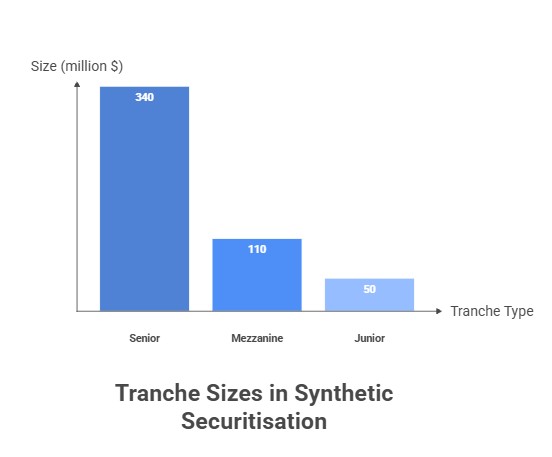
The synthetic securitisation is divided into three tranches, reflecting varying investor risk appetites: i) senior tranche ($340 million) ii) mezzanine tranche ($110 million) iii) junior tranche ($50 million).
The transaction attracted strong interest from institutional investors. The senior and mezzanine tranches were privately placed on an unfunded basis with five investors. This includes Deutsche Bank, Santander CIB, AXA XL, AXIS Capital, and Liberty Speciality Markets. Deutsche Bank served as the arranger and placement agent for these tranches.
The junior tranche was placed separately with Newmarket, completing the capital structure.
What are the implications for emerging markets?
This innovative TFSS transaction is a milestone in IFC’s efforts to leverage private capital for trade finance in emerging markets. By enabling risk transfer and expanding guarantee capacity, the securitisation supports SMEs, which are vital engines of economic growth and employment.
The success of the transaction showcases that well-structured synthetic securitisations can attract various investors and provide measurable developmental impact, even in fragile or conflict-affected areas.