

At FCI’s 58th Annual Meeting in Lisbon, Michael Harte, Head of Global Receivables Finance & Open Account Products at Lloyds Bank, explained warehouse financing to TTP: what it does, who it’s for, and where it goes wrong.
Every trade finance structure can, in the end, be drawn on the back of a napkin. This one came close: Sheraton notepaper, June, Lisbon. Harte began where the industry often does, with a triangle. “You’ve always got the same three minimum players in an open account product,” he said. “Your seller, your buyer, and then your primary bank.”
The triangle has served for a long time because it describes almost everything. Goods flow one way, money flows the other, and a bank finances the interval in between, either from the seller’s side as a receivable (receivables finance) or from the buyer’s side as a payable (supply chain finance). What it has never described well is the stock itself: the widgets, as Harte’s sketch had it, sitting in a warehouse waiting for someone to pay for them.
Banks stop holding the goods
Banks used to occupy that middle ground themselves. A generation ago, a bank might run its own desk holding inventory for clients, and that was roughly when the appetite ran out. “Banks don’t want random assets,” Harte said. A bank is not an inventory manager. And when a client structure failed, the bank discovered what it had been holding. “You’ve bought something as a bank believing it to be X, with X value, and in actual fact the due diligence failed and it isn’t worth what you thought.” A lender that unexpectedly becomes the owner of a warehouse full of specialist components may have little knowledge of how to value, store or sell them.
The accountants finished what the credit committees started. If the company holding the stock is owned or controlled by the bank, is the arrangement genuinely off the client’s balance sheet, or is it a loan in fancy dress? Under both US GAAP and IFRS, the question kept returning to the same answer: the structure behaved like a loan, and a loan belongs on the balance sheet. Accounting standards and disclosure requirements have only reinforced that distinction in recent years, increasing scrutiny of how such arrangements are reported to investors.
So the banks gave up holding the goods, and independent providers took the work, and with it a corner of the drawing. They supply the special purpose vehicle, or SPV – a company built to do one job. Silver Birch and Pemberton are among the structured-finance boutiques in this market. “Your trifecta,” Harte said, “suddenly becomes more of a four-corner model.”
Three corners become four: Harte’s sketch of the model, with Lloyds, seller, buyer and SPV around the edges and the widgets in the middle. Sheraton Lisboa, June 2026
Two years of stock, two years to pay
Harte gives a live example, a client that came to Lloyds. The widget in this deal, the goods in the middle of the drawing, is a component used in fibre-optic cables, and the corporate depends on it enough to want eighteen months of stock in a single order. Partly this is insurance against disruption. Partly it’s commerce. A seller that is offered eighteen months of revenue upfront will negotiate, and can put the cash to work in its own business; Harte put the discount at ten per cent. The difficulty is that the buyer would rather not pay for eighteen months of components on day one, and would rather not warehouse them either. “Can you have your cake and eat it?” Harte said. “Well, almost, you can.”
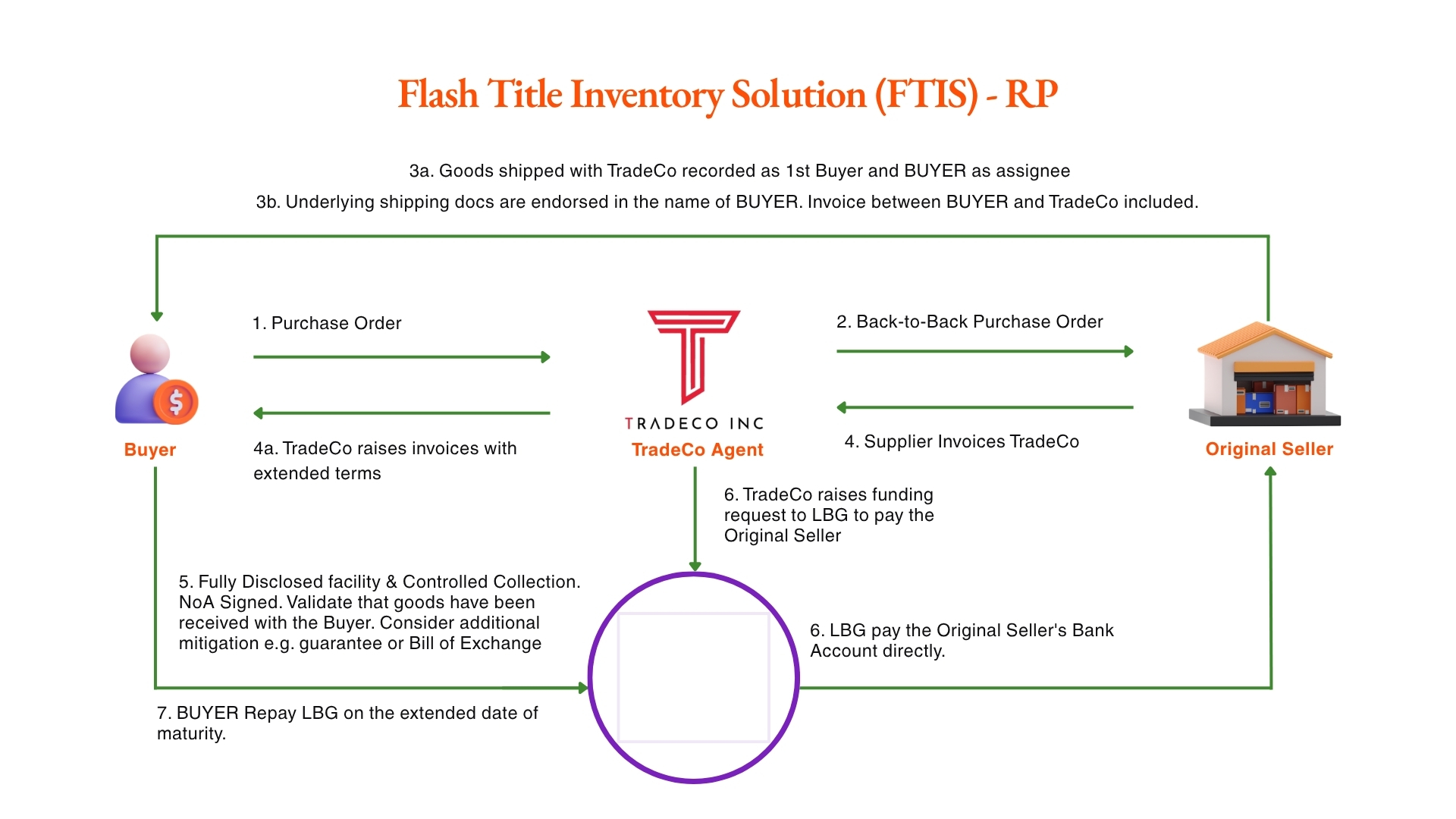
The “almost” is the SPV. It comes between the buyer and the goods in one of two ways. In an inventory hold, it takes custody of the stock, warehouses it, and releases it as needed. The second is what the market calls flash title: the goods go straight to the buyer, while on paper, title makes a detour through the SPV for an instant. On Harte’s sketch, that detour is the dotted line running up from the buyer’s corner. Then comes the manoeuvre that makes it all legible to a receivables bank: the buyer becomes the seller. Selling the stock to the SPV creates a receivable, which Lloyds finances like any other, advancing funds less a discount charge and perfecting its position with a notice of assignment. The bank never goes near the widgets.
“I’ve got no legal security interest in what the underlying goods are,” Harte said. “My interest is the receivable or the IPU.” An IPU is an irrevocable payment undertaking. The original seller keeps its standard 30-day terms and gets paid on those terms. The two years to pay sit between the buyer and the SPV.
The stockpiles keep growing
The demand is not hard to trace. PwC’s latest working capital study, covering more than 17,000 listed companies, finds days inventory outstanding, the time stock sits before it is sold, spiked in the pandemic and never came back down; in the cash-intensive sectors of Western markets it is at a ten-year high. The firm describes stocking policy drifting from ‘just in time’ to ‘just in case’ to ‘just because’. In January 2026, the Asian Development Bank reported that 80 per cent of banks in its latest trade finance survey expect demand to rise as companies reconfigure supply chains. Harte sees it spreading through telecommunications, aerospace and defence, and into metals. “I wouldn’t say this is the newest tool in the toolbox,” he said, “but it’s becoming popular at the moment.”
The SPV must stand alone
It is a tool for the few. Harte said Lloyds would offer it only to the most creditworthy corporates, “FTSE 100 type clients”, and that such structures come undone when the bar slips, when a product built for blue chips starts being offered further down the credit ladder. The SPV must be properly orphaned: no ownership or administration by the buyer, no cash flowing through it, and ideally no mixing of assets across transactions, a point on which aerospace and defence clients allow no compromise.
The consequences are on display in a Texas bankruptcy court, where creditors of First Brands, the US auto parts group that collapsed in September 2025, allege the same inventory was pledged to multiple lenders; its founder, who denies wrongdoing, was indicted for fraud in January. Safeguards cost money, which sets a floor under the deals worth doing. “It needs to be meaningful volumes,” Harte said. A standby letter of credit can still do some of the same validating work, and for many trades it will. What the four-corner model adds is the balance sheet treatment, and for a treasurer staring at two years of prepaid inventory, that is the whole game.
Whether the fourth corner is permanent depends on why it was drawn. “Open account terms is all about trust,” Harte said. “There’s still trust out there, but I want to validate, and I want some extra confirmation.” If supply chains settle and the protectionist weather passes, buyers may stop stockpiling, and the market may fold itself back into a triangle. Trade finance has always built its structures to fit the trust available. For now, the drawing needs four corners.