
TTP’s Global Advisory Panel member, George Riddell, provides a market update on the developing US trade policy over the weekend.
Overview
This 23 February 2026 update covers the latest developments in US trade policy.
United States of America
The Supreme Court of the United States on 20 February ruled that President Trump lacked the legal authority to impose tariffs under the International Emergency Economic Powers Act (IEEPA), striking down the measures enacted pursuant to those emergency powers. In a 6–3 decision, the Court affirmed the earlier May 2025 judgment of the United States Court of International Trade, which had found the tariffs unlawful.
Tariffs in scope
Only tariffs imposed under the IEEPA are affected. This includes the so-called ‘reciprocal’ tariffs, fentanyl-related tariffs on China, Canada, and Mexico, as well as politically motivated tariffs threatened against countries, such as the existing tariffs on Brazil (40%) and the recently removed tariffs on India (25%). Existing tariffs that have been imposed under other legal mechanisms, namely Section 232 (e.g. autos, steel) and Section 301 (e.g. Chinese goods), are not impacted by this decision.
White House response
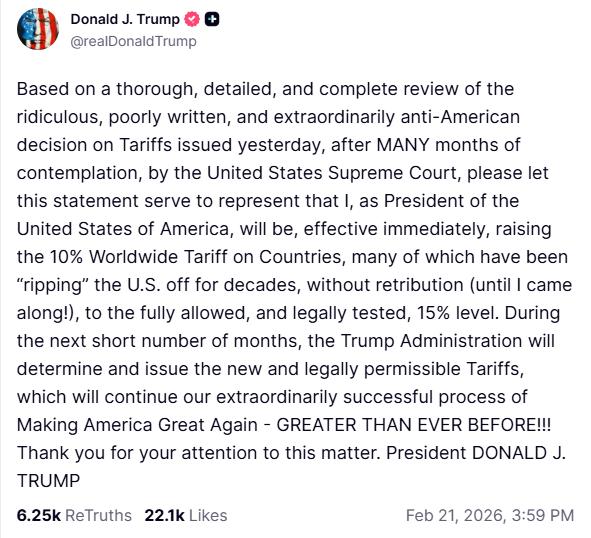
Following a press conference, President Trump issued an Executive Order invoking Section 122 of the 1974 Trade Act which allows the President to implement a blanket tariff on all imports to the US for 150 days. This was initially set at 10% but later raised to 15% on Saturday 21st February. This raise has not yet been implemented by US Customs and Border Protection.
Section 122 allows the President to impose duties of up to 15% or quotas for up to 150 days on imports from all countries, or selectively against countries that maintain unjustifiable or unreasonable restrictions on U.S. commerce. Any extension beyond that period requires an act of Congress. The 150 days ends on 24 July 2025.
In-transit goods which were loaded before 24 February and enter the US before 28 February.
Exceptions to the S122 tariffs
As part of the S122 tariffs, certain exemptions were provided for in Annex I and Annex II of the Executive Order. These include:
a) Certain critical minerals
b) Metals used in currency and bullion
c) Energy and energy products
d) Certain natural resources and fertilisers
e) Certain agricultural products, including beef, tomatoes, and oranges
f) Pharmaceuticals and pharmaceutical ingredients
g) Certain electronics
h) Passenger vehicles, certain light trucks, certain medium- and heavy-duty vehicles, buses, and certain parts of passenger vehicles, light trucks, medium- and heavy-duty vehicles, and buses
i) Certain aerospace products
j) Information materials, donations, and accompanied baggage
k) All articles and parts of articles currently or that later become subject to additional import restrictions imposed pursuant to Section 232
l) Qualifying USMCA products
These exceptions largely replicate previous exemptions provided for under the IEEPA tariffs, however businesses should check to ensure that if they were previously relying on an exemption that this is contained within the respective Annexes.
Tariff stacking
The Executive Order confirmed that the S122 tariffs do not stack with existing S232 tariffs.
Ending IEEPA tariffs
Alongside the S122 Executive Order, President Trump issued two other Executive Orders, the first Executive Order ended certain IEEPA tariff actions although he kept the national emergencies declared remain in effect.
In it he directs the head of each executive department and agency to take all appropriate steps to end the additional ad valorem duties imposed under IEEPA “as soon as practicable”. On 22 February, US Customs and Border Protection issued a notice to traders that they are ending the collection of IEEPA tariffs from 24 February 2025.
Refunds
The Supreme Court decision ruled that the tariffs were illegal but did not provide an opinion on the question of refunds. Any refund process will likely be difficult to navigate and prolonged. Although no official statement by the Administration has been made, in the press conference on 20 February President Trump said in response to a question from a journalist,
“Wouldn’t you think they would have put one sentence in there saying that keep the money or don’t keep the money, right? I guess it has to get litigated for the next two years. So they write this terrible, defective decision, totally defective.”
The decision leaves open the possibility of each importer having to challenge CBP in order to obtain a refund.
De minimis
The third Executive Order saw President Trump clarify with regards to de minimis. In it he said that he had determined that it is still necessary to continue the suspension of de minimis including for shipments sent through the international postal network.
More tariffs on the horizon?
In a separate statement, USTR Greer provided more detail about the future trade actions beyond S122 tariffs. This includes:
- Initiate investigations under Section 301 of the Trade Act of 1974. The purpose of S301 is to deal with “unjustifiable, unreasonable, discriminatory, and burdensome acts, policies, and practices”. He said that they expect these investigations to cover most major trading partners and to address areas of concern. These included: industrial excess capacity, forced labour, pharmaceutical pricing practices, discrimination against U.S. technology companies and digital goods and services, digital services taxes, ocean pollution, and practices related to the trade in seafood, rice, and other products.
- Continue ongoing S301 investigations,including on Brazil and China.
- Maintain tariffs currently imposed under S232 and conclude ongoing investigations.
If these investigations are to be concluded ahead of the 150 days set out in S122, they will need to be done so on an accelerated timeframe. Current ongoing S232 investigations including on pharmaceuticals, aircraft, polysilicon, wind turbines, robotics and medical consumables and devices.
US trade deals
In his statement, USTR Greer said that “we are confident that all trade agreements negotiated by President Trump will remain in effect.” The response from the US’ trading partners in response to the new tariffs has been more muted.
Some trading partners will likely benefit from the new S122 tariffs as they are lower than their “reciprocal” tariffs which had been imposed under IEEPA including Brazil, China and India. While the UK, EU and Korea which had been granted low reciprocal tariffs as part of their trade deals with the US could see their tariffs rise under S122, calling into question the benefits of the agreements.
The European Commission issued a statement in response to the ruling. Invoking the EU-US Joint Statement of August 2025, the Commission insisted that “a deal is a deal” and that EU products must continue to benefit from the most competitive treatment, with no tariff increases beyond the ceiling previously agreed. The European Parliament’s trade committee chair Bernd Lange called an emergency meeting for Monday 23 February to propose freezing ratification of the EU-US trade deal which had been scheduled for a committee vote on 24 February.
Separately, it is being reported that Indian trade negotiators have postponed their trip to Washington DC where they had been due to finalise the US-India trade deal.
If you would like to discuss any of these developments in more detail – don’t hesitate to contact George Riddell ([email protected]), Managing Director of Goyder Ltd.