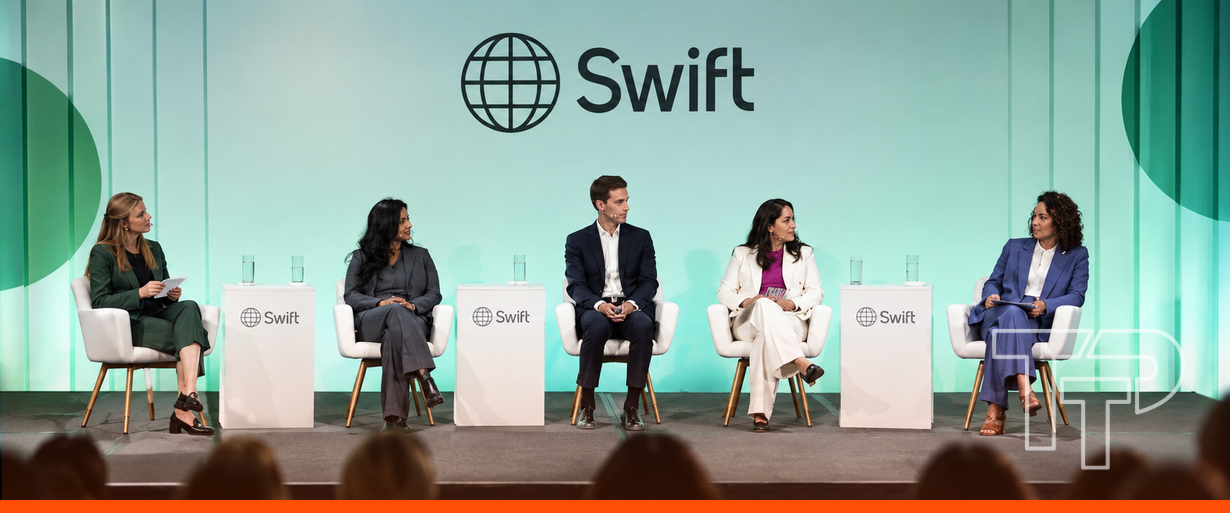
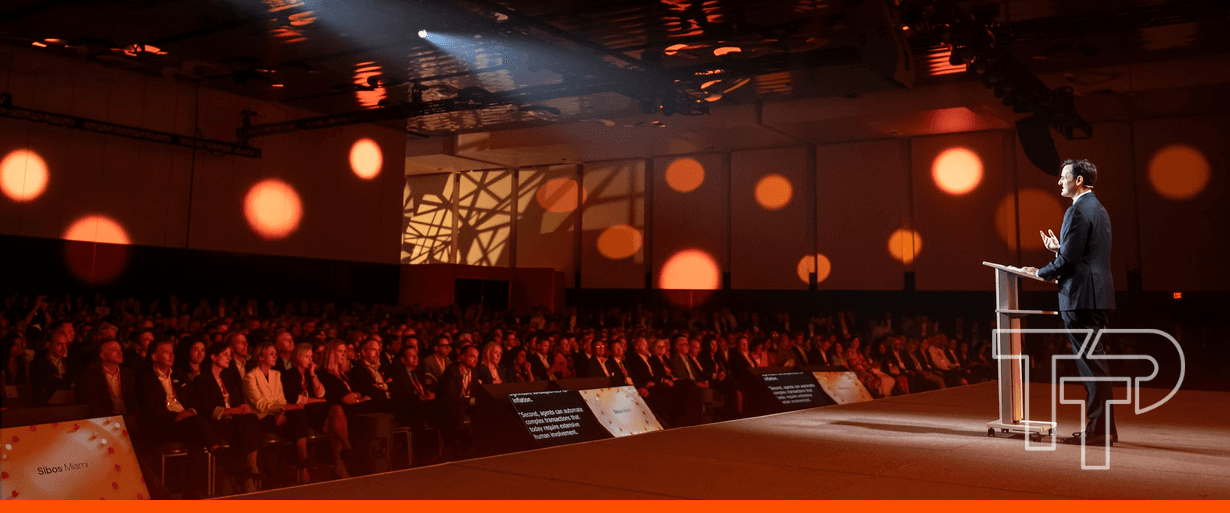
Sibos opened in Miami for the first time, with its largest North American attendance yet. The opening plenary covered AI agents, changing trade routes, quadrillions of dollars moving through payment systems, and the financial industry’s continuing appetite for shiny new things.
Swift chair Graeme Munro welcomed delegates to a city he described as a gateway to Latin America and the Caribbean, and an increasingly important financial and innovation hub. His final advice before getting down to business was more local: “Don’t forget your sunscreen.”
IMF first deputy managing director Dan Katz took on the implications of AI for payments, while Swift chief executive Javier Pérez-Tasso sat down with Citi chair and chief executive Jane Fraser for a conversation that ranged from global trade and corporate liquidity to tokenisation, interoperability, and AI.
Fraser came with some news. Citi is expanding its work with Coinbase, including a way for merchant clients to receive stablecoin payments. The announcement comes a year after Fraser warned investors of an “overfocus” on stablecoins and argued that tokenised deposits could solve many of the same problems.
She has not changed her mind about tokenised deposits. Citi has added the UAE and Japan to Citi Token Services, extending a network that allows clients to move tokenised deposits around the clock.
When Pérez-Tasso asked what corporate clients now wanted from their banks, Fraser warned against starting with the technology.
“There are a lot of shiny objects that are being built around in this space at the moment, and there’s a lot of hammers in search of a nail,” she said.
For Citi, she said, the starting point is what clients need: payments that are always on, fast, secure, and efficient, without forcing the customer to worry about what is happening underneath.
“Our clients want this to be as uncomplicated for them as possible,” Fraser said.
That means connecting rather than choosing between what already exists and what is being built. Fraser said traditional payment systems, tokenised deposits, and digital assets all need to work together.
“Alone is the problem,” she said. Pérez-Tasso agreed. For the Swift community, he said, interoperability means taking the best of every jurisdiction and technology without forcing the industry onto a single platform.
Trapped liquidity tops the list of client complaints
The conversation was not all about new technology. Pérez-Tasso put it to Fraser that global commerce had proved resilient despite the shocks of recent years. She agreed, and said she found it remarkable how much companies had adapted.
“Trade is not in retreat. It’s just being rebooted around the world,” she said.
Some established trade corridors are shrinking while others are growing quickly. Citi’s own trade flows were up by double digits in the first half of the year, Fraser said.
Companies have also spent heavily to make themselves more resilient after the pandemic, the war in Ukraine, and disruption in the Middle East. That has created a more prosaic problem: where the cash sits.
Fraser said releasing trapped liquidity now accounts for more than 70 per cent of the pain points Citi hears from clients. The bank is working on ways to release that money, while companies try to fund the physical and financial resilience they have built.
She argued that resilience should not be treated simply as a cost. A company in a stronger position when something goes wrong can take risks its competitors cannot.
“You can actually go on offence rather than just be defence,” she said.
AI starts with the payment system we already have
Katz argued that AI could improve the existing payment system before the industry attempted more fundamental changes.
AI agents could continuously compare fees, exchange rates, and execution quality and route transactions to the most efficient provider. They could automate payments that currently require coordination, and take on some of the work involved in regulatory reporting, customer due diligence, and sanctions screening.
The gains could be particularly large in cross-border payments, he said, where different currencies, legal systems, and regulatory requirements add friction.
IMF staff estimate that nearly $1 quadrillion moves across borders each year.
“For those of you like me who had to actually look this up, one quadrillion is actually 1,000 trillion,” Katz said. “It’s a lot.”
At that scale, he said, improvements measured in basis points can produce huge gains.
One agent, nine pairs of eyes
Katz’s bigger question was what happens when AI stops helping with payments and starts making them.
An economy in which autonomous agents transact continuously will need payments that are more digital, interoperable, and programmable, he said. But regulators should be wary of pushing the market towards a single answer. Different technologies and business models can themselves provide resilience.
For Fraser, the more immediate question is how much freedom to give the agents.
“I don’t trust my husband to do the grocery shopping,” she said. An agent that could make the purchases rather than simply produce a list was an attractive prospect. Letting one loose with the money requires rather more thought.
Authentication and control are among the questions occupying banks now. Citi has built a platform called Arc, through which every agent it creates must pass. Fraser expects the old management ratios to turn upside down. Where one manager might have supervised nine people, she envisages one agent with nine sets of eyes watching what it does, including other models and agents.
“I’m sure as heck not going to be having rogue agents running amok without the right controls,” she said.
Her closing instruction was simpler.
“Let’s get it done safely, securely, and quickly.”
If only it were as simple as sunscreen.