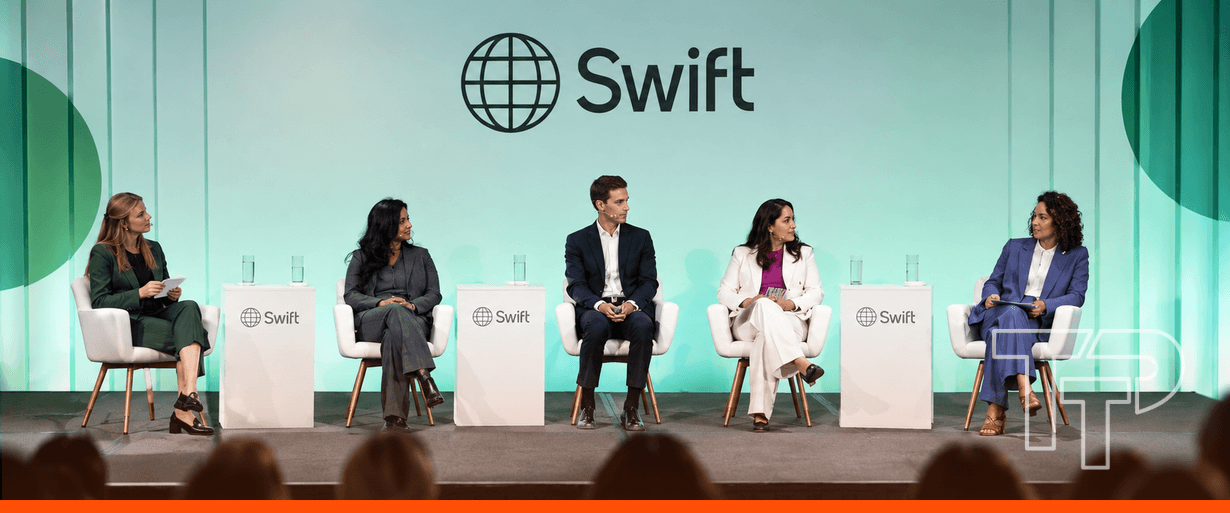
On day 1 at Sibos 2026, industry leaders gathered to answer an important question — is moving to a T+1 settlement cycle mainly an operational issue or a coordination challenge? Jennie Baisch from Swift moderated the panel “Making T+1 a reality: standards, data and collaboration” with Daniel Clark from Deutsche Bank, Laura Cote from U.S. Bank, Camille Papillard from BNP Paribas, and Ruchi Saraswat from Royal Bank of Canada. They talked about the practical aspects of shorter settlement periods, shared lessons from past transitions, and looked at Europe’s upcoming plans.
Beyond settlement: An ecosystem challenge
The panel stressed that T+1 affects more than just backend settlement. Camille Papillard pointed out that a shorter cycle impacts all upstream functions, including funding, inventory management, foreign exchange, and securities lending. As processing windows decrease from about twelve hours to three or four, organisations must eliminate siloes to enable smooth cross-desk execution.
Laura Cote looked back at the US transition in 2024, noting that while firms worked well together during the actual move, automation and client education were what actually kept things running smoothly afterwards.
Looking at Europe, she warned that the market setup is far more complex due to different markets and currencies. In such an environment, tactical workarounds are unsustainable. Banks need total process automation, clean data, and aligned industry testing well ahead of time.
Regional realities and the path to T+0
Addressing execution strategies across Asia-Pacific, Daniel Clark highlighted how various market structures handle tight timelines. In China, the Northbound Connect uses strict pre-trade validation controls that ensure almost immediate T+0 securities confirmation and T+1 cash movement.
In contrast, India took a phased transition to move its domestic equities market from T+2 to T+1 across different market capitalisation tiers.
These contrasting models underscore the need for global financial institutions to build adaptable post-trade frameworks capable of handling cross-border time-zone differences, varied funding windows, and complex sub-custody networks.
Looking ahead, Ruchi Saraswat stated that despite heavy investments in technology, manual interventions remain a major bottleneck for post-trade teams.
While the broader market increasingly discusses T+0, there has to be caution against rushing into instant settlement. Real-time settlement requires instant liquidity and perfection across execution layers, which can strain institutional liquidity pools that rely on batch netting mechanisms.