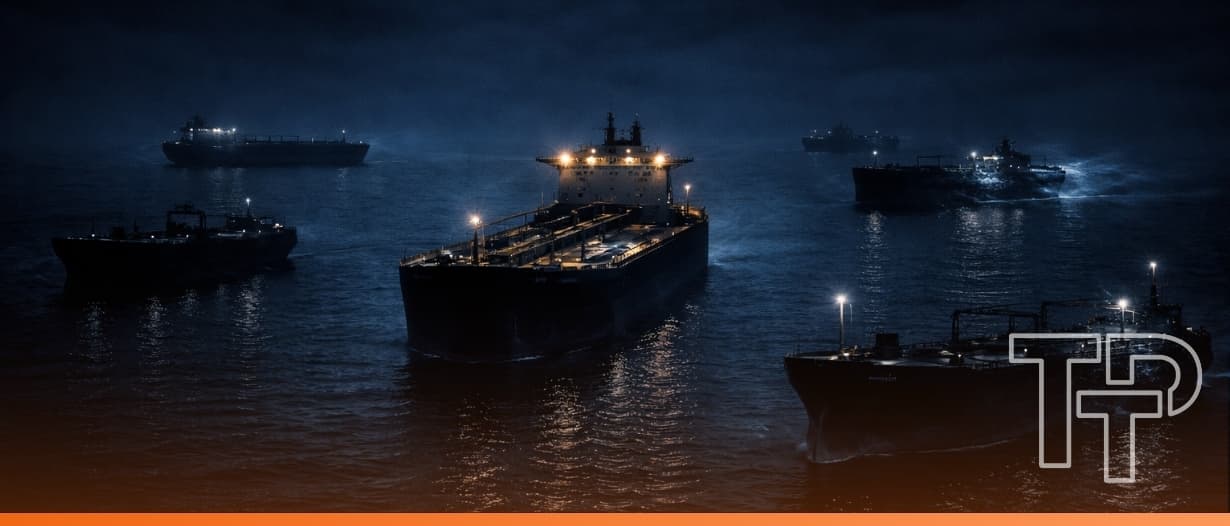
Across the world’s oceans, oil tankers have become chess pieces in geopolitical games, where sanctions and enforcement gaps dictate the next move. Due to the current political tension from the US and the sanctions on Russia, Iran, and Venezuela, a “shadow fleet” of ageing tankers has become more prominent in the endeavour to transport sanctioned oil. This fraudulent practice has created stateless ships that fall outside the global oil trade mechanism.
Michelle Bockmann has dedicated her career as a Senior Maritime Intelligence Analyst at Winward, a US-owned AI company focused on maritime welfare, working closely with government and commercial clients, emphasising that the “shadow fleet” has been used for sanctioned oil trades for years.
The rise of the shadow fleet
Modern oil transport has expanded beyond traditional maritime trade regulations. After the United States and its allies sanctioned oil trade from Russia due to the war with Ukraine, the industry saw a significant rise in the “shadow fleet”, which is also referred to as the “Dark fleet” or the “Ghost fleet”.
“It goes by a lot of names. There’s no specific definition, but typically it’s a parallel fleet that operates outside the international rule-based order that is involved in shipping sanctioned oil,” Bockmann explained.
Unlike conventional vessels operating within regulations, shadow tankers are typically older ships with undefined ownership. Their operations often conceal complex corporate arrangements spanning multiple jurisdictions. Rather than participating in the commercial market, these vessels form an ecosystem that notably impacts the mechanics of global trade, albeit outside of official channels.
Deception and false flags
At the heart of the Shadow fleet’s operations is their efforts “to obfuscate the destination and the origin of sanctioned cargo,” which Bockmann describes as a deliberate effort. These vessels are not simply designed to transport oil across borders. In fact, they are deploying high-level tactics designed to make tracing extremely difficult.
One of the most common evasion tactics is manipulating the Automatic Identification System (AIS), which is a tracking transponder required on all commercial ships. “Each vessel has an automatic identification system,” Bockmann said, “and they can spoof their location… they can pretend to be in one place when they’re really somewhere else. They can go dark; they can turn that vessel transponder off.” In some ports, she mentioned, tankers rarely appear on AIS at all while loading.
Flagging practices illustrate another layer of complexity. In regulatory shipping practices, flagging refers to the country under whose laws a ship is registered, a requirement for all commercial vessels. One of the most recent cases is that shadow fleet operators initially sought out permissive registries with limited oversight, “for example, Equatorial Guinea doesn’t have an international ship registry, but somebody has set up a website purporting to be one and will issue fraudulent certificates,” Bockmann said.
The rising number of unauthorised vessels amid geopolitical tensions has become a severe phenomenon on the oceans. They are exiting outside the governance, which creates a fleet operating beyond the “international rules-based order”, turning legal grey zones into places to launder this oil from illicit origins.
Geopolitical fault lines in maritime governance
If global trade is the lifeblood of the global economy, shipping is its circulatory system. Bockmann remembers, “Back before 2018, a lot of my job was looking at just your basic supply and demand fundamentals. [Today] almost everything that is shaping the supply and demand and ton-mile demand factors for shipping is now tied to geopolitics”.
To extend the analogy, geopolitical tensions are now constricting the arteries. Sanctions on Russian crude and petroleum are a clear example of how energy flows around the world have changed. But the implications of these challenges extend well beyond politics. Instead of taking the shortest, most efficient routes, ships are now travelling much longer distances to avoid dangerous waterways. Ageing tankers without insurance are another threat, particularly when factoring in the environmental costs of a major spill.
For financial institutions and business owners, maritime instability now directly translates into financial risk and supply chain disruption. Bockmann expanded on the idea that government pressure can change countries’ buying patterns overnight. Political decisions that can shift markets “one social media post away,” she mused.
The human cost and global welfare
Beyond sanctions and enforcement mechanisms, the human cost is another aspect of the shadow shipping world that is often overlooked. In general, every sanctioned tanker has 20 to 25 crew members on board, typically from developing countries. Many of these maritime workers do not realise they are joining a high-risk and uninsured vessel, often without fully understanding the sanctioned status.
Working conditions, at the same time, can be harsh on some tankers, with long contracts and mounting psychological stress. In the most critical situation, if a vessel is caught in geopolitical crossfire, crews can be stranded for months, unsure of their legal protections.
In a broader perspective, global welfare is deeply intertwined with maritime governance. This rising number of illegal fleets causes major spills in coastal communities and across the oceans. This has a negative impact across the value chain. Local fishers and hospitality businesses would face environmental and financial damage.
Over the long term, the impact of maritime governance failures does not remain at sea. This places workers, coastal communities, and global supply chains at risk. Ultimately, we must ask whether rising geopolitical tensions justify human costs and global welfare.