

UK overseas trade in goods:October 2025 data reveals rising exports amid trade deficit
Live Updates
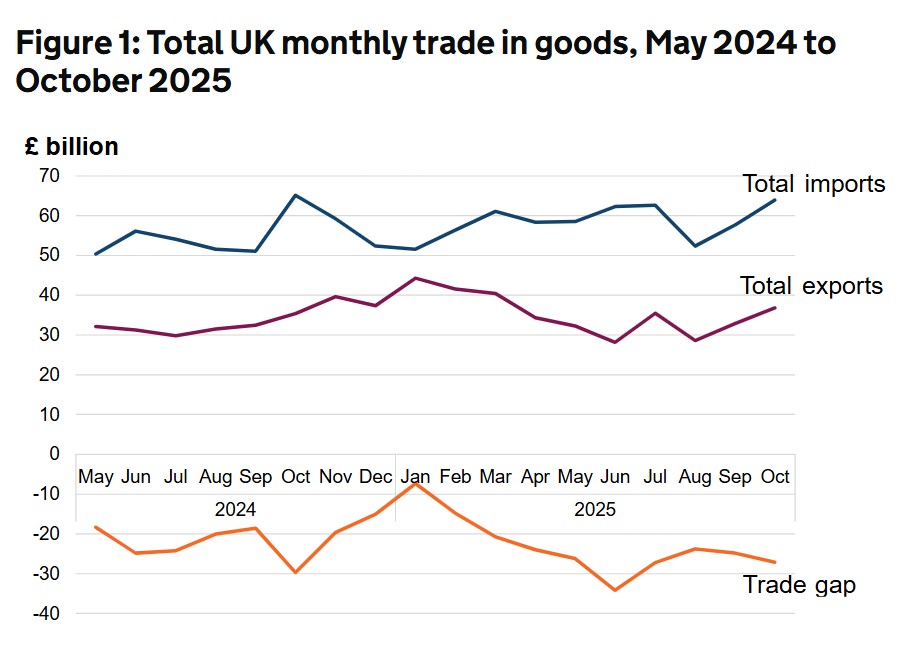
In October 2025, the UK’s total exports of goods reached £36.8 billion, marking a 12% increase (£4.0 billion) from September 2025 and a 4% rise (£1.4 billion) compared to October 2024, says the UK’s overseas trade in goods for October 2025 data announced by HM Revenue & Customs.
The commentary says that the imports stood at £63.9 billion, up 11% (£6.2 billion) from the previous month but down 2% (£1.2 billion) year-on-year. The trade deficit widened by £2.3 billion to £27.1 billion from September 2025.
A significant factor influencing these figures is the movement of non-monetary gold (NMG), which caused volatility in both exports and imports. Exports of NMG increased by £1.0 billion, contributing to a £2.9 billion rise in exports excluding NMG.
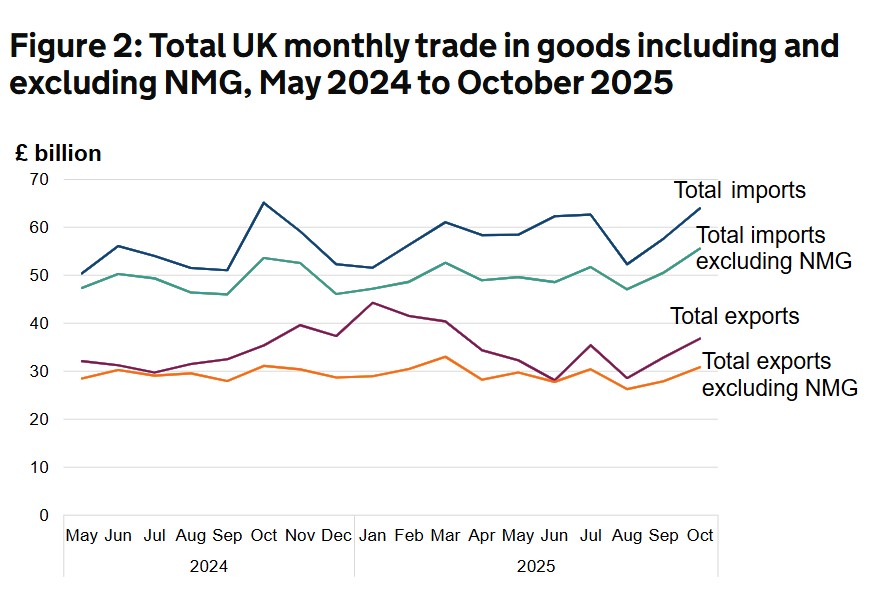
Imports of NMG rose by £1.2 billion, part of a £5.1 billion increase in imports excluding NMG.
Trade with the European Union remains substantial, with the EU accounting for 41% of total exports and 46% of imports.
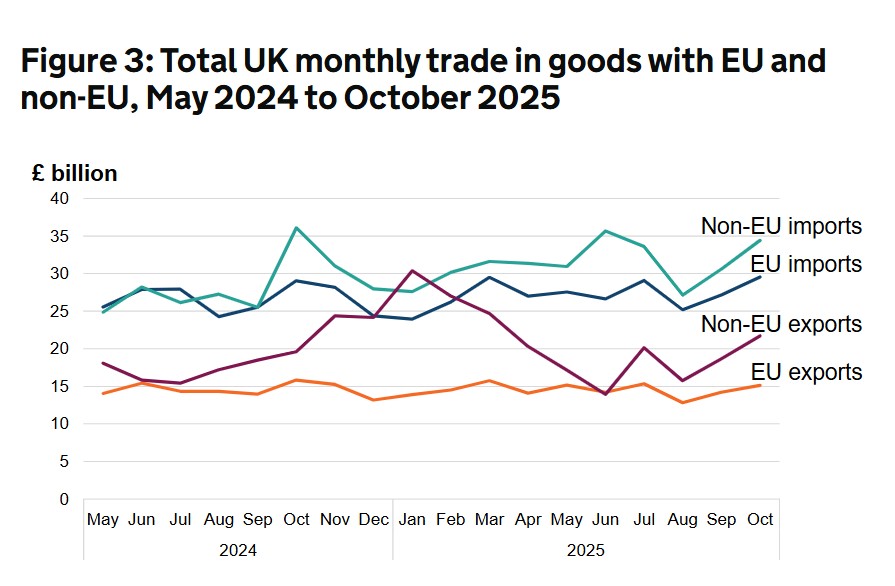
When excluding NMG, these shares rise to 48% and 52%, respectively. Non-EU countries make up the remaining trade volumes, reflecting the UK’s efforts to diversify its trade relationships post-Brexit.
Metals shining brighter in exports
Precious metals dominated exports, comprising 21% of total exports in October 2025, up from 20% in September and 14% in October 2024. This sector saw a 19% increase month-on-month and a 59% year-on-year rise, driven largely by trade with Switzerland and Azerbaijan, despite declines in Hong Kong and Oman.
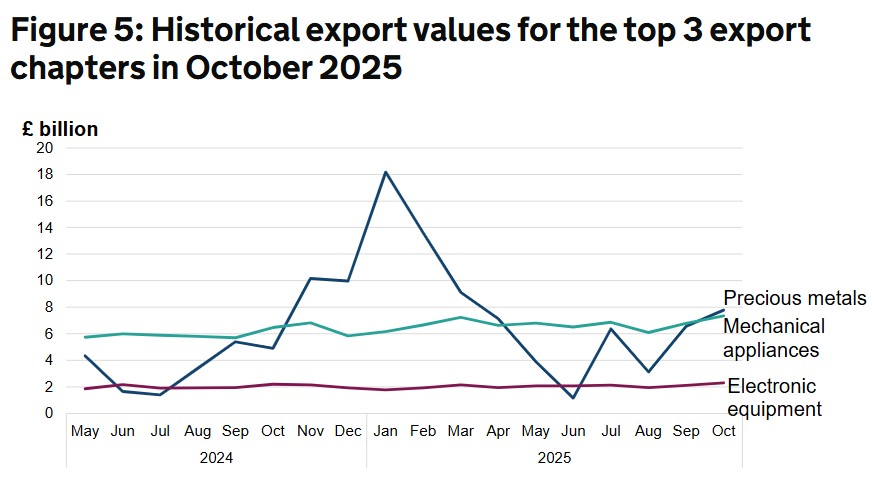
Mechanical appliances, the second-largest export category, accounted for 20% of exports, slightly down from 21% in September but up from 18% in October 2024. Exports in this sector grew 8% month-on-month and 14% year-on-year, with China and the USA as key markets.
Electronic equipment remained the third-largest export sector, representing 6% of exports. It saw a 9% increase from September and a 5% rise year-on-year, with the Netherlands and Germany as leading destinations.
A glance at the import trends
Imports of precious metals accounted for 19% of total imports, up from 16% in September but stable year-on-year. Imports in this category rose 34% month-on-month but fell 4% compared to October 2024.
Mechanical appliances made up 12% of imports, steady from September and up from 11% in October 2024. Imports increased 11% month-on-month and 8% year-on-year, predominantly from China and Germany.
Motor vehicles ranked third, comprising 10% of imports, down from 11% in September but unchanged year-on-year. Imports grew 6% both month-on-month and year-on-year, with Germany and Turkey as primary sources.
Country-level trade analysis: The US is the largest export partner
The US was the UK’s biggest export partner, accounting for 12% of exports, an increase from 11% in September but a decrease from 13% in October 2024.
Exports to the US increased 20% month-on-month but declined 7% year-on-year, with pharmaceuticals, motor vehicles, and inorganic chemicals leading.
Germany was the second-largest destination for exports, accounting for 8%, and it showed steady growth. China, the third-largest, accounted for 7% of exports, up from 6% in September but down sharply from 14% in October 2024 due to a 50% year-on-year decline.
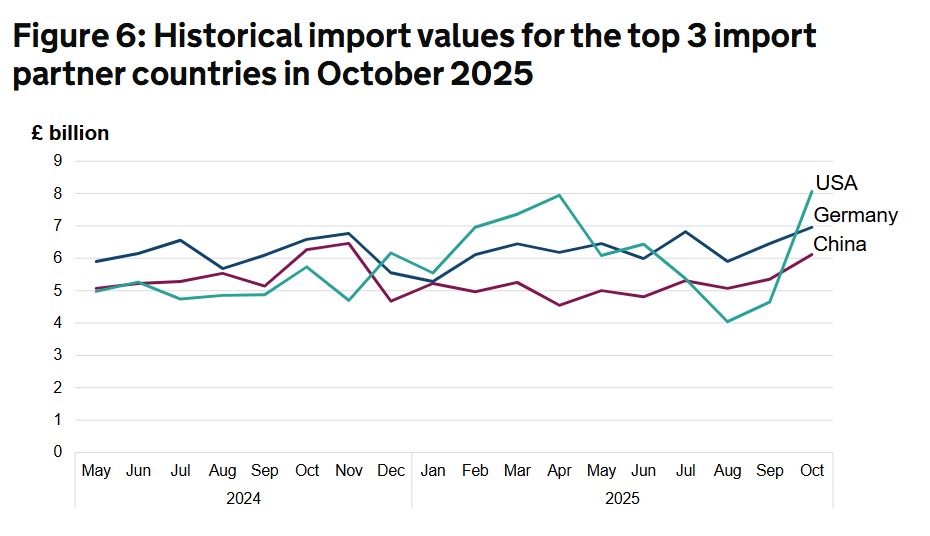
In terms of imports, the US made up 13% of the total, a significant increase from 8% in September and 9% in October of 2024. This reflects a 74% rise from the previous month and a 41% increase from last year. Germany followed with 11% and China with 10%. China’s share increased by 14% from September but showed a slight decline compared to last year.
Economic implications ahead
The increasing trade deficit shows that the UK faces challenges, including inflation, supply chain issues, and changes in global demand.
Although the UK’s strong services trade helps balance some of the goods deficits, the overall imbalance highlights the need for policies to improve export competitiveness and reduce reliance on imports.
In this, diversifying trade partners and sectors is also a strategic priority to mitigate geopolitical and economic risks.
Read the full commentary by HMRC here.