

Nacha’s Smarter Faster Payments 2026 kicks off in San Diego

Alan Koenigsberg
Founder/CEO, Koenigsberg Insights
Published 27 Apr 2026
Live Updates
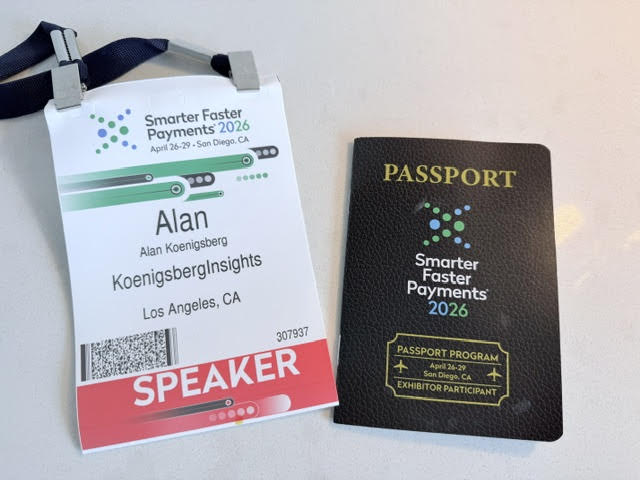
I have arrived in San Diego for Smarter Faster Payments 2026 run by Nacha and one of the core industry convenings for the US payments infrastructure.
- April 26–29, 2026
- Audience: banks, fintechs, corporates, regulators, tech providers
- Focus: ACH + real-time + emerging rails + risk + strategy
This is my 27th NACHA conference, yes 27! I have witnessed such incredible change over the last nearly 30 years and I am proud of this industry and the ecosystem it has created. This conference, in many ways, is a reunion for me and an opportunity to meet so many young professionals coming into this exciting industry. I also have two incredible privileges to share. First, Trade Treasury and Payments has asked me to report on the conference daily, so you will hear from me daily on views, perspectives and goings on! Second, I am participating in a session named Spotlight on B2B payments innovation this coming Tuesday.
Now on to some preconference thoughts as I head into the weekend. As I prepare for Smarter Faster Payments 2026; It’s not just a conference; it’s a command center. Here, banks, fintech firms, regulators and infrastructure service providers come together, sometimes in agreement but often at odds, to influence the future flow of money within the US and beyond for the next decade. I believe there will be a different atmosphere this year. The industry no longer engages in discussions about speed. We’ve got it, it’s Real Time… all the time. Using ACH, RTP, and emerging real-time systems, we have already shown we can transfer funds instantaneously. The big question becomes something much more basic: Is it possible to send money with security, intelligence and scale, while maintaining trust?
Observing the Shift. I believe there is a prominent theme in 2026:
Payment systems are evolving from a mere utility to become an indispensable strategic control point. Fraud discussions have gone from peripheral to central concerns. And it encompasses unauthorised fraud and authorised push fraud, which is when transactions technically continue as planned but result in incorrect outcomes. Because this paradigm shift requires thinking again about:
- Liability. – Identity. – Governance. – Ultimately, trust. At the same time, AI is speeding up decision-making across the ecosystem. It improves fraud detection, transaction routing optimisation, and treasury processes. Yet beneath the progress is a new tension. AI is speeding up decision-making cycles more quickly than institutions can refresh their judgment frameworks. This disparity makes a highly risky environment.
An Invisible Infrastructure Challenge. So there may be another conversation happening, quieter but no less important. What will be ACH’s future role? ACH is still foundational to a large portion of the US financial system. It is reliable, scalable, and closely integrated with current systems. Real-Time Systems Are Developing Fast but That begs the critical question:
Will this lead to ACH transitioning into an intelligent backbone that takes risk into account — or will it be slowly marginalised by faster and more adaptable solutions? Although no one directly tackles this question, it sits at the forefront of many minds in this industry.
A lot of questions to answer: Who should bear the cost of the fraud when the transaction is considered “approved”? How will there be a better way to reconcile regulation and innovation? Who owns customer relationships, banks, fintechs or platforms? When may data gathering become too much in the fight against fraud, and when does privacy matter? But these are no longer theoretical questions; they are urgent decision-making processes of today.
The Farther Away Risk: Knowledge Transfer, and this issue warrants greater consideration. We find ourselves in the midst of a generational change in payment know-how. A significant part of institutional knowledge, including knowledge of system functionality, best practices for practical risk management and decision-making in a fast-changing context, is not formally recorded. At the same time, young professionals step into the field with different tools and presumptions, as well as dependencies on AI technology. This begs another crucial question: Who inherits not only systems, but judgment? I wrote about this very subject in Trade Treasury Payments and KoenigsbergInsights.com. Would love to hear from you and continue the conversation!
As I approach NACHA this year, I am less looking at trends and more focused on signals. The evolutionary infrastructure is coming together with Risk transformation, AI-driven decision-making and Knowledge transfer across generations. All this is happening together at the same time. This does not bring a gradual outcome, like in the past, but instead, brings about disruptive shifts.
An exciting agenda, fantastic speakers and industry networking and debate ahead this week.
Nacha Smarter Faster Payments has kicked off in full force. Day one at Payments 2026 made one thing very clear to me: the conversation has moved beyond whether payments will speed up. That part is over. The real question now is who can operate at speed with trust, control, and purpose. Payments 2026 is taking place April 26–29 in San Diego, and from the opening sessions, it was obvious that the industry’s attention is centred on faster payments, AI, fraud, open finance, and stablecoins.
What stood out to me most on day one was how quickly the discussion turned from innovation theatre to operational reality. Sessions focused on risk in faster payments, fraud, and compliance in the AI era, open-finance data rights, and stablecoins as a practical force in the market. That tells me the industry understands something incredibly important: speed alone does not create leadership and success; resilience, governance, interoperability, and trust do.
I also came away thinking that AI is no longer being treated as a distant, far-out concept. It is being discussed and applied as an operating tool in fraud prevention, payment integrity, customer experience, and decisioning. At the same time, the stablecoin conversation is no longer sitting on the fringe. Nacha gave it a dedicated strategic lane, with real-world use cases tied to cross-border payments, merchant adoption, financial inclusion, and treasury operations. That is a sign of where the market is headed and how NACHA is relevant at the centre of practitioner conversations.
For me, the biggest takeaway from day one is simple: payments is no longer a utility or operational discussion. It’s an infrastructure, product, and core business discussion. The institutions that win from here will be the ones that can move money faster, see/address risk sooner, connect systems more with the client at the centre, and build trust at scale. What a day, and there is more to come!
I’ll be speaking on Tuesday, April 28, in the Spotlight Session on payments innovation trends driving B2B transactions. After day one, I’m even more convinced that B2B payments sit right at the centre of where this industry is going next.
As I often note….’ Infrastructure determines participation. Participation determines prosperity…NACHA does a good job at including all ecosystem players under the tent.

NACHA 2026 – Day 2 Tuesday | Let’s Get Real!
Here is the rundown.
1) Execution over Talk… Day 2 peeled back the headlines and went straight into the mechanics: -API enablement and orchestration. Treasury friction and ERP gaps. Real-world deployment of faster payments. The messaging was consistent: We’ve transcended “why faster payments” to now it’s “why is this still so hard to implement?”
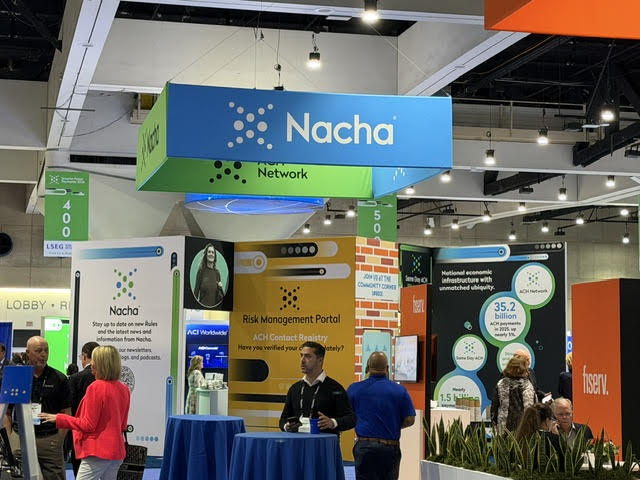
2) ACH demonstrated that it had stamina… During 2025, the annual same-day ACH payment volume was 1.4 billion payments valued at $3.9 trillion. For 2024 and 2025, same-day ACH volume increased 16.7%, and the value of those payments also grew 21.4%. ACH Network payment volume significantly increased by almost 4.9% on year from 2024, and as of 2025, there were 35.2 billion payments in total, with an average of 141 million daily transactions. The worth of those payments came up to $93 trillion, a 7.9% rise from 2024. This is the fourth quarter in which the ACH Network has seen significant milestones. December 2025 achieved the highest monthly volume of the ACH Network in history, with 3.22 billion payments, and the highest monthly same-day ACH payments totalled 172.1 million. Total fourth-quarter ACH Network volume was 9.1 billion payments worth $24.4 trillion, rising by 5.1% and 8.9%, respectively, over the fourth quarter of 2024. There, as with the data Nacha provided us and those interviews, we learned a simple truth: the ACH is not going anywhere. On the contrary, though, this is not an OR, but rather an AND negotiation with RTP, Card, Wire, etc. A universal use case for all payment types. Same-day ACH keeps growing quickly. -B2B usage is accelerating. – It’s still deeply embedded in corporate workflows.* The industry isn’t replacing ACH; it’s refashioning around it.
3) Interoperability is the real fight. All serious conversations came together on that: FedNow, RTP network and ACH all exist. None are unified. The problem is no longer speed. It is coordination across rails, systems, and stakeholders.
4) Fraud is growing in velocity and so too rapidly that there is a noticeable change in conversation -the language -Real-time payments = real-time exposure. -Currently, AI is central on both sides of the battle. -Risk models are re-evaluated at the infrastructure level. Fraud is not a control function anymore; it’s very much a design constraint.
5) APIs = control layer, maybe the biggest theme. -APIs enable orchestration. -APIs enable visibility. -APIs allow for embedded finance.
(6) Steven Bernstein from JPMorgan moderated a session that featured me, ADP, and Verizon talking and debating about “Payments Innovation: Trends Driving B2B Transactions,” A Spotlight Session. The team reframed the conversation well. Highlighted payments to strategic demand, from function into imperative. -Elevated payments from function to strategic imperative. -Payments are not a utility. It is infrastructure. -shift from cost efficiency to economic enablement
Disturbed the illusion of progress as speed. Whereas real-time rails were centre stage today, we built the conversation around the premise that: Speed without interoperability is fragmented and not truly corporate scalable. Speed without governance increases the danger. Speed without treasury readiness doesn’t promote adoption.
B2B is the real battleground, as Consumer payments may be “solved” in perception. B2B is where real complexity needs simplification and opportunity lives.
Virtual cards and working capital dynamics have enormous benefits to small businesses and the emerging middle market as they grow. Previously ignored due to product gaps and credit perceptions, working capital, Buy Now Pay Later, moving up market, and Synthetic Supply Chain are real opportunities for FIs, Fintechs, and their clients. Still, however, Supplier enablement challenges and the shift to embedded finance in commercial ecosystems must be managed and executed well to meet demand in the market.
Trust is where the opportunity lives. Identity, Governance and Security are B2B keys to drive success. And trust must be delivered at scale and not just the product.
One important takeaway: The industry is innovating faster than institutions can operationalise at both banks and corporates. The tension between innovation and execution is exactly where winners and losers will emerge.
The one-hour session brought home that payments are coordinated infrastructure.
Interoperability is the next competitive stage. B2B is underpenetrated and underbuilt.
Treasury must evolve beyond the ‘cost play’—or become miss real economic revenue and client solution benefit.
Day 2 roundup: the day was jam-packed across a record of 12 learning tracks, which provided an inclusive surrounding for practitioner learning, debate, and executive discussions on a wide range of topics from ACH to Risk and Stablecoin. Rails, Risk, Treasury, and Innovation were truly synergised across one integrated narrative. This isn’t about faster payments anymore; it’s more about who can design and control the system around them.
If we can rally around one thing, it is that ‘Infrastructure determines participation and Participation determines prosperity.’
On to Day 3!
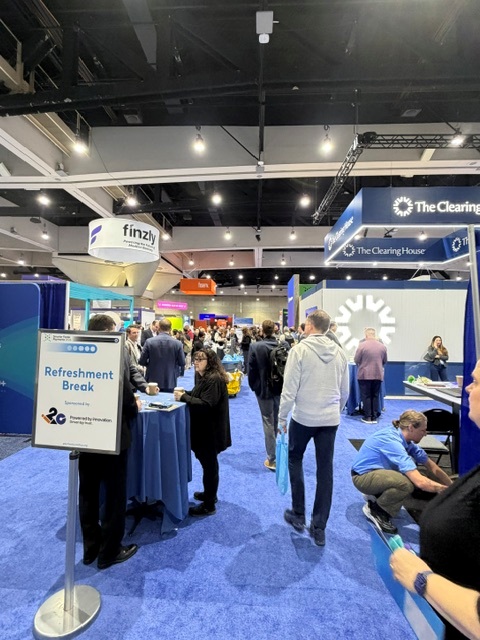

*Nacha statistics compliments of Nacha.org
NACHA 2026 San Diego draws to a close. Day 3 Recap
Day three is a real day, folks!
Day three sunset the show, final sessions, and goodbyes until next time. The conversations shifted from what’s possible to what’s operationally inevitable. Real-time is no longer a pilot; it’s infrastructure. Fraud isn’t a side conversation; its core and interoperability are quickly becoming the dividing line between those who win and lose.
What stood out to me:
RTP + FedNow momentum is real but uneven. Adoption is accelerating, but fragmentation is still holding back full network effects.
Fraud and identity dominated many conversations. Every innovation conversation now starts with risk, not speed. That’s a real shift.
B2B remains a significant unlock for all payment types. The industry knows where the volume is, but monetisation and behaviour change are still lagging.
Banks are resetting and recalibrating their role. Not stepping back—but rethinking where they add the most value, where they partner, and where they must move faster.
My session on Tuesday reinforced something I’ve believed for a long time:
Payments is no longer a back-office function; it is core to the strategic value proposition and growth. The institutions that understand that will have the advantage.
Overall Assessment and My Takeaways: Conference venue, sessions, and content were excellent.
-We are compressing years of change into quarters. Current strategy cycles are too slow for what’s happening now. The winners will be the ones who simplify, connect, and execute.
-Real-time is table stakes, not a differentiator
-Identity sits at the centre of every transaction.
-Interoperability defines market access.
-AI will be embedded in fraud, routing, and decisioning.
-Margins will tighten further, forcing choices on where to play and partner
While innovation is at the heart of this business and NACHA, it’s time for execution at scale, which is the name of the game.
Regions