
India’s RBI reports stable foreign exchange reserves at USD 691.11 billion amid global volatility

Devanshee Dave
Reporter, Trade Treasury Payments
Published 4 May 2026
Live Updates
The Reserve Bank of India (RBI), India’s central bank, has published its 46th half-yearly report detailing the management of the country’s foreign exchange reserves for the period October 2025 to March 2026.
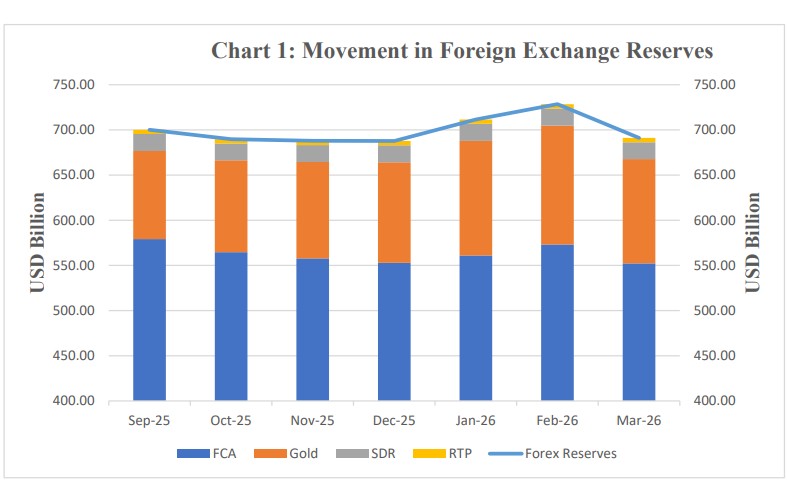
The total reserves stood at USD 691.11 billion, reflecting a slight decrease from USD 700.09 billion recorded in September 2025. The reserves comprise Foreign Currency Assets (FCA), gold, Special Drawing Rights (SDR), and the Reserve Tranche Position (RTP) with the International Monetary Fund (IMF). The FCA portfolio is maintained in major currencies such as the Euro, US dollar, Japanese yen, and Pound sterling, with valuations expressed in US dollar terms.
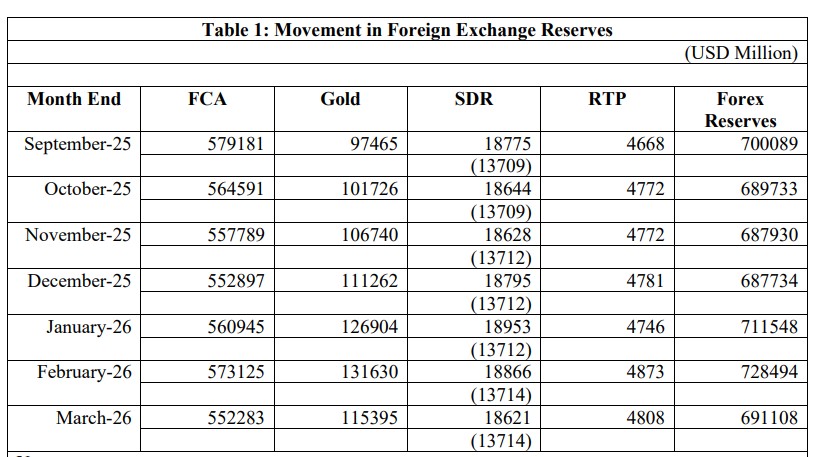
The decrease in reserves was influenced by factors including RBI’s foreign exchange market interventions, income from reserve deployment, government external aid receipts, and asset revaluations.
Despite the nominal decrease, valuation gains during the period were significant, amounting to USD 50.2 billion, compared to USD 3.1 billion in the corresponding period of the previous year.
Sources of accretion and valuation changes
On a balance of payments basis (excluding valuation effects), foreign exchange reserves decreased by USD 30.8 billion during April to December 2025, compared to a depletion of USD 13.8 billion in the same period the previous year. However, when including valuation effects, reserves increased by USD 19.4 billion during April to December 2025, reversing the previous year’s trend.
Key sources of accretion included foreign direct investment, portfolio investment, banking capital, non-resident Indian (NRI) deposits, short-term credit, and external commercial borrowings. Valuation changes as a result of gold price movements and currency fluctuations.
As of December 2025, India’s foreign exchange reserves covered 10.8 months of imports on a balance of payments basis, slightly down from 11.3 months in September 2025. The ratio of short-term debt to reserves increased from 19.7% to 21.9%, while the ratio of volatile capital flows to reserves rose from 66.1% to 69.1%. These metrics indicate the country’s ability to meet external obligations and absorb external shocks.
Management of gold reserves
The RBI held 880.52 metric tonnes of gold as of March 2026, of which 680.05 metric tonnes were held domestically. The remainder was held in safe custody with the Bank of England and the Bank for International Settlements. Gold’s contribution in total foreign exchange reserves increased from 13.92% in September 2025 to 16.70% in March 2026, reflecting changes in gold valuation and strategic asset allocation.
This adjustment signals a deliberate strategy to hedge against currency fluctuations and geopolitical risks, leveraging gold’s traditional role as a safe-haven asset.
Conservative investment approach and liquidity management
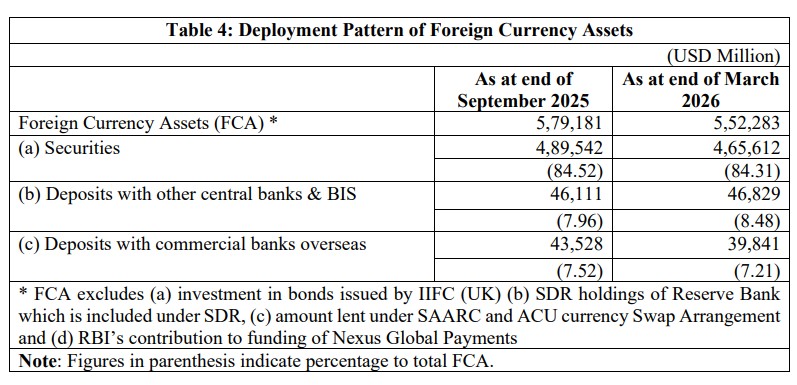
The RBI’s reserve portfolio continues to prioritise safety, liquidity, and diversification. FCA constitute the bulk of the reserves, amounting to USD 552.28 billion (84%).
Additional placements consist of deposits with central banks, the Bank for International Settlements (BIS), and other reliable institutions to maintain high liquidity and low risk.
India’s import cover remains strong at 10.8 months, providing a substantial buffer to withstand external shocks such as sudden capital outflows or commodity price volatility.
Improvement in India’s external financial position
India’s Net International Investment Position (Net IIP) improved significantly to –USD 260.5 billion from –USD 363.9 billion in the previous report.
The Net IIP is the difference between a country’s external financial assets and liabilities, essentially its net worth relative to the rest of the world. A negative Net IIP indicates that liabilities exceed assets.
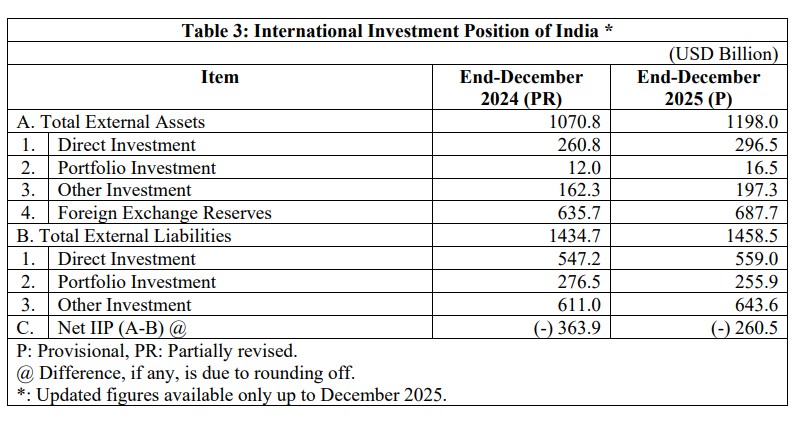
The RBI’s report shows an improvement in India’s Net IIP, suggesting a healthier external financial position through increased foreign assets or reduced liabilities.
Read the full report here.