
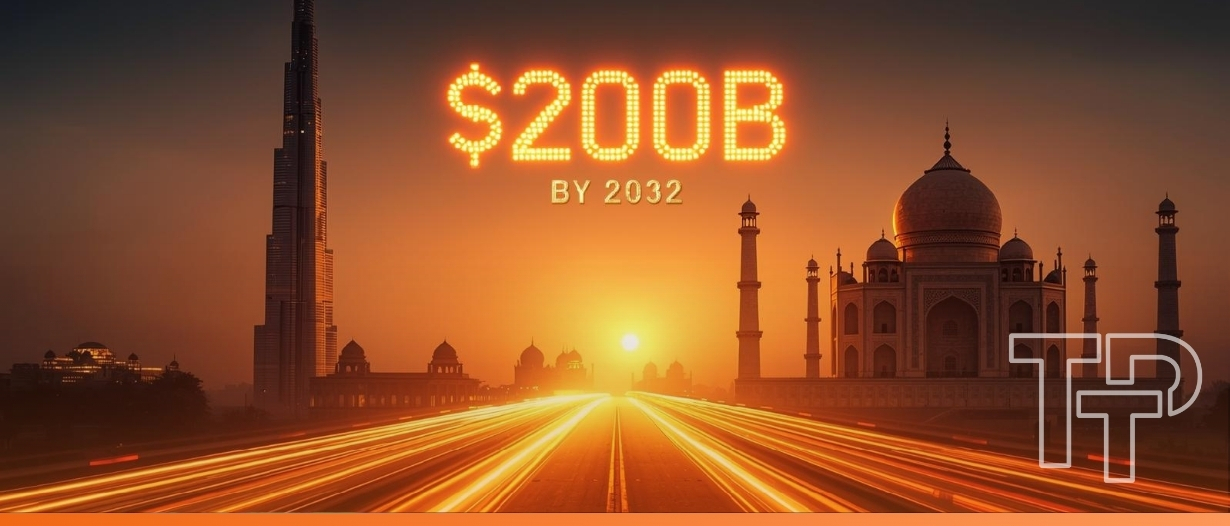
India and the UAE set an ambitious goal to double bilateral trade by 2032

Devanshee Dave
Reporter, Trade Treasury Payments
Published 20 Jan 2026
Live Updates
India and the United Arab Emirates (UAE) have finalised a series of landmark agreements to deepen their already robust bilateral relationship. The two nations have set a target to double their bilateral trade volume to $200 billion by 2032, building on the momentum generated since the signing of the Comprehensive Economic Partnership Agreement (CEPA) in February 2022.
This ambitious goal was announced on 19th January during a high-profile visit by UAE President Sheikh Mohamed bin Zayed Al Nahyan to New Delhi, where he met with Indian Prime Minister Narendra Modi to discuss expanding economic, defence, and technological cooperation.
Trade growth and economic synergies
Bilateral trade between India and the UAE has surged past $100 billion in the fiscal year 2024-25 (April 2024 to March 2025), reflecting a decade of growing economic ties. The CEPA has played a pivotal role in reducing tariffs and expanding market access for goods and services, promoting trade growth.
Both leaders emphasised the importance of sustaining this trajectory by encouraging closer collaboration across multiple sectors.
The focus now extends beyond trade to include energy security, defence cooperation, and emerging technologies, underscoring the multifaceted nature of the relationship.
Energy, defence and security cooperation
A significant development is the signing of a 10-year agreement under which the UAE’s ADNOC Gas will supply 0.5 million metric tons of liquefied natural gas (LNG) annually to India’s Hindustan Petroleum Corporation, starting in 2028. The deal is valued at $3 billion.
This long-term energy partnership will improve India’s energy security and support the UAE as a key energy exporter. The deal would also help India diversify its energy sources and move towards cleaner fuels.
The two countries agreed to strengthen their defence partnership. They will focus on cybersecurity and counterterrorism. They also discussed possible cooperation in advanced nuclear technologies to improve security and technology capabilities.
Infrastructure and investment partnerships
The UAE pledged investment in the development of a Special Investment Region in Dholera, Gujarat, India. This includes the creation of strategic infrastructure, such as international airport, pilot training school, maintenance, repair, and overhaul (MRO) facility, greenfield port, smart urban township, railway connectivity, and energy infrastructure.
Prime Minister Modi also invited the UAE’s sovereign wealth funds to participate in the second National Investment and Infrastructure Fund (NIIF), scheduled to launch in 2026.
Financial and space sector integration
The visit witnessed the establishment of branches of DP World and First Abu Dhabi Bank (FAB) in India’s Gujarat International Finance Tec-City (GIFT City). FAB’s GIFT City branch is positioned as a key bridge connecting Indian corporates and investors to its expertise and global network across the Gulf Cooperation Council (GCC) and Middle East and North Africa (MENA) regions.
Additionally, India and the UAE partnered on Micro, Small, and Medium Enterprises (MSME) initiatives on both sides. Some of the projects include the implementation of the ‘Bharat Mart’, the ‘Virtual Trade Corridor’, and the ‘Bharat-Africa Setu’, designed to promote MSME products across the Middle East, West Asia, Africa, and Eurasia.
India and the UAE also agreed to deepen cooperation in the space sector, exploring joint initiatives to commercialise space sciences and technologies. The partnership aims to build an integrated space ecosystem with end-to-end infrastructure and a strong industrial base.
Objectives include enabling joint missions, expanding global commercial services, creating high-skilled employment opportunities, fostering startups, and strengthening bilateral investment through sustainable business models.
Strategically important partnership
As of September 2025, India accounted for 9% and 14% of the UAE’s total trade and non-oil exports, respectively, making it the second-largest trading partner; this partnership is significant for the UAE.
On a similar note, in India, the UAE ranks third as a trading partner after the US and China in fiscal year 2025. The agreements and initiatives announced during the UAE President’s visit to India reflect a new era of economic synergy and shared strategic interests.