

Berne Union sets “adaptability” tone in Ottawa as members back record $2.7tn of trade in H1 2025

Carter Hoffman
Deputy Editor, Trade Treasury Payments
Published 22 Oct 2025
Developing story
Live Updates
Unlocking the power of blended finance partnerships
Moderated by Rafael Docavo-Malvezzi, Global Chief Underwriting Officer, Political Risk, Credit and Bond, AXA XL we heard from panellists:
• Christopher Clubb, Managing Director, Convergence
• Max Magor Ndiaye, Senior Director, Syndication Client Solutions and Africa Investment Forum, African Development Bank (AfDB)
• Mariane Søndergaard-Jensen, Senior Director, Head of International Regulation and Policy, EIFO
This session explored the evolving role of blended finance as a bridge between development objectives and private investment.
Key takeaways:
• Blended finance remains essential to mobilising private investment in developing markets — with roughly USD 70 billion mobilised today versus a USD 6 trillion annual need.
• Public capital can act as catalytic capital, reducing perceived risk and encouraging institutional investors to engage in higher-impact, frontier projects.
• Collaboration between ECAs, MDBs, and insurers is critical to standardise structures and unlock scalable development financing.
• Risk-reduction tools, including tiered funds, guarantees, and strategic capital allocation, can improve credit ratings and crowd in private capital at lower cost.
Blended finance, when combined with transparent standards and partnership across the public–private divide, remains one of the most practical levers to turn development ambition into investable opportunity.

In the first Panel session of the Berne Union Annual General in Ottawa, Canada
Moderator: Abbey Sturrock, SVP, Deputy Global Public Agency Leader, Marsh
– Julia Beck, Director of Strategy and Impact UK Export Finance
– Jared Kotler, Global Head of Credit and Political Risk Solutions The Hartford
– Terence Chiu, Commissioner, HKECIC – Hong Kong Export Credit Insurance Corporation
Discuss what the export credit insurance industry will look like in 10-15 years?
Main takeaways:
ECAs are adapting: Governments are shifting towards more activist industrial strategies, creating new opportunities for export credit agencies to support critical sectors like energy transition and strategic imports.
Public-Private Partnerships matter now more than ever: Collaboration between government and private sectors is essential for solving complex global challenges, especially in areas like green energy and infrastructure development.
SMEs are the backbone of economic growth and continue to be critical drivers of innovation and job creation. But they require flexible and responsive support mechanisms.
Global investment in clean energy is hitting $2.2 trillion. This will be a massive opportunity for forward-thinking organisations.
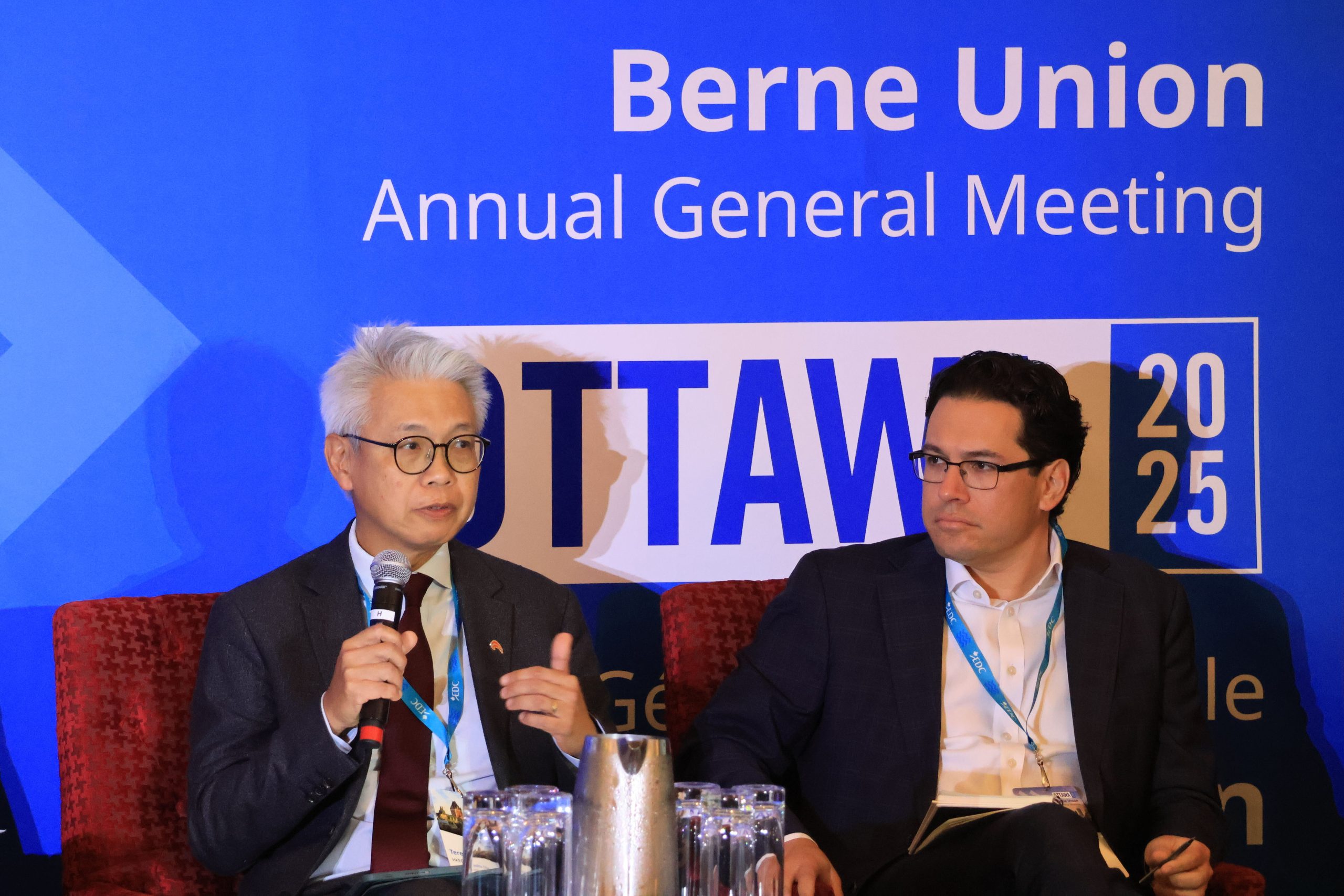

The Berne Union opened its Annual General Meeting today in Canada’s capital with more than 200 delegates from 87 organisations across the export finance ecosystem. According to a release from the organisation of the world’s export credit agencies (ECAs), demand for non-payment protection is elevated, and members are on track for another strong year after issuing $2.7 trillion in new commitments in the first half.
Heightened risk perception is still shaping trade flows and financing choices. The Union reports that short-term cover climbed to a record $2.59 trillion in H1. Nominal volumes were up 12% on H2 2024, though the data were flattered by a weaker US dollar, leaving the real-terms trend broadly flat year on year. In other words, the insurance need remains persistently high even as currency moves cloud the headline comparisons.
Ottawa’s message: adapt to a moving landscape
The theme for this year’s AGM is “adaptability”, with scene-setting keynotes on mega-trends in the global economy, unlocking private capital in higher-risk markets, and securing critical minerals. Berne Union President Yuichiro Akita said, “This year’s AGM is set against a backdrop of significant regulatory, technological and geopolitical shifts, presenting complex challenges for international business… The theme of adaptability emphasises the critical importance of adjusting to the rapidly evolving landscape that shapes the export credit and investment insurance industry.”
Alison Nankivell, President and CEO of Canadian ECA, Export Development Canada (EDC), said, “In such a pivotal moment for global trade, EDC – a long-standing member of the Berne Union – is honoured to host this year’s AGM… This AGM is a timely opportunity for the global export credit and investment insurance industry to discuss how we can better equip exporters and investors.”
What the industry data show
According to the Berne Union’s release, medium- and long-term (MLT) business reached $77 billion in H1, driven by large transactions in transport and renewables across North America and Europe. Renewable energy lodged more than $10 billion of new commitments in the period and is now the second-largest sector for new MLT business and the third-largest by exposure at $82 billion.
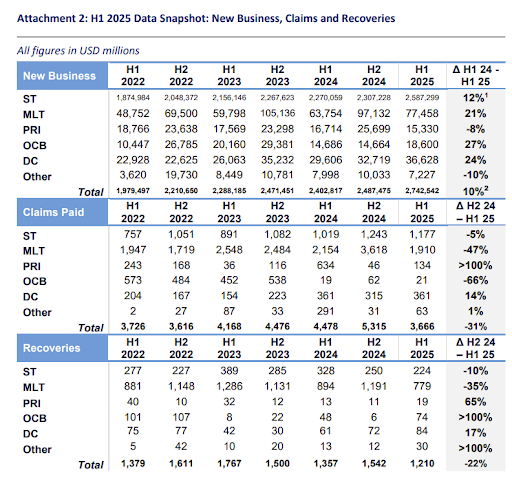
Policy support is also stretching beyond classic export mandates. New domestic and other cross-border credit totalled $55 billion in H1, lifting outstanding exposure under these products to $255 billion (around $100 billion higher than in 2019) as ECAs lean into supply-chain resilience, critical inputs, and working capital at home.
On the claims side, while they are easing after last year’s spike, they are still a strong gauge of stress. Aggregate claims paid fell 31% versus H2 2024 to $3.7 billion. MLT claims, at $1.9 billion, continue to reflect sovereign debt distress in markets such as Ghana, Zambia, and Ethiopia, while indemnifications linked to sanctions on Russia-related entities have increased. Short-term revolving credit claims edged up, consistent with firmer insolvency indicators.
The takeaway for trade, treasury, and payments
Two currents define this AGM. First, elevated risk is now a steady-state feature of the market, which sustains demand for credit and political risk cover even as currencies swing the optics of growth. Second, export credit is widening into adjacent spaces like renewables at scale or domestic and untied instruments that harden supply-chain resilience.
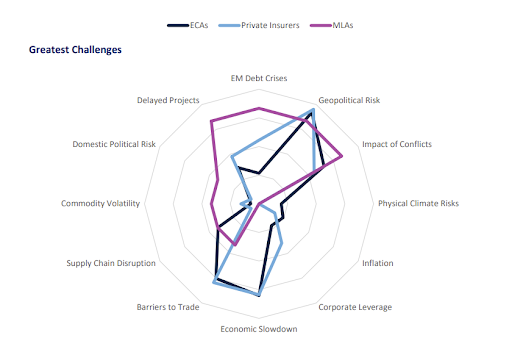
The industry’s challenge over the next year is execution.
Regions