
African finance ministers and central bank governors seek global support as the US-Iran war threatens economic stability

Devanshee Dave
Reporter, Trade Treasury Payments
Published 20 Apr 2026
Live Updates
African finance ministers and central bank governors are urgently turning to global lenders as the economic fallout from the US-Iran conflict threatens to reverse recent stabilisation gains across the continent. Rising energy costs, supply chain disruptions, and aid reductions are placing significant pressure on growth prospects and fiscal stability.
At the IMF and World Bank Spring Meetings, African policymakers highlighted a convergence of external shocks. This includes increasing energy costs and supply chain disruptions as key factors undermining the continent’s growth trajectory. Despite differing views on the scale of the impact, there was consensus that risks remain tilted to the downside due to global uncertainty and domestic vulnerabilities.
Economic outlook deteriorates amid external shocks
Sub-Saharan Africa started 2026 with a strong economy, growing about 4.5% in 2025 due to previous stabilisation efforts. However, the ongoing conflict in the Middle East has hurt this positive trend. It has raised fuel and fertiliser prices, making food less affordable.
This situation has worsened food insecurity, increased poverty, and created more social tension, all while aid flows continue to decline.
The IMF expects Africa’s growth to slow down to between 4.2% and 4.3% in 2026, with disparities across countries.
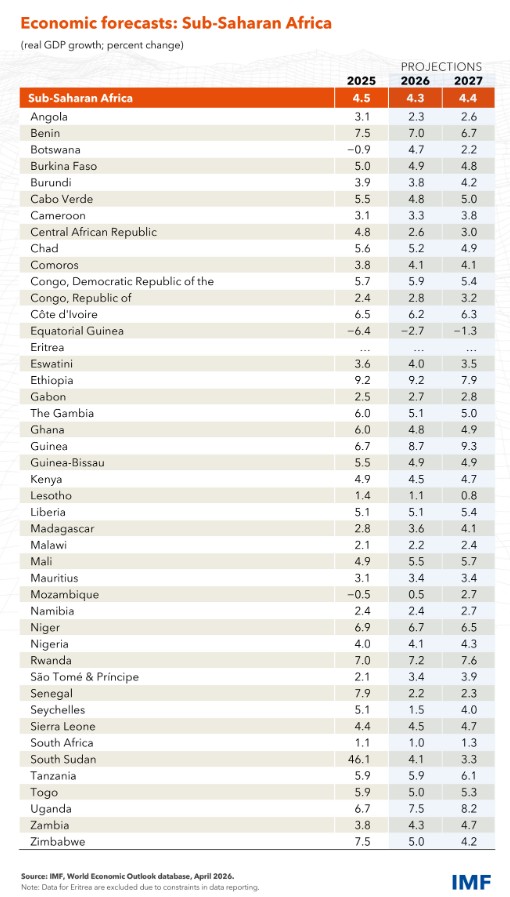
North Africa is experiencing significant downgrades, and inflation is set to increase again, undoing recent improvements in price stability.
Seedy Keita, chairman of the African Caucus and finance minister of The Gambia, warned alongside IMF Managing Director Kristalina Georgieva, saying, “The war adds another layer of complexity, with the potential for severe scarring, including inflation, food shortages and social tensions.”
Rising inflation and food insecurity prompt emergency financing requests
A number of African nations are currently pursuing urgent financial assistance to address the crisis. The Republic of Congo has asked for a new program from the IMF after its previous agreement ended in 2025.
Similarly, Angola is pursuing a $165 million budget support loan from the African Development Bank as part of a broader $1 billion external financing plan.
Kenya has asked the World Bank for financial assistance to deal with fuel shortages and rising inflation caused by increasing oil prices.
The central bank governor highlighted this request as “significant,” showing the serious challenges that import-dependent economies face.
Meanwhile, Mozambique does not currently meet IMF criteria for new financing but is actively negotiating and exploring measures to restore macroeconomic balance.
Despite early repayment of over $700 million to the IMF, the government continues to seek fresh support amid ongoing economic challenges.
Divergent fiscal trajectories across the continent
A gap is growing between countries that have made strong fiscal reforms and better debt management, which keeps investors confident, and those with weaker economies that are facing more financing pressures because of tighter global liquidity.
Nigeria’s Minister of Finance, Wale Edun, emphasised that the country is not seeking a new IMF programme at present, focusing instead on domestic reforms such as revenue mobilisation, exchange rate unification, and reducing external borrowing dependence. These efforts aim to rebuild macroeconomic stability following years of foreign exchange constraints and fiscal strain.
African policymakers face a difficult challenge. There is no clear end in sight for the US–Iran conflict. They must manage rising inflation, protect vulnerable people, and sustain growth, all while depending more on external funding to deal with unpredictable global circumstances.
The IMF cautions that even a swift resolution may not fully prevent lasting disruptions if critical shipping routes, such as the Strait of Hormuz, remain affected, underscoring the need for both short-term shock responses and long-term resilience-building.