
Trade between Asia and Europe has long been dominated by two main routes.
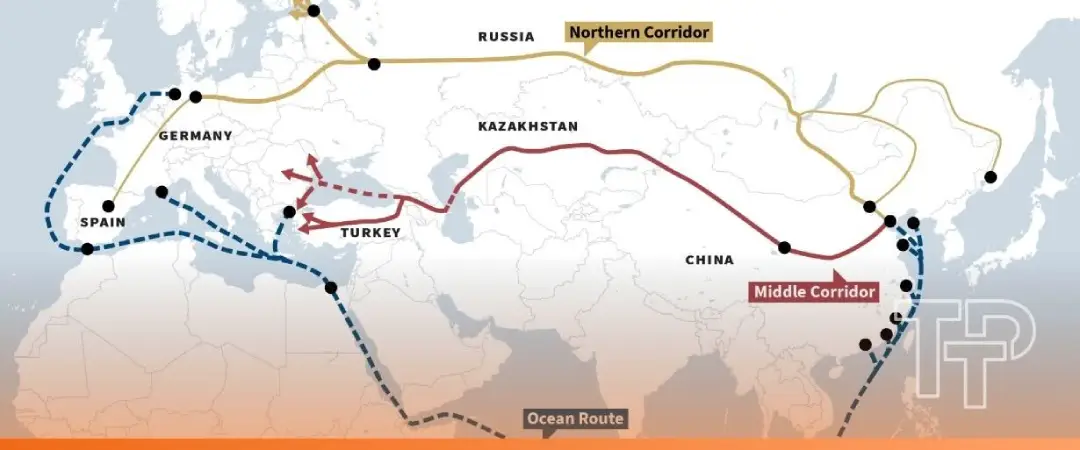
The first, generally known as the ocean route, runs south from the manufacturing hubs along Asia’s coast, through the South China Sea and the Malaca straight, past India and up the Red Sea towards the Suez Canal, before entering the waters of the Mediterranean and reaching its European destination after a 20,000 km journey that takes on average, 45-60 days to complete.
The next, dubbed the Northern Route, takes an overland path from China, cutting through Mongolia before making the bulk of the journey to Europe through Russian territory. Much shorter than the ocean route, the path of the Northern Corridor stretches approximately 10,000 km in length and is completed in 15-20 days on average.
Between these two dominant paths, however, lies a third potential option. Officially called the Trans-Caspian International Transport Route, but more commonly known simply as the Middle Corridor, it connects China and Central Asia to Europe through Kazakhstan, the Caspian Sea, Azerbaijan, and Georgia. While it is the most direct of these routes, coming in at a mere 7,000 km that can be travelled in 10-15 days, it has only in the past half-decade, amid increasing geopolitical posturing, gained prominence as a viable option.
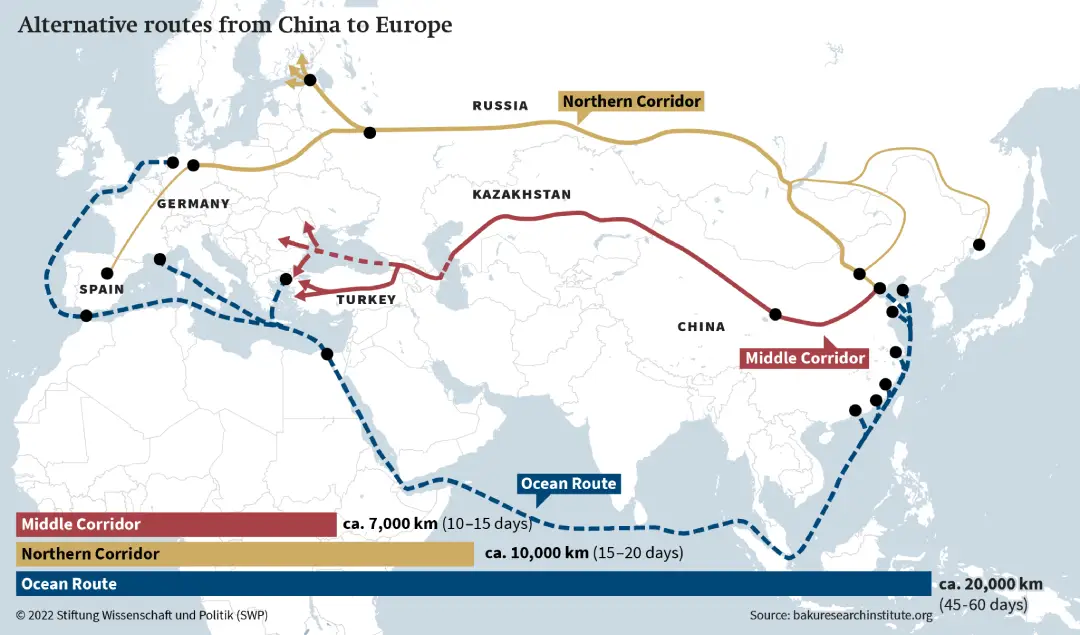
The three alternative routes from Asia to Europe (Source: Baku Research Institute)
And gained prominence it has. Demand for the Middle Corridor has surged dramatically, with freight volumes increasing by 70-90% between 2022 and 2024, largely due to disruptions following the Russian invasion of Ukraine in 2022. The OECD estimates that trade volumes along the corridor could triple by 2030.
But this rapid growth is placing new pressure on a system that was not built for this level of demand and is now struggling to catch up.
Mikheil Babunashvili, Director of the Georgian Branch at freight forwarder FS Mackenzie, said to the audience at the Digital Trade for Growth in the Middle Corridor conference, “This corridor is becoming a leading one as geopolitical situations change in the world. But it is a very important period for us [in Georgia and in the region] to develop and to take this opportunity.”

Mikheil Babunashvili, Georgian Branch Director, FS Mackenzie speaks on his panel at the Digital Trade for Growth in the Middle Corridor conference
Georgia, specifically, finds itself in a key location along this new route as it is geographically located between the Caspian and Black Seas. As the corridor evolves into a more integrated rail and maritime network, the country will have an outsized role in connecting different legs of the corridor into a single, functioning system.
While infrastructure is being developed both within Georgia and in other states along the route, some experts would argue that it is not happening fast enough, and most would agree that coordination across countries is lacking. If left as is, this lack of coordination is liable to negatively impact how much the corridor is used and how well it works.
Anna Ivanishvili, Head of Railway and Terminals Department at Georgian-based Metro Logistics, said on the same panel at the Tbilisi-hosted event, “Now, the spotlight is on our part, and we have to use it fast, we have to invest fast, we have to build fast. Otherwise, this opportunity will be lost.”
Perhaps the key to seizing that opportunity and overcoming many of these impending challenges lies with digitalisation.
The delay is in the documents
A cursory evaluation of the Middle Corridor’s needs seems to point to an obvious solution. Clearly, with demand on the rise and expected to continue, the corridor needs more ports, more rail links, and more physical infrastructure to build capacity. While these are certainly critical components of a high-functioning transport route, they may not be the main bottleneck. It is possible that this lies in how information moves across the system.
Today, much of the process still relies on paper documents and manual updates, much like they did hundreds of years ago. These documents carry key information about the cargo, the sender, and the destination, but also carry all of the inefficiencies traditionally associated with paper-based processes.
“As you can imagine, this whole process is very time-consuming and slow,” Ivanishvili said. “As a result, what we see in most cases is that the cargo moves faster than the information itself. So we see a lot of conversation about investments in infrastructure, like new terminals, new ports, and customs clearance zones. Of course, all of it is very important and crucial. But I would say that without digitalisation of the documentation, the efficiency of all of it can significantly drop.”

Anna Ivanishvili, Head of Railway and Terminals Department at Metro Logistics, speaks on her panel at the Digital Trade for Growth in the Middle Corridor conference
Consider how information needs to exist with a system like this. In practice, even a minor error in a railway bill can trigger a long and complex correction process. If information needs to be adjusted, the change often has to pass through multiple railway operators, each relying on back-and-forth communication. This can take weeks, and in some cases up to a month, before the document is corrected and accepted.
These delays can then create downstream issues with customs compliance, which can directly affect whether goods are able to continue moving along the supply chain. If the information system is slow, the whole corridor is slow.
“If we want the middle corridor to reach its full potential,” Ivanishvili said, “we have to make sure that the information moves way faster than the cargo does.”
One means of achieving this, thinkers in the region hope, is by making many of these paper-based processes digital. Digital systems would allow operators to share information in real time and update documents without waiting for manual processes to run their course.
Though in this case, as in many others, the challenge of converting to digital has less to do with the technology itself and more to do with how the law treats digital documents. Earlier legal frameworks developed by UNCITRAL allowed for electronic documents in many areas, but left out some of the most important trade instruments, such as bills of lading and warehouse receipts, since, at the time they were developed (1996, 2001, and 2005), the technology was not yet in a place to support them.
“These documents are peculiar,” Milot Ahma, Principal Counsel at the European Bank for Reconstruction and Development (EBRD), told the audience during his presentation at the same conference. “They have features that differ from other documents. You need to have possession, you need a single possession, and an exclusive possession, and you also need a reliable system to enable that and to ensure that the possession is indeed exclusive and singular.” This is something that has historically been difficult to replicate in a digital environment, which is one reason why, for the most part, digital documents have yet to become widespread.
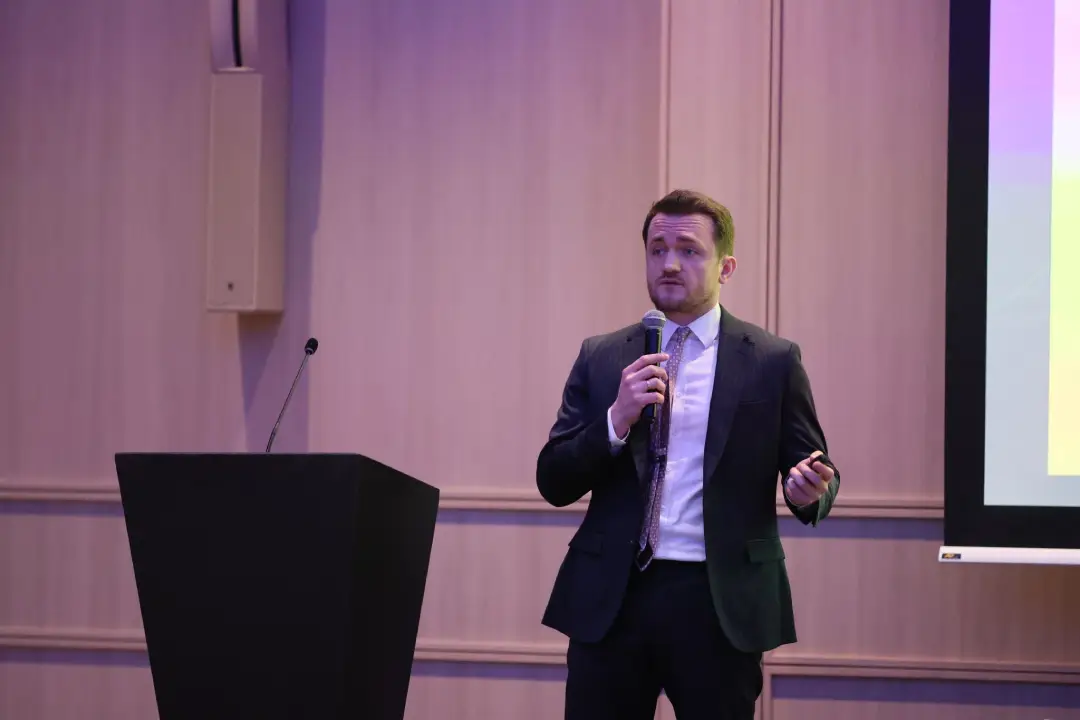
Milot Ahma speaks at the Digital Trade for Growth in the Middle Corridor conference
That is starting to change. New legal frameworks are being introduced to recognise these documents in a digital form, which will allow them to be created, transferred, and used without relying on paper, while still carrying the same legal weight.
This will be quite important because the legal validity of these digital documents has implications far beyond just the time it takes for goods to transit the corridor, especially when you stop to remember that just because goods are moving faster, it does not automatically mean that more trade will happen. For that, businesses need access to finance. Since banks often rely on these trade documents to lend, it follows that if they cannot trust them in digital form, they will not fund a transaction that uses them in their digital form. Making these digital documents, and the systems that exist around them, legally valid will help unlock that financing.
“We don’t just want to make the corridor faster,” Ahma said, “we want to make it bankable.”
Without these systems, the corridor’s overall efficiency and the ability of the region to promote trade are likely to stay limited, even if the physical infrastructure improves. The corridor not only needs more capacity. It needs the kind of faster, cleaner, and more reliable data that digitalisation has long been promising to provide.
Why, then, is digitalisation not happening faster?
One route, many systems
While it has a single enticing name and can be drawn on a map of the world with a single red line, the Middle Corridor is not one system, but rather a chain of interconnected systems that are spread across many countries. Each of these countries has its own rules, its own processes, and its own level of digital development, which creates fragmentation.
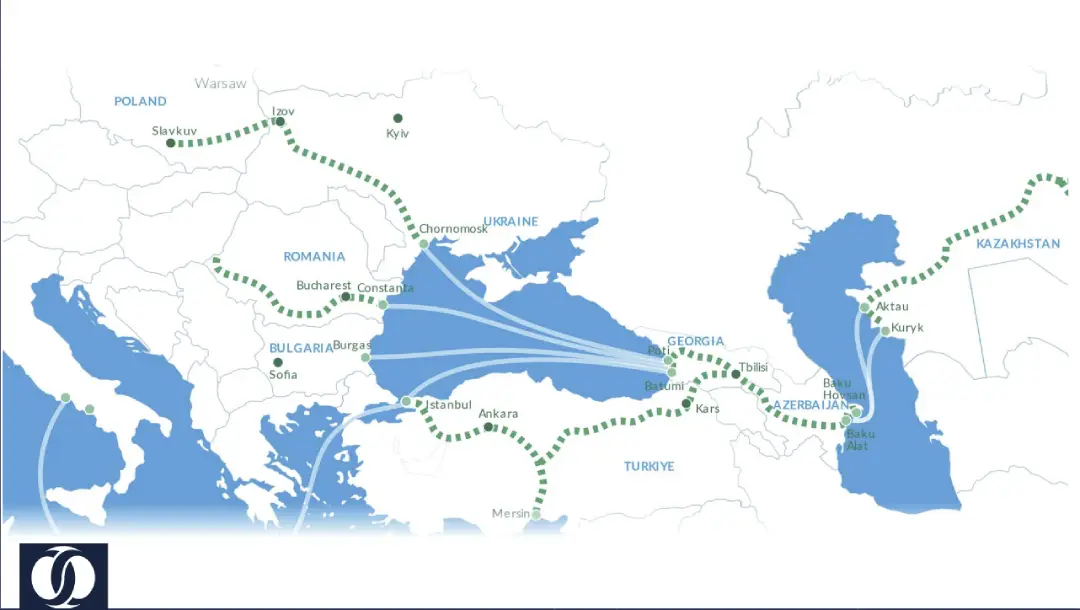
The Middle Corridor is made up of many different sections spread across several countries (Source: EBRD)
When any one shipment traverses the middle corridor, it must cross several borders, and it must pass through multiple legal and customs systems. Each one of these may require different documents and may process information in a different way, which often leads to repetition, duplication, and, inevitably, delays.
“We need a single solution for the middle corridor,” freight forwarder Mikheil Babunashvili said. “The countries should unite in this initiative, and we just need one direction, one kind of documentation, one kind of rules to make things easier.”
That does not necessarily mean building one single platform. With the number of different governments and private companies involved, each with its own sometimes conflicting priorities, achieving that level of agreement and cooperation is likely to be an infeasible utopian ideal.
“If we expect every business to change how they operate, it will take over 100 years,” Oswald Kuyler, a Senior Digital Trade Advisor at the Asian Development Bank, said during the conference. What is more likely to be achievable is building the digital structure and standards that will enable the many different systems that all of these businesses and stakeholders prefer to use to still work with one another, so that documents can move between them without friction.
But for that to work outside of the conference circuit, those systems and standards need to be recognised across every country along the route. Partial solutions do not work.
“This whole process of digitalisation should be implemented simultaneously in all countries in the corridor,” railway expert Anna Ivanishvili said, “because otherwise the system of bottlenecks will still remain, and the effectiveness and efficiency of it will be lost.”
“We can draw stakeholders into two parts,” Mikheil Babunashvili added. “First is developing the business, we are here, and the second one is the governments. And we always say that if one of those chains is broken, the middle corridor is broken. So we are together – all the stakeholders – and we are creating the picture all together.”
That makes this problem one of coordination just as much as it is one of digitalisation. Without coordination, digitalisation cannot be effective. Without digitalisation, the corridor cannot perform. And with such a large opportunity as the middle corridor is presenting now, the risk of failure is far too great to let the whole chain be dragged down by its weakest link.
A narrow window
The Middle Corridor has, over the course of just a few years, gone from being a backwater backup option for goods moving from China to Europe to being a central and rapidly growing route for those products. But this shift happened so quickly that the system has not had time to adjust and is now coming under strain.
While physical infrastructure needs are part of the problem, the heart of it may lie more in a lack of fast, reliable, and sharable information, where small errors can stop entire shipments. But this much-needed digital information system cannot be achieved without overcoming the fragmentation that exists along the corridor. Without alignment, any progress made in one place will be held back by delays in another.
There are early signs of progress. Countries along the corridor have already agreed on plans to improve how data and documents are shared across borders, but the bigger challenge now is putting those plans into practice and allowing their systems to align so they can build trust in new ways of working.
The countries and companies that find themselves as key decision makers along this middle corridor have an important decision to make that may have implications for generations to come. This tremendous opportunity, stemming from drastically increasing demand, is knocking on their door. The corridor will only succeed if its systems can catch up with its growth.
They can choose to embrace it by coming together to work with neighbours to build the shared systems that will allow them to all prosper. Or they can act as individuals and let the opportunity pass them by.
Perhaps to the north, or perhaps to the south. Here’s hoping they can help make sure that everyone wants to take the middle ground.