
Tunisia’s digitalization strategy – incorporating 192 different initiatives within in its 2026-2030 national development plan – is an ambitious effort to strengthen the economy through digital efficiency, improve service delivery, reduce bureaucracy, and boost investor confidence. Trade and finance are slated for transformation, if the country can master not just the technical and regulatory challenges, but also the cultural challenges. To fully enjoy the benefits of a digital evolution, a coordinated, multi-layered architecture is needed that can help align national legal reform with international standards.
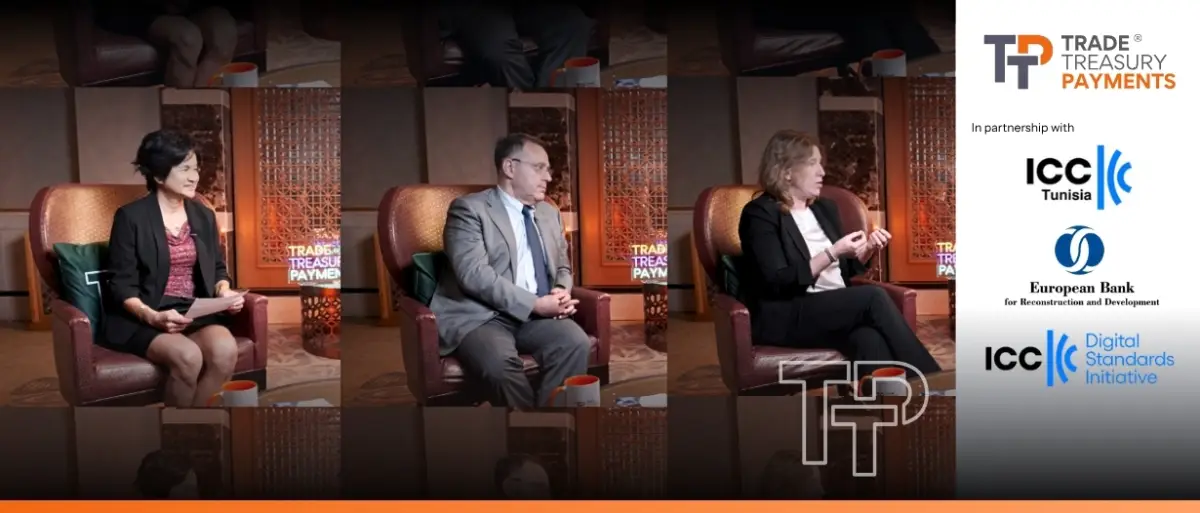
At a lively workshop on digitalization of trade finance in Tunisia, co-organised by the European Bank for Reconstruction and Development (EBRD), the ICC Digital Standards Initiative (DSI), and ICC Tunisia, participants from the worlds of finance, policymaking, and every other corner of Tunisia’s trade ecosystem gathered to discuss the nation’s digital trade future.
Trade Treasury Payments (TTP) spoke with several attendees about how the architecture can be established to realise this future.
Legal foundations for certainty
Legal certainty lies at the core of any comprehensive digital trade transformation. Paper documents like bills of lading, promissory notes, and bills of exchange have underpinned international trade for decades, transferring titles and providing security for banking institutions. In modern trade, the same confidence once assured by these paper documents should be (and surely but slowly is) provided by their electronic equivalents.
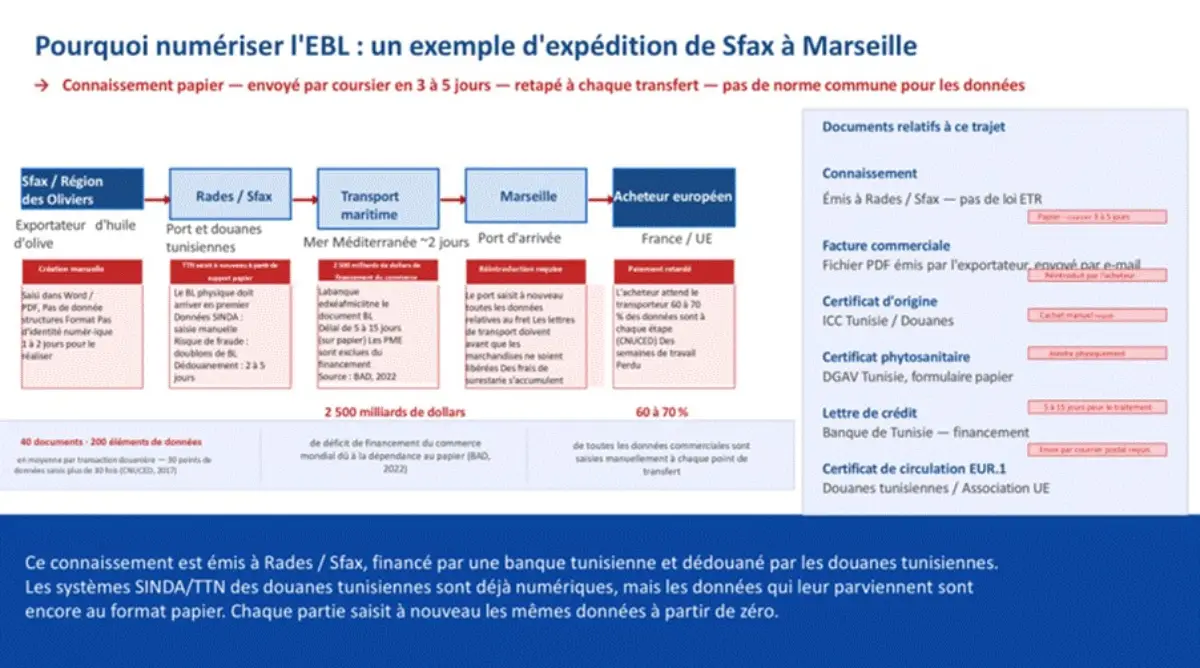
Tunisia has made great progress in recognising basic electronic transactions and signatures, but needs to go further to achieve full trade digitalisation and interoperability with external markets. There is currently no explicit legal framework for electronic transferable records, meaning there is no legal equivalence for these digital documents to have the same certainty as their paper counterparts. This leaves these processes fundamentally anchored to paper documentation, which limits cross-border digital trade and caps the nation’s transactional velocity.
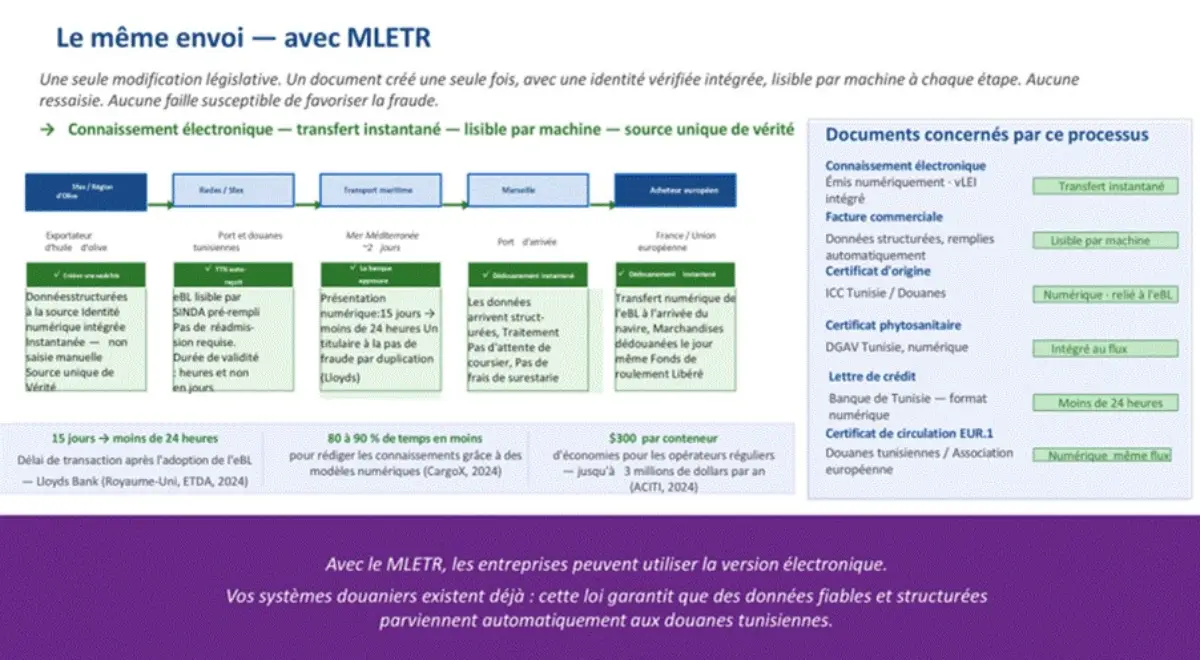
The framework provided by the UNCITRAL Model Law on Electronic Transferable Records (MLETR) is one means of addressing the resulting gap. As Catherine Bridge Zoller, Legal Counsel within the Legal Transition Programme at the EBRD, explains, MLETR is essential because it allows electronic documents to replicate the exact legal effects of paper, guaranteeing the legal certainty of possession in a digital trade landscape.
Driving Tunisia’s digitisation
The EBRD is working to support countries across more than 40 jurisdictions EBRD is working to support countries across more than 40 jurisdictions this involves a tailored, localised approach. Rather than impose an external structure, the transition begins with a thorough diagnostic and stakeholder mapping exercise to ensure the necessary buy-in for reform.
The EBRD team benefits from its flagship Trade Facilitation Programme, a banker-led initiative established in 1999 that supports cross-border trade and trade finance through a broad network of more than 130 issuing banks across 28 active countries, including Tunisia, and a network of more than 800 confirming banks. In Tunisia, the TFP already has a strong operational footprint, with five active issuing banks (Amen Bank, Attijari Bank, Banque de Tunisie, UBCI and UIB) and more than 1,400 transactions supported since its launch in 2014, with a total value of over €1.2 billion. In partnership with the TFP, the EBRD’s Legal Transition Programme engages with public sector institutions like the Ministry of Commerce and Export Development, the Central Bank of Tunisia, the Ministry of Justice, and Tunis Trade Net to deliver reforms. The aim of this extensive and bespoke process is to design a legal reform project that both cleanly aligns with MLETR and respects the realities of Tunisia’s banking sector, business practices, and judicial and regulatory environment.
The TFP’s new Innovation Lab, a platform and advisory initiative to help partner banks digitalise trade-finance operations meanwhile provides local financial institutions with the confidence needed to scale up their digital operations Shona Tatchell, Director of EBRD’s TFP sees the EBRD as well placed to help bridge the gap between public-sector legal reform and private-sector needs, ensuring that reforms delivered by the public sector are responsive to market realities and capable of supporting practical uptake by businesses and financial institutions.
Standardisation and interoperability
Legal frameworks create the rules of the game, so to speak, but international trade cannot flow without a unified language, which is where digital standards become critical.
Major maritime codes, commercial powerhouses, and regional frameworks like the AfCFTA Digital Trade Protocol are all converging towards harmonised digital practices. For an export-focused economy like Tunisia, alignment with global efforts like these is the best way to avoid being digitally isolated from global value chains.
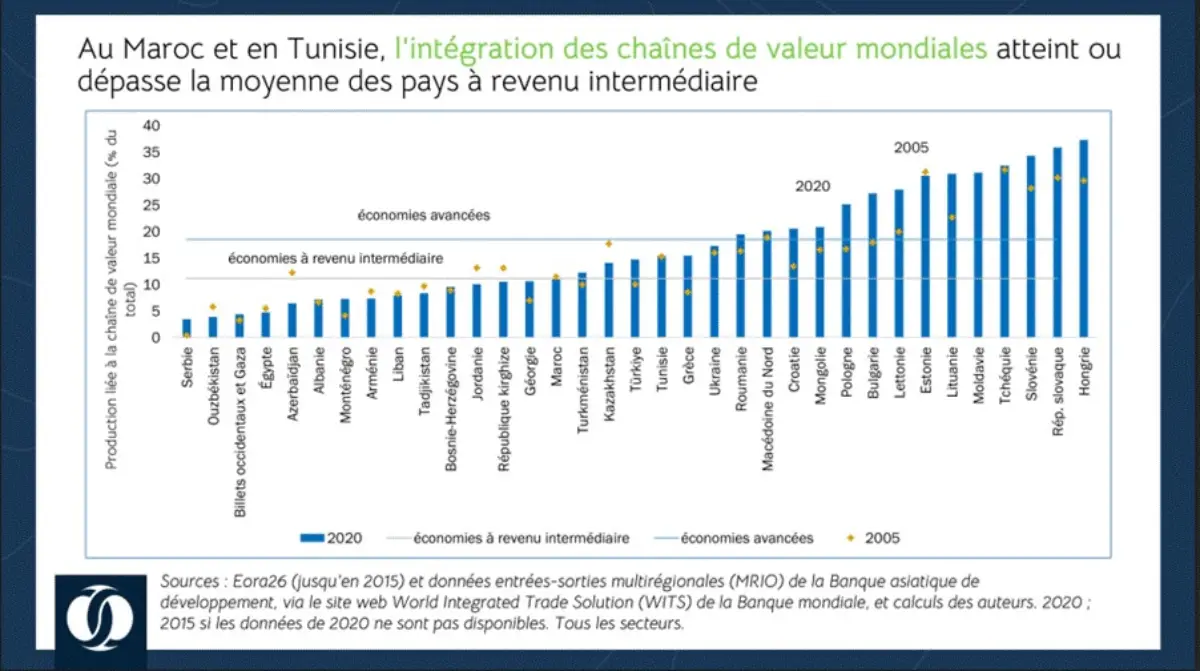
Pamela Mar, Managing Director of the ICC Digital Standards Initiative (DSI) and editorial board member of TTP, highlights the strategic necessity of this digital transition. Tunisia’s commitment to cross-border commerce is a recognised institutional priority – the mission of the DSI in Tunisia is to support and promote the country’s transition from analogue to digital trade. This standardisation must extend well beyond the banking sector and encompass the entire logistical chain.
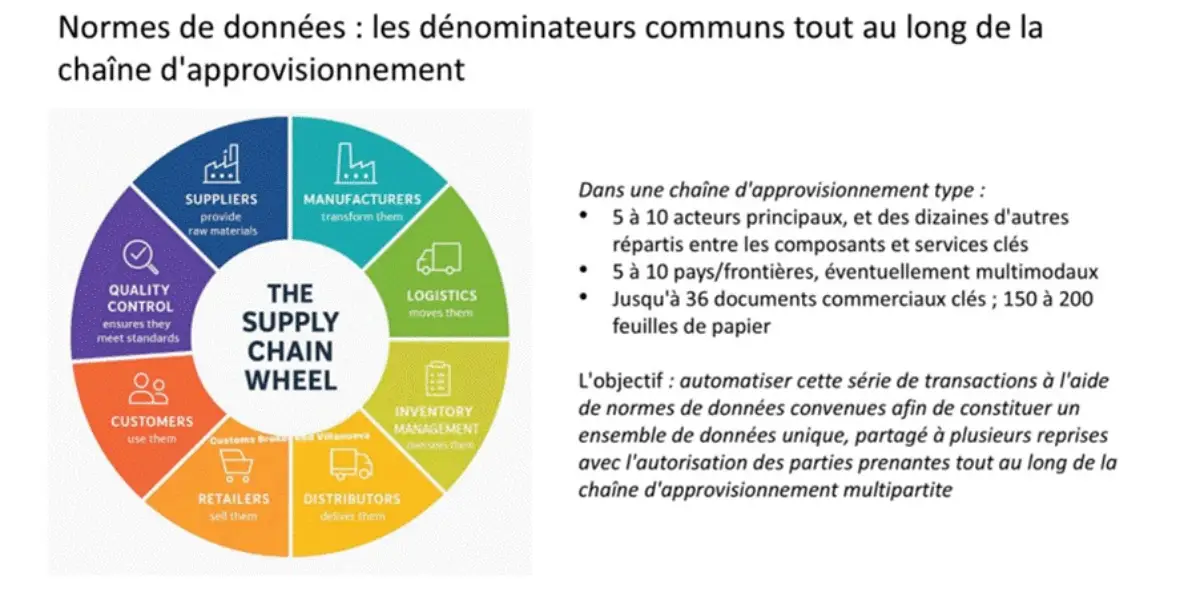
In practice, this means moving towards “submit once, use multiple times” data architecture. By adopting global data standards, Tunisia can ensure that critical information flows across borders, ports, and corporate entities unimpeded, reducing administrative friction. Integrating globally recognised corporate identity frameworks also adds a necessary layer of digital trust, making transactions fully verifiable and secure for all global parties. Promoting these types of reforms can allow Tunisia to enhance its competitiveness and unlock its potential.
Moving from strategy to execution
But such a shift is tricky, as Mar acknowledges – changing people’s habits is a major challenge in this kind of large-scale digitalisation. As Luca Castellani, member of the TTP Global Advisory Panel, also recognises, passing laws and selecting data standards are merely initial phases in a longer journey. The actual implementation on the ground relies on local market structures; if they are not ready, then the laws cannot function.
Reconciling innovative global frameworks with embedded, prescriptive and often rigid national laws remains a significant practical hurdle. Castellani spoke to the challenges of electronic signatures meeting heavily restricted cryptographic standards as just one example. True interoperability requires domestic legal frameworks to remain flexible enough to recognise digital trade documents governed by foreign laws.
Successful operationalisation will require a sustained capacity-building effort that focuses around the humans involved – an effort that must move beyond bank clerks and port authorities and deeply integrate lawyers, judges, corporate managers, and any other stakeholders in the commercial lifecycle. Each of these stakeholders needs the necessary training to validate, interpret and ultimately trust digital documentation.
Securing Tunisia’s digital future
Tunisia would appear to have all the core ingredients needed to build a competitive, international digital trade ecosystem: progressive public institutions, an enthusiastic banking sector, and a clear vision of international alignment.
By treating digital trade reform as a comprehensive architecture incorporating legal clarity of frameworks like the MLETR with global data standards and targeted capacity building and training projects, the country is actively designing its own economic future.
Watch our video highlights and see the key moments in action.