
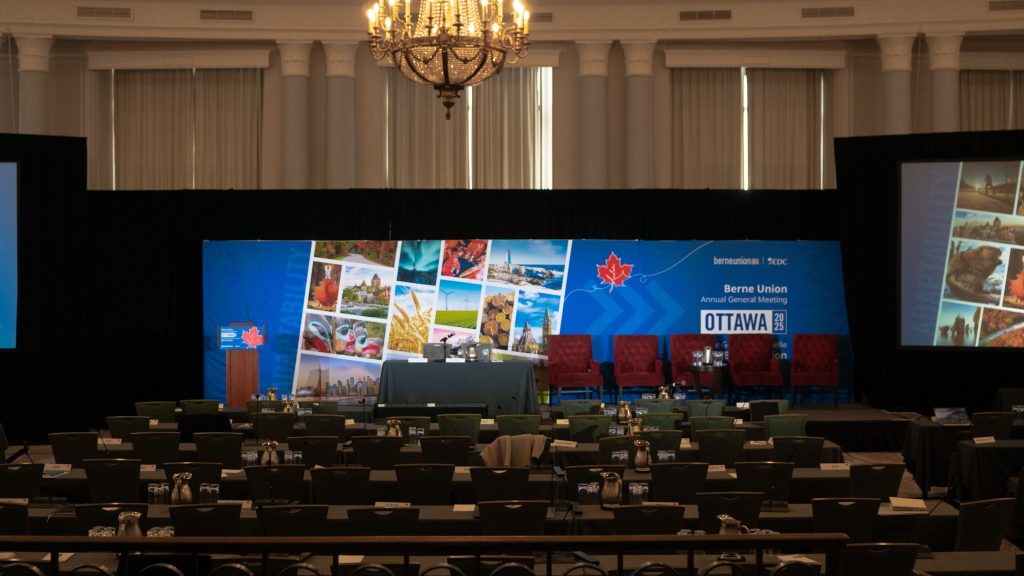
At last week’s Berne Union Annual General Meeting (AGM) in Ottawa, it was clear why this gathering, co-hosted this year with Export Development Canada (EDC), remains such a cornerstone for the export finance community. At first glance, the agenda looked predictable, and of course, the familiar talking points dominated many sessions, too. AI, data, and interoperability continue to occupy their share of airtime. Panellists spoke about the promise of automation to speed up underwriting and improve customer experience, even as they cautioned that human oversight and data quality remain essential.
Sustainability and the energy transition were also a core part of the conversation. For export credit agencies (ECAs), insurers, and development finance institutions, supporting green and resilient finance is now important to remain relevant even as some of the climate rhetoric globally has lulled. Climate adaptation, in particular, seems to be being reframed as a financial stability issue, as opposed to purely an environmental one.
And, as always, SMEs held their place on the agenda. Despite all the progress in digital access and alternative finance, small businesses still face many of the same barriers of limited collateral, slow onboarding, and high compliance costs. Of course, there was talk about how digital underwriting and automation offer hope, but despite that, the gap remains wide.
Not to breeze past these crucial topics – they will surely continue to shape the industry’s trajectory in the months and years ahead, so it is good that they are discussed in the room – but we have reported on these issues in immense depth in the past. What I want to spend more time analysing in this article are two other topics that I picked out from the discussions in Ottawa that felt a bit different from our usual commentary.
Trade finance is being pulled into national security
A year ago, the concept of national security was hardly a hot topic within the financial world. Today, however, it’s one that comes up, in some form or another, at nearly every industry event. This event in Ottawa was no different.
In practical terms, governments are asking export credit agencies (ECAs), development finance institutions, and political risk insurers to step further into areas that would once have been considered outside their traditional commercial role. This includes critical minerals, strategic imports, defence-related support, and supply chain resilience. It is becoming evident that, in a world where geopolitical shocks are now frequent, the state is no longer comfortable leaving strategic capabilities entirely to the market.
That shift seems to be being driven by two forces, the first being instability. Participants at the AGM described a political environment that moves on a “six-month horizon”, where alliance structures and trade restrictions can change quickly. Under these conditions, governments are beginning to treat questions like energy security and export routes as matters of sovereignty.
The second force is interventionism. The period in which governments could claim to act mainly as referees and leave allocation to the private sector is ending. Industrial policy has returned. Rather than simply facilitating exports, some ECAs are being pushed to support “national interest” priorities more directly, whether that means securing access to critical minerals, anchoring strategic supply chains, or backing infrastructure with national security relevance. Defence financing was mentioned more than once during the event as part of a broader pattern in how governments see strategic finance.
This comes with real implications. Agencies that were designed, in a peacetime world (which we’ve heard experts time and time again in the past 6 months say is no longer our current state) to be commercially neutral are being asked to underwrite activities that carry different kinds of exposure, political sensitivities, and, in some cases, longer time horizons than traditional export deals.
The more ECAs and similar institutions are used to execute geopolitical strategy, the more they will have to defend their creditworthiness and independence. If these institutions are pushed too far into politically exposed or pre-commercial areas and suffer losses, it could weaken the very model governments are relying on.
There seem to be two views that have come up in response. One is that this is simply the next phase of the job. Trade has always followed political alignment. Export credit has always been used, openly or otherwise, as an instrument of statecraft. The alternative view is that the system is approaching a stress point. Agencies cannot be asked to carry strategic risk on their own balance sheets indefinitely without clearer mandates and a shared burden with the state.
Which view proves to be correct remains an open question.
It is time for blended finance to grow up
The second theme that struck me from the event was the role of blended finance. The basic idea of blended finance is that public and concessional capital can be used to reduce risk in markets or projects that would otherwise sit outside the risk appetite of commercial lenders and investors. The aim is to “crowd in” private capital, especially into emerging and lower-income markets where long-term investment is urgently needed.
Many of the most strategically important projects over the next decade (from energy transition infrastructure to processing capacity for critical minerals) are in geographies that are considered high risk by conventional ratings logic. In a typical case, a perfectly viable project will still sit in a country whose sovereign ceiling (the market shorthand for the maximum rating investors are willing to tolerate based on the country’s perceived credit risk) is below investment grade. Large pools of institutional money cannot enter without a route to an investment-grade profile.
Thankfully, the industry already has some idea of how to solve that problem, in principle at least. One mechanism is tiered capital structures. In this structure, different investors take different levels of loss if something goes wrong. Concessional or public funders could accept the “first loss” (meaning they absorb the earliest and highest-risk portion of any default); Multilateral development banks (MDBs), development finance institutions, and ECAs could take a mezzanine position, and leave private investors to take the senior tranche (which is designed to behave like high-grade debt). Another mechanism is political risk insurance or guarantees that explicitly cover specified risks (for example, expropriation, transfer restrictions, or political violence) so that commercial lenders can remain in a deal even amid difficulties.
These tools already exist and have worked in specific markets, including in fragile or conflict-affected environments where no single commercial bank would have stayed in without public backstopping. The problem is scale.
The concept of blended finance has been around for over a decade, but has not yet reached a scale to have the necessary impact. Part of the reason for this is that today, most blended finance transactions are bespoke. They take too long to assemble, involve too many one-off negotiations, and are difficult to replicate. This means that, despite years of discussion, the volumes mobilised are still very small compared to what is needed. Participants at the AGM noted that private capital currently mobilised for developing markets through these structures represents only a fraction (on the order of one per cent) of what would be required annually to meet stated development and climate goals.
Panellists suggested that there are two main barriers standing in the way. The first is standardisation. Investors need predictable structures they can repeatedly take to their credit committees. If every deal is unique, every deal becomes a debate. The call from the room was to professionalise this. In other words, to move from artisanal transactions to standard building blocks, with clear risk waterfalls and documented governance, that can be repeated across countries and sectors.
The second barrier is governance and incentives inside public institutions themselves. In simple terms, MDBs and other public lenders are still largely set up to lend their own balance sheets alongside the private sector, rather than to use their balance sheets to de-risk everyone else. Only a very small share of MDB capital is currently devoted to first-loss positions or callable guarantees that truly change the risk profile for private money. Unless this changes, the system will continue to mobilise capital mainly in the safest middle-income markets, while the most distressed and most strategically significant markets will stay underserved.
A system under pressure, and finding its balance
To me, it seemed like the thread linking these conversations in Ottawa was that the export finance system is being asked to do more, and to do it under tougher conditions. Governments are leaning on ECAs and development financiers to advance national security, climate, and development priorities simultaneously, while also maintaining commercial discipline. The institutions themselves are responding with creativity by testing new blended finance structures, expanding political risk cover, and experimenting with digital tools to keep their operations efficient. Yet, the strain is visible. Balancing developmental mandates with fiscal prudence, and political expectations with credit integrity, is becoming the defining challenge of this era.
Still, the tone at the AGM was far from defeatist. If anything, it reflected a maturing understanding that trade and development finance will always sit at the intersection of markets and policy. The industry has weathered many cycles of change before, and this one (shaped by a combination of security concerns, sustainability goals, and capital realignment) is no exception. What matters now is finding a way to coordinate, ensuring that public, private, and multilateral actors each know their role in the evolving financial architecture. If that balance can be struck, the system will come out stronger for having adapted to the pressure.