
How volatile financial conditions influence availability and impact trade levels:Insights from IFC-WTO joint research
Live Updates
Global trade drives economic growth by linking exporters and importers globally. However, it comes with risks like payment delays, liquidity issues, and delivery uncertainties that can disrupt transactions. Trade finance has a critical role in managing these risks and enables businesses to confidently engage in cross-border trade.
A joint study by the International Finance Corporation (IFC) and the World Trade Organization (WTO) uses new global bank data from the International Chamber of Commerce (ICC) to show how changes in global financial conditions impact trade finance availability and trade volumes, particularly in emerging and developing economies.
Why trade finance matters
Trade finance plays a crucial role in bridging the gap between the production, shipment, and receipt of goods, making it indispensable for international trade. However, it carries inherent risks such as payment default, delivery failure, and liquidity challenges. These risks are heightened by the complexities of operating across different legal systems, operational environments, and countries with varying risk perceptions, especially in emerging and developing markets.
For instance, a coffee farmer in South America may need funds to harvest and ship crops, while a European buyer needs assurance that payment occurs only after the goods arrive as promised.
Tools such as letters of credit, trade loans, and supply chain finance mitigate or reduce these risks by ensuring payments and providing liquidity.
Many companies, especially small and medium-sized ones in developing countries, cannot fully engage in global trade without trade finance. This lack of access hampers their growth and limits the economic benefits that open markets can provide.
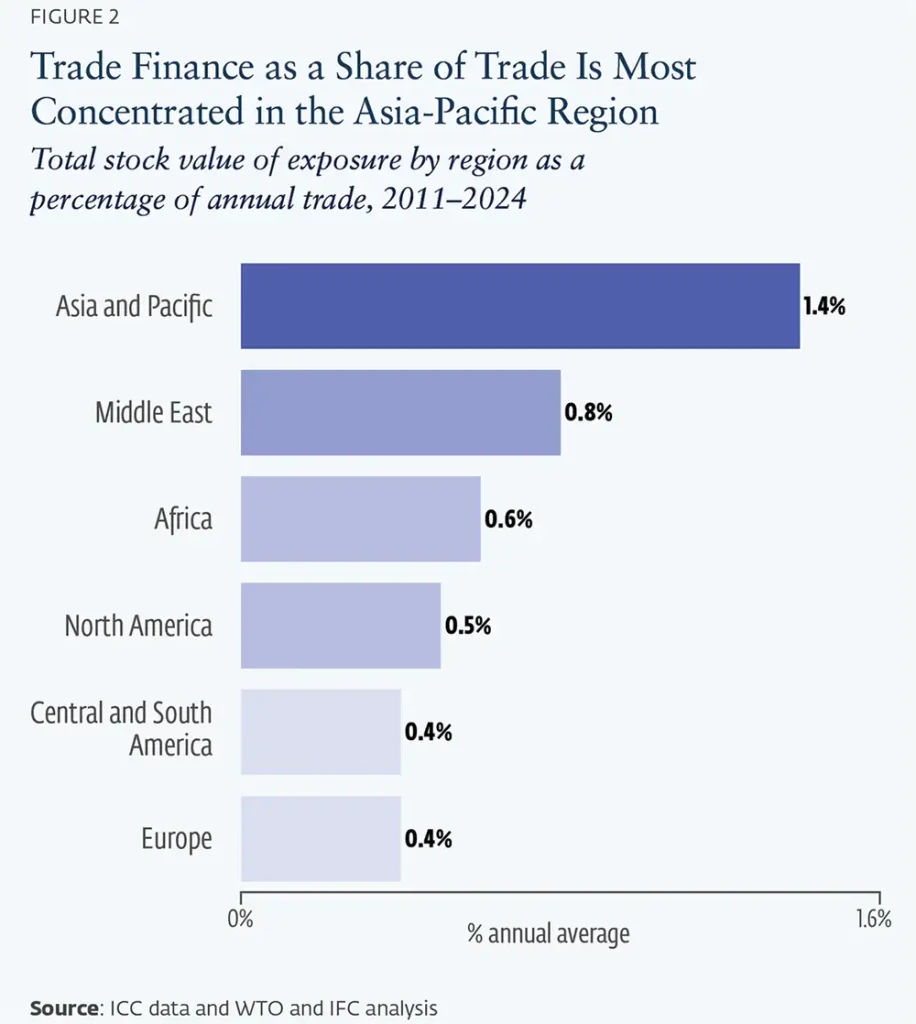
Asia-Pacific leads in trade finance usage globally
The Asia-Pacific region leads global trade finance usage, followed by Europe and North America.
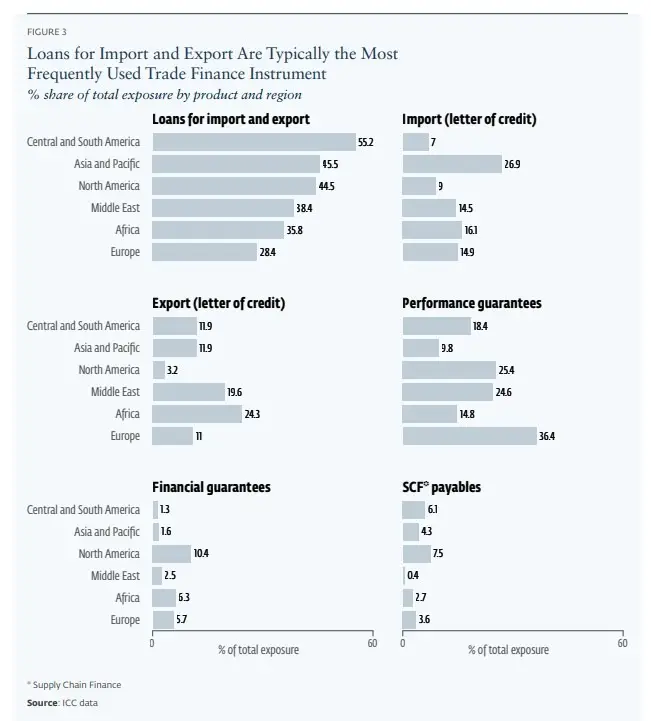
Trade loans form a significant part of trade finance in Asia-Pacific, Central and South America, and North America. Conversely, Europe and Africa rely more on payment guarantee instruments such as letters of credit and guarantees.
Trade finance is mainly used for long-distance trade, forming new trade relationships, and transactions in countries with weak legal systems, less developed financial markets, and higher political risks.
These instruments mitigate risks inherent in such trades, ensuring smoother cross-border transactions and fostering trust between trading partners
Key insights from the research
Key insights from the report say that there is a clear link between a country’s trade growth and the expansion of bank-intermediated trade finance. Analysis across 100 countries shows that a 1% increase in trade corresponds to a 0.41% rise in trade finance, confirming that demand for trade strongly drives trade finance growth.
The level of financial development greatly affects trade finance growth. For every one-point increase in a country’s financial market development index, trade finance growth rises by 10%. This shows that banks provide more trade finance in countries with better financial infrastructure.
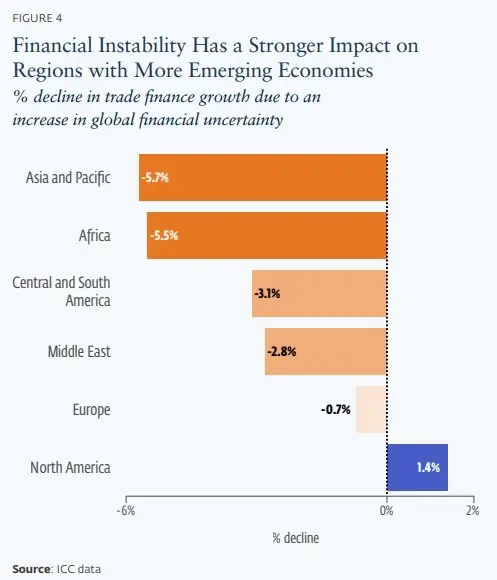
However, global financial volatility negatively affects trade finance availability. Using the VIX index as a measure of market uncertainty, a one-point rise in volatility corresponds to a 3.3% decrease in trade finance growth. Developing regions are generally more vulnerable to such shocks, while North America shows comparatively lower sensitivity to global financial fluctuations.
Economic implications and policy recommendations
Trade finance shortages have historically amplified trade downturns. During the 2008-2009 financial crisis, 15-20% of the trade collapse was linked to constraints in trade finance. Similar patterns emerged during the COVID-19 pandemic.
Unmet demand for trade finance remains substantial, estimated at 7-10% of global merchandise trade annually. This persistent gap restricts many firms from capitalising on trade opportunities, particularly in developing economies.
The evidence emphasises the need for policies that i) ensure access to trade finance during crises, mitigating sudden contractions in trade ii) strengthen local financial markets to build resilience and expand trade finance availability iii) promote diversified trade finance instruments beyond traditional bank guarantees, including supply chain finance and credit insurance.
Read the full report here.